

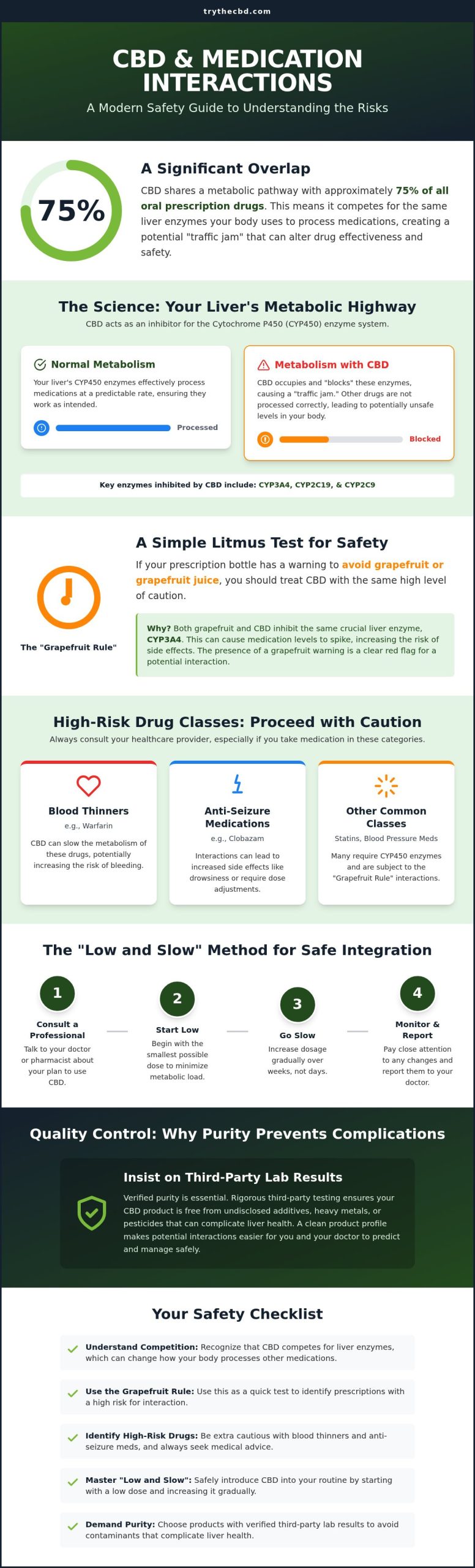
Did you know that CBD shares a metabolic pathway with approximately 75% of all oral prescription drugs? Understanding cbd oil and medication interactions is no longer just a precaution; it’s a vital safety step for anyone integrating hemp into their daily wellness routine. It is completely natural to feel hesitant when you encounter conflicting health advice online or find that your doctor isn’t fully versed in the latest cannabinoid science. You deserve to feel confident that your supplements are supporting your health rather than complicating it.
We’ve designed this 2026 safety guide to clear the confusion by explaining the science of liver enzyme metabolism and the “Grapefruit Rule.” You will learn how CBD can create a metabolic traffic jam that affects how your body processes common medications, especially those with a narrow therapeutic window. We’ll provide a list of the most common drugs involved and a framework for having a productive, evidence-based conversation with your healthcare provider. By focusing on purity and rigorous third-party testing, you can navigate your journey toward well-being with total transparency and peace of mind.
Key Takeaways
- Understand how CBD acts as a bioactive compound that competes for liver enzymes, which can change how your body processes other substances.
- Learn to use the “Grapefruit Rule” as a practical litmus test to quickly identify if your prescription carries a high risk for cbd oil and medication interactions.
- Identify high-risk drug classes, including specific blood thinners and anti-seizure medications, that require close monitoring and professional medical consultation.
- Master the “Low and Slow” integration method to safely introduce hemp products into your routine while minimizing the metabolic load on your system.
- Discover why verified purity and third-party lab results are essential for avoiding the undisclosed additives that complicate liver health.
The Science of CBD Oil and Medication Interactions
CBD is more than just a wellness trend; it’s a potent bioactive compound that your body must actively process. Like many substances we consume, Cannabidiol (CBD) travels to the liver to be broken down and prepared for elimination. This is where the potential for cbd oil and medication interactions begins. When you introduce CBD into your system, it competes for the attention of specific enzymes. Think of your liver as a busy highway with a limited number of lanes. If CBD takes up several lanes, other medications you’re taking might get stuck in a “traffic jam.” This metabolic competition can fundamentally change how your body handles your prescriptions, leading to levels that are either too high or too low for safety.
What is the Cytochrome P450 Enzyme System?
The Cytochrome P450 (CYP450) system is a family of enzymes responsible for detoxifying approximately 75% of oral medications. These enzymes act as a filter, ensuring that drugs are broken down at a predictable rate. However, CBD is a particularly “sticky” molecule in this system. It occupies these enzymes, effectively blocking them from processing other drugs. Research from 2026 confirms that CBD is a moderate to strong inhibitor of the CYP3A4, CYP2C19, and CYP2C9 enzymes. When these pathways are blocked, other drugs circulate in your system for much longer than intended. The Cytochrome P450 system serves as the primary metabolic gateway for the vast majority of pharmaceuticals entering the human body.
Agonistic vs. Antagonistic Interactions
Understanding the direction of these interactions is crucial for your safety. When CBD slows down the metabolism of another drug, it can lead to an agonistic effect. This means the concentration of the medication in your body rises to potentially toxic levels because it isn’t being cleared out fast enough. Conversely, some interactions are antagonistic. In these cases, the presence of CBD might prevent a “prodrug” from being activated, making the medication weaker and sub-therapeutic. Most users find that a slower metabolism is the primary concern, as it extends the life of a drug beyond the doctor’s intended window. For those just starting out, reviewing what CBD stands for provides the necessary foundation for understanding how these cannabinoids function within your unique biochemistry. Choosing high-purity products from Colorado-grown hemp ensures you are dealing with a consistent profile, which makes cbd oil and medication interactions much easier to predict and manage alongside your healthcare provider.
The Grapefruit Rule: A Litmus Test for CBD Safety
If you’ve ever looked closely at a prescription bottle, you might have noticed a small yellow sticker advising you to avoid grapefruit juice. This isn’t just a random dietary suggestion; it’s a vital safety warning regarding how specific natural compounds interfere with your liver’s ability to process medicine. For many users, this “Grapefruit Rule” serves as the most reliable litmus test for potential cbd oil and medication interactions. The logic is straightforward. If a drug carries a warning against grapefruit, it’s highly likely to interact with cannabinoids as well. This chemical overlap means that if your pharmacist has warned you away from the breakfast fruit, you should treat CBD with the same level of caution.
Why Grapefruit and CBD Share a Warning
The reason for this shared caution lies in the specific chemistry of how these substances behave in your system. Grapefruit contains furanocoumarins, which are natural compounds that inhibit the CYP3A4 enzyme. Coincidentally, cannabinoids like CBD target this exact same enzyme pathway. According to Harvard Health on CBD interactions, this inhibition causes bioavailability spikes. When the enzymes that usually break down your medication are occupied by CBD or grapefruit, the medication enters your bloodstream in much higher concentrations than your doctor intended. This isn’t just a minor fluctuation; it can lead to a significant increase in the drug’s potency and its potential for side effects. You should remember that the absence of a grapefruit label doesn’t guarantee safety, but its presence is a clear red flag that requires your attention.
Common Medications with Grapefruit Interactions
Several major categories of pharmaceuticals are known to be affected by this enzymatic interference. Statins, such as Atorvastatin (Lipitor), blood pressure medications like Losartan, and immunosuppressants used for organ transplants are among the most common examples. When cbd oil and medication interactions occur with these drugs, the results can be physically demanding. For instance, elevated levels of statins in the blood can lead to severe muscle pain or even liver damage. Similarly, blood pressure medications that aren’t metabolized correctly might cause your pressure to drop too low, leading to dizziness or fainting.
It’s a common misconception that only synthetic products cause these issues; however, even high-quality Full Spectrum CBD Oil follows this metabolic rule. If you’re currently taking a medication with a grapefruit warning, you must consult your physician before adding any hemp-derived products to your routine. If your doctor has already cleared you for use, you can find consistent, third-party tested hemp products to ensure you’re receiving the exact concentration you expect without any undisclosed additives. This level of transparency is essential for maintaining a predictable wellness routine that respects your body’s metabolic limits.
High-Risk Drug Classes and Potential CBD Side Effects
While many people successfully integrate hemp into their wellness routines, certain categories of prescription drugs demand a higher level of vigilance. The primary concern with cbd oil and medication interactions isn’t necessarily the CBD itself; it’s how CBD causes other drugs to accumulate in your system. When your liver is busy processing cannabinoids, your primary medication can reach levels that are technically an overdose. This accumulation leads to side effects that range from manageable drowsiness to serious internal complications. Understanding which drug classes are most sensitive to these changes is the first step in maintaining a safe balance between natural support and pharmaceutical necessity.
CBD and Blood Thinners: The Warfarin Connection
Warfarin is perhaps the most significant concern for healthcare providers. Because CBD occupies the metabolic pathways required to clear Warfarin from your system, the drug stays active far longer than your physician intended. This extended half-life can lead to an increased risk of internal bleeding or excessive bruising from minor contact. An FDA consumer update on CBD highlights these safety concerns, noting that the potential for liver injury and drug interference is a key area of ongoing research. If you’re taking blood thinners, you must schedule more frequent INR (blood clotting) testing when you begin using hemp products. This allows your doctor to adjust your dosage based on how your specific metabolism handles the combination.
Psychotropic and Anti-Anxiety Medications
Managing mental health often involves SSRIs like Zoloft or Lexapro, which are also processed by the liver enzymes we’ve discussed. When cbd oil and medication interactions occur in this category, users often report a “heavy” feeling, increased drowsiness, or persistent brain fog. These symptoms occur because the concentration of the antidepressant remains high in the bloodstream. To minimize these effects, many users choose to start with a THC-Free CBD Oil. This allows you to benefit from the cannabinoid without the added complexity of THC, which can sometimes create a psychoactive synergy that worsens sedation.
Anti-Seizure and Pain Medications
The interaction between CBD and anti-seizure drugs like Clobazam is well documented in clinical settings. Studies have shown that co-administration can result in a 300% to 500% increase in the concentration of Clobazam’s primary metabolite. This massive spike can lead to extreme sedation and respiratory issues. Even common over-the-counter options like Ibuprofen (NSAIDs) require caution. While the interaction is less severe than with Warfarin, the prolonged presence of NSAIDs in your system may increase the risk of gastrointestinal irritation or kidney strain. Always monitor your body’s response and prioritize high-purity, Colorado-grown hemp to ensure your liver isn’t dealing with additional “toxic load” from pesticides or synthetic additives.

How to Safely Integrate CBD into Your Routine
Safely managing cbd oil and medication interactions requires a methodical approach that prioritizes your body’s metabolic limits. The “Low and Slow” method is the gold standard for anyone taking prescription drugs. By starting with a minimal dose, perhaps just 5 to 10 mg, you allow your liver enzymes to adjust without creating an immediate metabolic bottleneck. This gradual introduction helps you identify your personal threshold before any significant competition for enzymes occurs. Consistency is equally vital. Taking your CBD at the same time every day helps stabilize enzyme levels, making your internal environment more predictable for both your supplements and your prescriptions.
Timing plays a crucial role in how these substances coexist. Many wellness experts suggest separating your CBD dose from your primary medication by at least two to four hours. This window can reduce the likelihood of a “traffic jam” in the liver, as it gives your system a head start on processing one substance before the other arrives. To track these nuances, keep a wellness journal. Note the time of each dose, the amount taken, and any changes in how you feel. Small details like increased fatigue or a change in appetite can provide the data your healthcare provider needs to make informed adjustments to your wellness plan.
Your Doctor Discussion Checklist
Entering a consultation with specific data points transforms the conversation from a general inquiry into a clinical strategy. Most doctors appreciate when patients take an active role in their safety. When you visit your physician, bring your CBD Oil and Tinctures bottle or the third-party Certificate of Analysis (COA). By 2026, many states require these QR codes on labels to ensure transparency. Use this checklist to guide the meeting:
- How is my medication metabolized? Ask if it relies specifically on the CYP3A4 or CYP2C19 pathways.
- Can we monitor my blood levels? Inquire if a standard blood test can check for elevated drug concentrations.
- What specific side effects should I watch for? Identify symptoms that signal the medication is becoming too potent.
If your primary doctor is unfamiliar with cannabinoid science, consider seeking a cannabis-informed physician who specializes in botanical medicine to bridge the gap.
The Role of Delivery Methods
The way you consume CBD determines how much of it reaches the liver at once. Sublingual oils are absorbed through the mucous membranes under the tongue, partially bypassing the “first-pass metabolism” that occurs with edibles. CBD edibles must pass through the digestive tract and the liver entirely, which creates a higher potential for cbd oil and medication interactions. For those seeking localized relief without systemic concerns, CBD Topicals are an excellent choice. These creams and balms interact with receptors in the skin and rarely enter the bloodstream in significant amounts. While inhalation bypasses the liver initially, the cannabinoids still eventually circulate through the blood, so caution is still required. To ensure you are using the most reliable formulations, always select third-party tested hemp products that match your specific safety needs.
Quality Control: Why Purity Prevents Complications
When you choose a CBD product, you aren’t just buying a supplement; you’re selecting a partner for your liver’s metabolic health. Low-quality or “dirty” CBD often carries a hidden burden of heavy metals, residual solvents, and pesticides that the hemp plant naturally absorbs from the soil. These contaminants add a significant toxic load to your system, which can exacerbate the risks of cbd oil and medication interactions. A liver that’s already struggling to process environmental toxins or synthetic additives is far less efficient at managing the enzymatic “traffic jam” caused by cannabinoids. By ensuring your product is pure, you remove these unnecessary variables and allow your body to focus entirely on the predictable interaction between CBD and your prescriptions.
Potency consistency is another vital pillar of safety. Many unverified brands suffer from poor manufacturing standards, leading to bottles that contain significantly more or less CBD than the label claims. If you accidentally “megadose” because of an inaccurate label, you might overwhelm your CYP450 enzymes and cause your primary medication to reach dangerous levels in your blood. This is why we prioritize rigorous third-party testing for every batch. Knowing the exact concentration of your oil ensures your metabolism remains stable and your wellness routine stays within the safe boundaries established by you and your doctor.
How to Read a COA for Safety
A Certificate of Analysis (COA) is your most powerful tool for verifying purity. When you scan a QR code on a label, you should look specifically at the “Heavy Metals” and “Pesticides” sections. For optimal liver health, these should always show “ND” (None Detected) or levels well below the safety threshold. Verifying the exact milligrams of CBD per serving allows you to maintain a predictable metabolic rate, which is the key to preventing adverse reactions. For a complete safety checklist, you can review our guide on how to buy CBD online in 2026 to ensure you’re getting the transparency you deserve.
The Try The CBD Standard
We believe that approachable wellness begins with rigorous verification. Our hemp is grown in the high-altitude fields of Colorado, where clean air and organic farming practices ensure a naturally pure starting material. We use clean extraction methods to eliminate the risk of residual solvents, providing a product that supports your lifestyle without adding strain to your liver. If you’re new to hemp and concerned about cbd oil and medication interactions, starting with a CBD Oil Starter Kit allows for a controlled, measured introduction. This steady approach helps you monitor your body’s response with confidence, knowing that every drop is backed by a commitment to integrity and scientific standards.
Empowering Your Path to Informed Wellness
Integrating hemp into your lifestyle doesn’t have to be a guessing game. By understanding the “Grapefruit Rule” and the mechanics of liver enzyme metabolism, you’ve taken the first step toward managing cbd oil and medication interactions with total confidence. Safety is a collaborative effort between you, your healthcare provider, and the quality of the products you choose. Bringing a transparent Certificate of Analysis (COA) to your next medical appointment ensures your doctor has the exact data needed to support your personal health goals.
Choosing a partner that prioritizes purity eliminates the hidden risks of contaminants that can strain your system. We remain committed to your well-being by providing organically grown Colorado hemp that’s meticulously processed to meet the highest standards. Every batch is third-party lab tested for purity, and we provide transparent COAs on every product page to give you the reassurance you deserve. This commitment to integrity ensures that your focus remains on your wellness journey rather than on the uncertainty of what’s in your bottle.
Take the next step in your wellness journey with clarity and support. Shop Lab-Tested CBD Tinctures for a Safer Wellness Routine and experience the peace of mind that comes from rigorous verification. You’re ready to explore natural solutions with a knowledgeable, steady hand guiding your way.
Frequently Asked Questions
Can I take CBD oil with blood pressure medication?
You can, but it requires close monitoring by your physician. CBD often inhibits the enzymes responsible for breaking down common blood pressure prescriptions like Losartan or Amlodipine. If these medications aren’t processed at the correct speed, your blood pressure could drop significantly lower than intended, leading to dizziness or fainting.
How long after taking medicine can I take CBD oil?
A general safety window of two to four hours is often recommended by wellness experts. This gap allows your system to begin processing your primary medication before the cannabinoids arrive to compete for liver enzymes. Separating doses helps prevent the metabolic traffic jam that defines many cbd oil and medication interactions.
Does CBD oil interact with ibuprofen or Tylenol?
Yes, interactions are possible with these common over-the-counter options. CBD can slow the metabolism of NSAIDs like ibuprofen, which may increase the risk of gastrointestinal irritation or kidney strain over time. Combining CBD with acetaminophen (Tylenol) adds to the overall liver load, as both substances require significant processing by the same organ.
Is there a specific list of drugs that interact with CBD?
While there isn’t a single exhaustive list, the “Grapefruit Rule” identifies the majority of high-risk drugs. Any medication that carries a warning against grapefruit juice is likely to interact with CBD. This includes many statins, blood thinners, anti-seizure medications, and immunosuppressants used in organ transplants.
Can CBD oil affect my liver enzymes on a blood test?
It is possible for CBD to cause a temporary elevation in liver enzymes like ALT or AST. This usually happens at very high doses or when CBD interacts with other drugs that already stress the liver. Regular blood work is a proactive way to ensure your wellness routine remains within safe boundaries.
What happens if I take CBD with a medication that has a grapefruit warning?
Taking both substances simultaneously creates a high risk for a bioavailability spike. Because both CBD and grapefruit block the CYP3A4 enzyme, your medication can reach potentially toxic levels in your bloodstream. You should treat any grapefruit warning as a red flag for cbd oil and medication interactions and consult your doctor immediately.
Are topical CBD creams safer for drug interactions than oils?
Topical applications are significantly safer because they act locally on the skin and muscles. Since these creams and balms rarely enter the bloodstream in large amounts, they don’t typically reach the liver to interfere with enzyme pathways. This makes them an excellent alternative for targeted relief if you are on high-risk medications.
Should I stop taking my prescription to try CBD instead?
You should never discontinue a prescribed medication without the direct supervision of your healthcare provider. CBD is a natural supplement designed to support your wellness routine, not a replacement for pharmaceutical treatments. A knowledgeable doctor can help you integrate hemp safely alongside your current prescriptions through careful dosage and timing.
