

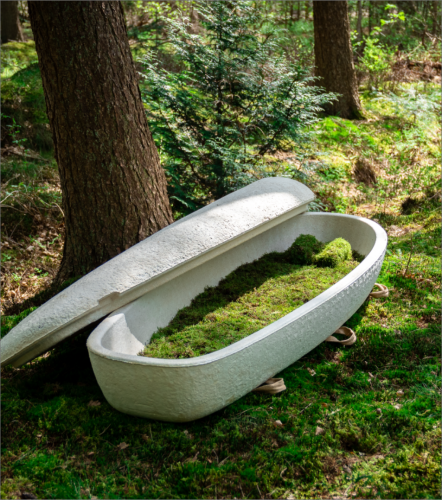
Dutch company Loop Biotech’s Living Cocoon is a biodegradable coffin made from mycelium and recycled hemp fibers that can break down in roughly 45 days while helping return nutrients to the soil. The concept gained fresh attention after a 70-year-old woman named Carolyn became the first person in Australia to be buried in one.
What should happen to our bodies after we die? For some people, it’s an uncomfortable conversation. For others, not so much. Either way, there is one thing everyone has in common: sooner or later, the question becomes unavoidable.
Many people want to be buried when they die, sometimes with the idea of returning to the earth and, in some sense, becoming part of it again. Others prefer cremation, or want their remains placed in a family vault. Except for cremation, those options typically involve a coffin, usually made of wood, a material that can take decades to break down.
That is the problem Dutch company Loop Biotech set out to rethink.
Its answer is the Living Cocoon, a coffin made from mycelium—the network of filaments that forms the vegetative structure of fungi—along with recycled hemp fibers.
How many things can be made from hemp? Or fungi? We have already seen building materials, textiles, and plastics. But a coffin made from mushrooms and hemp is bound to get attention.
The idea is to offer a more organic, environmentally friendly approach to the decomposition process, not just for the human body, but for the coffin itself.
After death, a human body may take anywhere from months to years to decompose, depending heavily on the surrounding conditions. Bodies placed in wooden coffins may take between 10 and 30 years to decompose, while those buried in copper or bronze coffins can take even longer. According to the company, bodies buried in biodegradable coffins such as the Living Cocoon may break down in one or two years, while the coffin itself can decompose in roughly 45 days. Conventional wooden coffins also eventually break down, but can take anywhere from several years to decades to fully degrade.
How Is the Coffin Made? Mushrooms, Hemp and Moss
The name “Living Cocoon” sounds almost paradoxical for a funerary product, but it makes more sense once you understand the philosophy behind the Dutch startup.

Image courtesy of © Loop Biotech B.V.
The Living Cocoon is handmade, making each coffin slightly different. According to the company, it can be grown in as little as seven days using locally sourced fungi and recycled hemp fibers.

“It’s an organism, so it’s made from mycelium, which is the root structure of mushrooms, and they are the biggest recyclers in nature, so they can decompose our bodies into new nutrients for nature to flourish,” Loop founder Bob Hendrikx said.
The coffin is described by the company as 100% natural and biodegradable. It weighs about 30 kilograms, or roughly 66 pounds, can support up to 200 kilograms—around 440 pounds—and takes approximately 45 days to become part of the earth.
Loop says the material is designed to help enrich the soil, support its biodiversity and return nutrients directly to the earth. The company also says the system is intended to reduce pollution, deforestation and emissions associated with conventional coffins.
What’s Inside the Coffin?
The Living Cocoon comes in white or brown, and the interior is not exactly bare.
A soft, moss-lined mattress and pillow can be used to cradle the body. Buyers can also choose wool, soft organic cotton or hemp for the interior, along with a blanket.
Loop also offers the Shroud, which the company describes as 100% natural, biodegradable and designed to enrich the soil.

Interior of the coffin lined with hemp, including its mattress, pillow and blanket. Image courtesy of © Loop Biotech B.V.
On its website, Loop says the coffin can be used for natural burials, conventional burials and cremations.
Because of the material’s hydrophobic properties, the coffin can also withstand rainy conditions. It has six built-in jute handles for carrying it, including on the shoulder, and customers can decorate it using biodegradable paint kits sold by the company.
If you’re familiar with composting, that is one way to understand the logic behind the product. The idea is for both the body and the coffin to gradually return to the soil and contribute organic matter to the surrounding ecosystem.
“It is the most natural way of doing it, where we no longer pollute the environment with the toxins from our bodies and all the stuff that goes into the coffin,” the creators have said. “We try to enrich it and become real compost for the nature.”
Australia’s First Funeral Using a Mushroom Coffin
For Hendrikx, shipping the product by sea was difficult. But he was already aware of the interest the project had generated in Australia since its launch five years earlier.
The Living Cocoon has already been used elsewhere. Loop says it has been part of environmentally conscious funerals in the United States, the Netherlands, where the company was founded, and other parts of Europe.
Still, the story of Carolyn, a 70-year-old Australian woman, stands out.
Carolyn recently made headlines after becoming the first person in Australia to be buried in this mycelium coffin at Springwood Cemetery in the Blue Mountains of New South Wales.
Her husband, Donald, said Carolyn had chosen the coffin herself before her death. He described her as someone whose life reflected the value of “giving back.”
“She was always there to help others,” Donald said. “It feels very true to who she was that, even after her death, she can still do something for others while giving something back to nature.”
Interest in alternative funeral practices appears to be growing around the world, especially among people who want their end-of-life choices to reflect the same environmental values they held while alive.
Hendrikx has described the concept as a kind of “eco-death,” centered on the idea that “maybe you don’t go to heaven when you die, but you go back to the earth.”
“It is an increasingly popular narrative when people talk about death and the process around it,” he said.
The mushroom coffin now joins a growing list of burial and funeral practices designed to bring death more closely in line with natural processes. Those include alkaline hydrolysis, a cremation alternative that uses water instead of fire, as well as shallow burials, which can allow bodies to decompose more quickly.
For some people, that may be the most appealing part of the Living Cocoon: the idea that burial does not have to mean protecting the body from nature, but allowing it to become part of nature again.
Cover photo courtesy of © Loop Biotech B.V.
