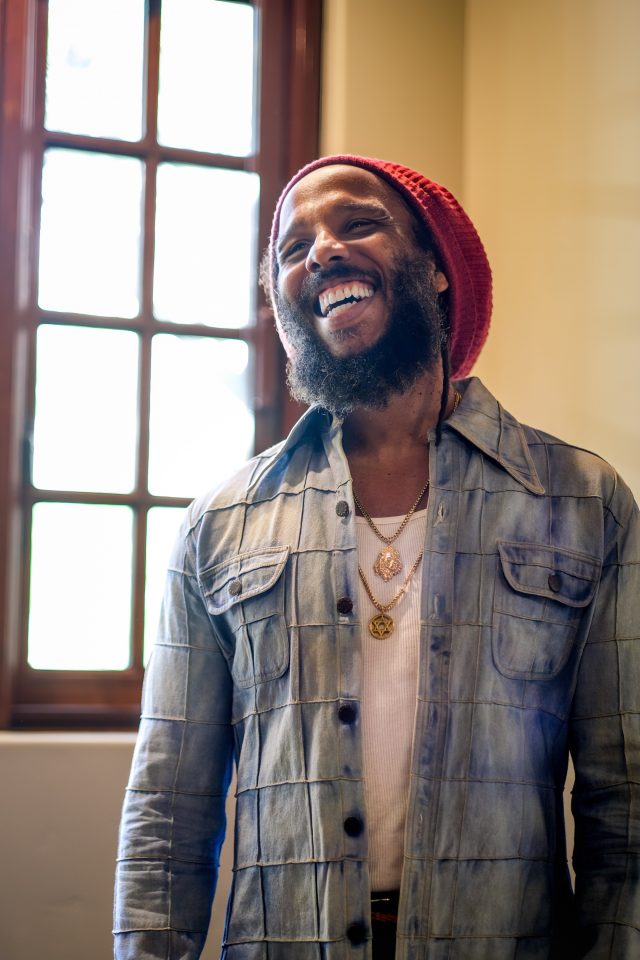
On Brightside, the eldest Marley finally wrote the song about his father he’d avoided for four decades, and found a better relationship with himself in the process.
The first time Ziggy Marley was on set for the 2024 Bob Marley: One Love documentary about his father, he got a “creative jolt.” So much so, he was inspired to make another album, Brightside, a dense, nine-track spiritual experience that doubles as medicine for the soul. Co-produced by his brother Stephen Marley and recorded in the 432 Hz frequency for meditation, the project includes songs like “Sweet Divine” and “Racism is a Killa,” and they uplift as much as they educate, much like Bob’s music does. As Bob’s eldest son, Ziggy had 12 years with his father and absorbed a lot of life lessons that were passed down to him.
Ziggy, a spitting image of Bob, had to tap into those years for “Many Mourn for Bob,” a song that acknowledges both his father’s imperfections and the seismic impact he had on the world as well as his own grief over losing his father to cancer in 1981. It’s a topic he doesn’t seem to shy away from, and there’s a sense the song was just as cathartic to write and sing as it was for his audience to hear. It was, after all, the first time he’d ever written a song specifically about his father.
“It was emotional,” he tells High Times of writing it. “It was emotional going back into my memories and into some things that I didn’t want to think about for a while. Also, connecting with him on a spiritual level in that way with this song, I would still have a strong connection, so it was emotional, but it was a very positive experience though.
“Even though it’s a melancholy type of story, it was positive because we understand existence goes beyond what we are taught is ‘real’ or what is ‘physical reality.’ There’s another reality we experience through creating songs, and through a song like that, it gives me a stronger connection to him and a way to understand him more.”
In many ways, Ziggy considers the song a collaboration with his father. He explains, “When I finished that song, I was like, ‘This is my father’s song.’ He wants people to understand that everything is not how it seems. ‘I am a man, I am a human being, I’m going to go through some things, too, emotionally and mentally.’ You think Bob is a machine or some kind of mythical figure or whatever, but the more people understand the human side of him, please have respect and pay respect to that and understand what he went through, understand him in that way also.”
Bob Marley died at only 36 and Ziggy, now 57, makes a conscious effort to prioritize his physical and mental health. In fact, prior to hopping on Zoom, he’d just completed a workout.
“I just finished exercising this morning, just before we talked,” he says. “I do swimming, lifting, jogging—I do everything. Everything I feel like doing, I do. For me, it’s very important because the physical activity—and I see it with my kids—is also helping the mental state of mind and the emotional state of mind. Everything is connected and works in balance with each other. If we’re missing a piece of it, then it’s going to affect the other piece of it, which affects the other piece of it and so on and so on.
“The physical exercise is not just about physical health, but the whole health of me as a human being. And it’s not even about exercising. It’s about doing stuff in the garden, getting up for a walk, cleaning up the garage or moving a box here. It’s about not being sedentary.”
Balance has been key to Ziggy’s life these days, especially when recording Brightside. He never forced it and instead, waited until the timing felt right. His first solo effort since 2020’s More Family Time, Brightside arrived in 2024 and went on to win the Grammy for Best Reggae Album.
“I’m getting older,” he explains. “Things come into a different perspective as my consciousness grows, my emotional health grows and my mental state grows. It took that time. I’ve always believed in everything happens in its timely manner. When it’s supposed to happen, it happens. I flow that way.
“Everything fell into place for this record, including building a new studio, having my own space, trying different frequencies in music and being more educated in the science of music, because music is a science as well as an inspiration. I found a balance of science and inspiration that I put into this record.”
Naturally, he benefited from the process, too. Throughout the songwriting and recording process, he was able to tear down some of the barriers he puts in place that typically keep his private life private.
“I felt like I got a better relationship with myself on this record,” he says. “I was very certain of the direction I wanted to go in. I was very in touch with my emotional and mental state of mind. I’m a very introverted person in terms of my personal life, but I was willing to share some of that with people out there.”
Though Ziggy has written songs about cannabis in the past, including 1999’s “One Good Spliff” and 2011’s “Wild and Free” with advocate Woody Harrelson, Brightside is devoid of that. It seems to signal a shift in his perspective on marijuana and how it’s cultivated in the United States.
“I’m not sure about the corporatization of it,” he says. “Let’s compare it to food. Back in the day, people used to farm food and then it became this big industry. Now it’s being farmed in a very unethical and unfriendly way to the earth. They do all type of things to preserve it, make it taste better, make it look better and make it smell better.
“We’ve got to be careful with herb because herb is a natural plant. If we corrupt that, then it is a detriment to what the purpose of the plant is.”
Ziggy Marley
“Same thing with herb, because nature is just like food. The best food of nature is in its natural state—not how man manipulated it to include GMOs and all that. That’s the same concern I have with cannabis.”
Ziggy is much more interested in how the hemp side of the plant could be used to replace paper, serve as fuel and support other environmental purposes.
“The funny thing is that herb is supposed to be used for more than just for smoking,” he says. “We still need to explore the plant more. We cannot stop exploring it. There’s so much more potential to this plant that is still left. To explore that, we need to get into the future.”
Ziggy is currently on the Brightside Tour in support of the album and will embark on the Dreaming the Same Dream Tour with Gov’t Mule in September.
“My dream is really to see a better world,” Ziggy says. “That’s a dream we have. We’re trying to be a part of that through the music, through life and through interactions with other people. We would really like to see the world move on from this state. We’re in a time now where even though it seems to be this way, on the bright side, a lot of things are being revealed to us that were hidden. It’s like, ‘Oh, I see you now.’ That’s the bright side.”