

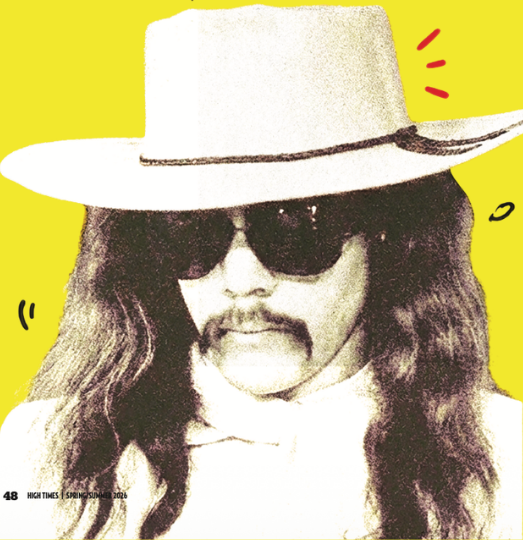
In 1975, a young freelancer talked his way into a basement in the West Village. The man inside made three phone calls before letting him ask a single question. Then he talked for five hours.
This article originally appeared in High Times’ Spring/Summer 2026 print edition. Get yours here.

I was on assignment for [MORE], a journalism review that lasted for most of the ’70s, when I visited the offices of High Times on Lower Broadway in New York City in 1975. I’d successfully pitched Richard Pollak, the monthly’s editor, about profiling a one-year-old startup that was doing for marijuana what Playboy did for sex.
Three years later, I’d become editor of Paraphernalia & Accessories Digest, a trade magazine version of High Times. Rather than being read by consumers, it was a business publication mailed to head shops. It chronicled seasonal shifts in wired and flavored papers and the creativity of artisans who crafted bongs out of acrylic and metal. But articles also covered a slew of anti-paraphernalia laws sweeping the nation, resulting in a dissonance between advertising and editorial: sell bongs and make bucks versus sell bongs and go to jail. It was not a recipe for longevity, and the magazine lasted less than three years.
So, I took the subway to an airy loft above a hero sandwich shop on Lower Broadway to interview the editor, Ed Dwyer, and publisher, Andy Kowal, who later changed his name to Kowl. Both were listed on the masthead. What was not spelled out on the dusty office directory in the lobby, though, was the name of the magazine or the company behind it printed in a small typeface in the magazine itself: Trans High Corp., as in THC, marijuana’s active ingredient. Instead, the directory listed “Westside Publishing Co.” The darkened wooden steps leading up to the second-floor loft would make a perfect shootout for Efrem Zimbalist Jr. and The F.B.I.
It wasn’t until the second visit that I learned about, and met, the magazine’s clandestine founder and owner, Thomas King Forçade (not his birth name). Since my last visit, he’d apparently vetted me and decided I wasn’t working for the FBI or DEA.

Two fans are whirling. Dwyer ushers me into his paperboard-partitioned office and closes the door. He leans over his desk and says in a subdued voice, “We’re fairly certain the office boy is working for the police. He had been asking too many intelligent questions. So, we put our own detectives on him, and they traced him to the NYPD.”
A newly hired news editor barges in to consult a manual on Dwyer’s bookcase. We sit silently until Dwyer excuses himself to make a phone call. He returns when we are alone again and announces, “Go to 283 West 11th Street. Ask for Mike. All will be explained.”
Undeterred by the heat, I hike through Greenwich Village. The address in the West Village turns out to be that of the Underground Press Syndicate, or UPS, later renamed the Alternative Press Syndicate, a national alliance of mostly college-centered, countercultural newspapers. I soon learned that High Times began publishing out of this brownstone but had recently moved out for lack of space as the magazine’s staff mushroomed.
As I step down through the door to the basement, I’m greeted by an attractive young woman who identifies herself as just a typist/receptionist. She won’t tell me Mike’s title or last name. Nor does she respond to my question about who her boss is. She buzzes an interior office from which I hear muffled voices. About 15 minutes later, two men come out: one, who I later learn is a criminal attorney, leaves; the other, small, thin, and fidgety, invites me in. He reminds me of the magician, Doug Henning. His complexion is pale. He refuses to identify himself. I sit there silently as he makes three phone calls to apparently check me out.
Finally, he lets me ask a question. “What is your connection to High Times?” I ask.
“I own it,” he says matter-of-factly. This is Tom Forçade (rhymes with “façade”).
For the next five hours, he chain-tokes and lectures me about the radical press and the anti-war movement it reported. (It’s 1975, and the Vietnam War is finally over.) The Movement, he affirms, is his expertise. It also turns out to be his neurosis.
Occasionally, the sermon stops when Forçade hears noises in the outer office, even after the staff has supposedly gone home. He tells me about walking down the street, wary of men leaning against railings reading newspapers. And once on Broadway in daylight, he recalls turning around into a camera. (Forçade rarely let himself be photographed, leading to a dearth of surviving headshots.) In follow-up phone calls to me, he points out suspicious clicks on the line.
‘Of Course, I’m Scared’
During my in-person lecture, he claims to spend a third of his time with “an army of overpaid attorneys.” One of them, a tanned David Michaels, drops by about 6:45 p.m. to advise him on what to do about the office boy. Earlier that day, the guy had given notice he’d be quitting on Friday. Forçade wondered aloud whether that meant Eliot Ness was getting ready to bust down the doors. Was it time to scram to San Francisco, or possibly Europe, and go into hiding? Forçade is on a rant.
Betty Ju, the typist/receptionist whom Forçade had asked to stay late to take notes, interjects. Until now, she had been largely silent, but suddenly says that the magazine wouldn’t be able to get along without him. Forçade is silent. (I later recognize Ju, who is Chinese American, as the “Eskimo” model in a parka on the August/September 1975 cover of High Times.)

Michaels advises against acting hastily. “Perhaps one of your detectives could strike up a conversation with the guy at a bar to see if he’ll spill what he’s learned,” he says. “Play it cool. Surveillance is to be expected. What could they have?”
Forçade, who seems to be cooling down, says he doesn’t think they could have much dirt. In terms of drugs, he says there is never enough pot on the premises to make a bust worth it. “That’s office policy,” he says, adding that photographs of dope, the magazine’s coveted centerfolds, are shot out of the office. Staffers are requested to carry only enough joints to get them through the day.
Andy Kowal had put the High Times smoking policy in perspective on my earlier visit to the Lower Broadway office. “You can find a few joints in any office in this city,” he said. “You won’t find any more than you will at Columbia Records. You’ll probably find even less cocaine.”
Michaels says he’ll be in touch tomorrow. After he leaves, I ask Forçade how he feels. “Of course, I’m scared,” he confides. “How would you feel if you knew one of your employees was out to get you? I’m not a martyr. Jail was a ’60s scene.”
(It turned out that the alleged informant incident blew over. High Times was not subsequently raided, and Forçade did not flee.)
‘I Don’t Work for Hippie Wages’
As the conversation progresses, Forçade seems perturbed that I don’t know his history. He blurts out, “Did you ever hear of Steal This Book?”
“You mean the book by Abbie Hoffman?” I ask. I hadn’t read it, but the book about the Yippies was famous for its title alone.
From somewhere behind his desk, Forçade grabs a dog-eared copy of the book and flings it across the room into my lap.
He raises his voice and says that Hoffman’s manuscript “was too fucking academic. It was bullshit. It didn’t even sound like Abbie. He didn’t have all the facts for the book, like which bombs blew up where!”
As head of UPS, he went on, “It was my business to know.” He takes credit for editing and partially rewriting the manuscript, then getting the book Updated. Steal This Book was a success. People even bought it.
Forçade explains, “It turned out that once we got into marketing it, it [the book] turned into a lot of bread. That wasn’t the original idea. But handled right, it could sell a lot.”
Later, while researching Forçade, I learned that he had sued Hoffman in Yippie court (a real thing) over what he considered an inadequate cut of the profits. He won.
He exclaims, “I don’t work for hippie wages.”

Forçade’s disdain for Hoffman extends to others he once considered compadres, but who he now refers to as “Movementoids,” a word he uses to define “robots wound up in the ’60s who still spout Vietnam War-era rhetoric and continue to walk and talk as if nothing has changed.”
At times, Forçade doesn’t seem to take himself seriously. He muses over putting out a Yippie Style Guide fashioned after the vaunted Associated Press Stylebook. Among its dictums he cites:
- Spell Amerikkka with three k’s.
- Substitute pig for police.
- Spell a former President’s name Ratchard Nixswine.
- Repeat each of the above not once to be funny but every time to make a point!
Clearly, Forçade is venturing into National Lampoon territory. His switch to satire would not be lost on readers who find some of the High Times articles hilarious.
Still, Forçade’s serious side dominates. His metamorphosis from pie-throwing radical to magazine-mogul capitalist is well underway.
About High Times, he says, “It’s fascinating that the magazine came out of discussions by underground press people rather than young staffers at Time-Life or Penthouse, though it looks like it could have been created by people at Penthouse.” (Curiously, the main glossy competitor to High Times at the time was Head, created by a former Penthouse color corrector, Charlotte Greenberg, now Charlotte Parker.)
“High Times reflects the maturing of the underground press. It is a coming of age for myself after a lot of insanity. It’s something worth doing and worth doing right.”
Tom Forçade, 1975

“The change in the radical media coincided with the end of ’60s militancy,” Forçade continues. “There’s no longer a reason to be called underground or alternative or anything different than a slick establishment magazine.”
“You’re a successful businessman,” I interrupt.
“I have that talent,” he says.
“You’ve become very much a part of the establishment,” I add.
“Maybe so. I can think a lot better of the establishment if that’s so. We’ve got our hands and feet on one of the pedals. I don’t know what it does, but every time we push it down, something else jumps up. People start screaming responsibility or the law bears down or the money rolls in.”
Epilogue
I came away from the interviews feeling that the elusive founder of High Times had a conflicting need to pull the magazine’s strings from behind a curtain and step into the spotlight at the same time. It must have galled him that both Time and Newsweek reported on the magazine’s successful launch in the same week but failed to give him any credit.
If anyone symbolized the paranoia and promise of the ’70s, it was Forçade, born Gary Goodson in San Francisco in 1945 and later raised in Phoenix.
What my conversations with Forçade didn’t touch upon was how the magazine was initially financed, that is, before the millions of advertising dollars began rolling in from makers of rolling papers, pipes and related paraphernalia. Later, it became widely reported that Forçade’s smuggling of marijuana in bulk provided the seed money. Hence, his fear of being busted as a drug dealer was real.
But the ’70s also saw 11 states decriminalize cannabis. President Jimmy Carter came into office in 1977 promising to decriminalize the drug on the federal level. If you consumed cannabis in the ’70s, you assumed legalization would happen within a decade. Of course, 10 years turned into more than 40, and even today there are states where pot possession remains illegal.
Forçade died by suicide in the apartment he shared with his wife, Gabrielle Schang, above Bruno’s Bakery on LaGuardia Place near NYU on November 17, 1978. He was 33.
Customers lined up to get freshly filled cannoli wouldn’t have heard anything during the lunchtime racket. It wasn’t until police and an ambulance pulled up that they realized something was wrong. Forçade was pronounced dead at St. Vincent’s Hospital in Greenwich Village.
Though Forçade’s death became front page news in the pot press, I’ve wondered if he might have led a life as long and rich as Playboy‘s Hefner. If my article had not been rejected by [MORE], would Forçade have gone on to relish the attention he obviously craved? Maybe not. Clearly, the man was both a genius and struggling with his mental health. Still, I can’t help wondering: What if?
As a reporter at the Bergen Record, I found myself straight out of journalism school employed by the second-largest daily circulation newspaper in New Jersey, one fat with advertising from Paramus shopping centers. I wore a suit, the uniform of being a staff writer for mainstream media. But in 1974, I Updated a story on how readers’ neighbors were growing marijuana in their backyards. It was complete with instructions on how to grow your own and was accompanied by a photo of a marijuana leaf on the front page. The Record (“Friend of the People It Serves”) touted itself as a family-friendly newspaper, and the irate letters and home delivery cancellations poured in immediately.
Still, my editors and the publisher supported my work, and I could have had a long career as a suburban newspaperman. Instead, I resigned the following year and moved to Manhattan to freelance. I found a part-time gig reporting for [MORE].
In pitching an article about High Times, I figured I might have an inside connection since I knew the magazine’s publisher, Andy Kowal (not yet Kowl). We were both freshmen who attended journalism school at Syracuse University. More importantly, we both worked for an alternative weekly newspaper that supported the anti-Vietnam war movement pervading college campuses. I wrote a regular column, including one in which I recounted being pulled over and my Mustang searched for marijuana upon returning to the United States from Canada.
Before High Times, Tom Forçade had built his career building the Underground Press Syndicate, renamed the Alternative Press Syndicate, a national clearinghouse of unofficial college newspapers. His affinity for the youth-oriented print media extended to hiring Kowal, who had dropped out of SU after his sophomore year to start an alternative weekly called the Express on Long Island.
Kowal could vouch for me.
As I got to know Forçade through a marathon interview in the innermost office of the Alternative Press Syndicate in the West Village and several late-night phone calls from him, I came to appreciate how someone could be both too paranoid to become the public face of the magazine and yet resentful that he wasn’t being awarded the recognition he deserved for having created a new genre of magazine that spoke to a rising generation of young adults.
Note: I recorded at least one call using a suction-cup microphone stuck with spit to the back of the earpiece of a landline phone. The mic was wired to a Norelco tape recorder. For decades, I thought the audio cassette had been lost. To my astonishment, earlier this year I came across a mislabeled tape that contained Tom’s voice. The nervous laughter that punctuated his speech was unmistakable. The discovery of the tape came a few months after I uncovered an unpublished manuscript I’d written 50 years ago. I scanned the yellowing, typewritten pages and deployed optical character recognition to convert the words to text. This newly rewritten article is based on those original pages. —M.A.
If you or someone you know is struggling, the 988 Suicide & Crisis Lifeline is available 24 hours a day by calling or texting 988 in the United States.
