

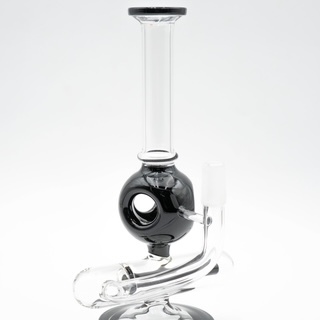
Flower gets smoked and disappears, but the right piece stays behind, becoming part of the room, the ritual, and eventually, the memories.
There is something unusual about the object at the center of a smoking ritual. The thing purchased for consumption is temporary by design. Flower gets ground, packed, lit, pulled through water, and eventually reduced to ash. The smoke disappears faster than that. The glass remains.
It sits on the coffee table after everyone has left. It gets rinsed in the sink and moved aside to make room for dinner. Someone asks where it came from. Someone else picks it up to look at the details. After enough time, an owner knows exactly where the piece has a small flaw and how it sits in the hand without looking down.
Cannabis glassware is unusual in that respect. The piece often becomes more permanent than the thing it was bought to consume.


Cannabis Glassware Becomes Part of the Room
A good piece does not live in a drawer. It becomes part of the landscape of a home, and that has always separated smoking glass from most other cannabis accessories. A grinder is useful, a lighter can become a favorite, a rolling tray gets used daily, and a stash jar can earn its place on a shelf, though none of them changes the character of a room. A distinctive bong or pipe has a presence that is harder to ignore, because glassware serves a function while also taking up visible space in a room.
Cannabis rituals are rarely as solitary as the transaction that precedes them. A piece can become associated with a particular apartment, a certain group of friends, one job, or one long stretch of a person’s twenties. The glass that lived on the coffee table during one chapter can become the object carried into the next one. That is part of what makes choosing a piece feel different from buying something disposable.
That continuity is the stated premise behind Select GWE, which describes its goal as honoring the personal rituals people build and the people who have built their lives around them. It is a different starting point than selling hardware by specification, and the collection reflects it. Someone furnishing a first shelf and someone looking for a centerpiece are not shopping for the same object, so the range runs from compact rigs like the Space Pyramid to sculptural work like the Dragon Head.

The company also keeps a running section of its site devoted to customer photographs of pieces in the rooms where they actually get used, which shows the premise in practice. The images are of finished rooms rather than staged product shots. There is no universal version of the right piece. Some people want something understated. Others want glass that demands a second look. Either way, the object starts to reflect the person who owns it.


Cannabis Glass Carries Its Own History
By the early 2000s, functional glass had grown from an underground craft into a real industry with collectors, skilled makers, payrolls, and serious revenue behind it. Jerome Baker Designs, founded by glassblower Jason Harris, was running roughly $4 million a year with 70 employees and was widely considered the largest glass smokeware company in the world.
On February 24, 2003, federal authorities announced Operation Pipe Dreams, a nationwide crackdown on the drug-paraphernalia industry led by the DEA. Across the operation and related regional takedowns, prosecutors announced 35 indictments charging 55 people. Jason Harris was among them. So was Tommy Chong, who later served nine months in federal prison. Jerome Baker Designs, which had grown into a roughly $4 million-a-year company with 70 employees, was effectively wiped out by the crackdown.
A bong was never simply a delivery device. It was a culture and an art form, and for a period it was something the federal government spent two years and $12 million attempting to eliminate. That history gives functional glass a weight that is easy to miss when everything else about cannabis is moving toward convenience. The culture of functional glass has survived criminalization, commercialization, shifting consumer tastes, and a legal market that arrived with entirely different priorities.

Select GWE’s shelves sit on the other side of that history without treating it as a footnote. Keith Haring-branded glass shares space with titles like Cannabis: The Illegalization of Weed in America, which puts the art-object lineage and the legal history in the same cart as the hardware. The company’s own framing follows from that arrangement: glass meant to feel intentional and approachable, and worthy of a place in someone’s home rather than defined by the stigma that helped criminalize the plant to begin with.
The legal market changed a great deal. It brought new money, new consumers, new product categories, and an enormous amount of infrastructure. The object itself retained older habits. Pieces still get passed around, customized, cleaned after a long night, and eventually broken. The reaction when one breaks is what separates functional glass from disposable equipment.
What Makes a Piece Survive
Anyone who has owned glass long enough has a story about breaking one. It slipped off a counter. Someone knocked it over while reaching past it. It fell during a move. It was simply old, and one bad moment finished the job. The reaction is rarely proportional to the retail price, because the value of a piece changes after purchase. On the first day it is merchandise. Six months later it has a history. It has been present for movie nights, late conversations, birthdays, bad decisions, good music, and quiet mornings, along with the sessions that were supposed to last 20 minutes and somehow became the entire evening.
Durability is the one place where that sentiment turns into a practical buying question. Borosilicate glass is prized for handling heat and sudden temperature changes. Wall thickness matters too, and Select GWE’s own buying guidance points to five millimeters or more as a useful sign of quality. A wide base adds stability on a crowded table. Joint size is worth checking before purchase rather than after, since the bowl and downstem still have to fit the piece.
Those specs are why travel pieces exist as their own category. Select GWE builds heavy-walled sandblasted glass onto a beaker base in a model it calls The Traveler, and pieces built to travel are the ones most likely to stay in service across a move. When a piece does eventually break, the reaction is usually about everything that happened around it rather than the object itself.
What Stays Behind
Cannabis culture has always had a complicated relationship with permanence. The plant gets harvested, the flower packaged, the joint rolled, and the smoke exhaled. What remains is resin and a stretch of time that cannot be recovered. The glass gives the ritual a physical memory, which is why the better pieces do not feel interchangeable. They become recognizable instantly, even across a crowded room. They develop a patina of use and occupy space differently after years of ownership than they did on arrival.
None of that requires an elaborate setup. It can be the person coming home after work, changing into sweats, putting on music, and finally getting some time alone. It can be somebody settling in with a book or disappearing into a project for a few hours. A good piece becomes a kind of witness to all of it. It stays through the sessions and conversations, through moves, parties, quiet nights, and long stretches of ordinary time. Eventually it stops feeling like something that was bought and starts feeling like something that belongs to a life.

That everyday version of the ritual is what Select GWE’s bundle boxes are built around. Rather than selling a water pipe and leaving the rest of the evening to chance, the boxes assemble glass alongside the apparel and lifestyle items that surround an ordinary session, treating the objects at the edges of a ritual as part of the experience rather than afterthoughts.


The company is not attempting to dictate what that ritual should look like. It is supplying pieces that can become part of one that already exists.
Images courtesy of Select GWE.
Sponsored Content Disclosure: Select GWE sponsored this article as part of a paid partnership with High Times. The story explores the role functional glass can play in cannabis ritual, memory, and culture, with Select GWE products included as examples of the sponsor’s approach. This is not an independent product review or endorsement. Product descriptions, specifications, and company claims attributed to Select GWE reflect information provided by the sponsor unless otherwise sourced.
