

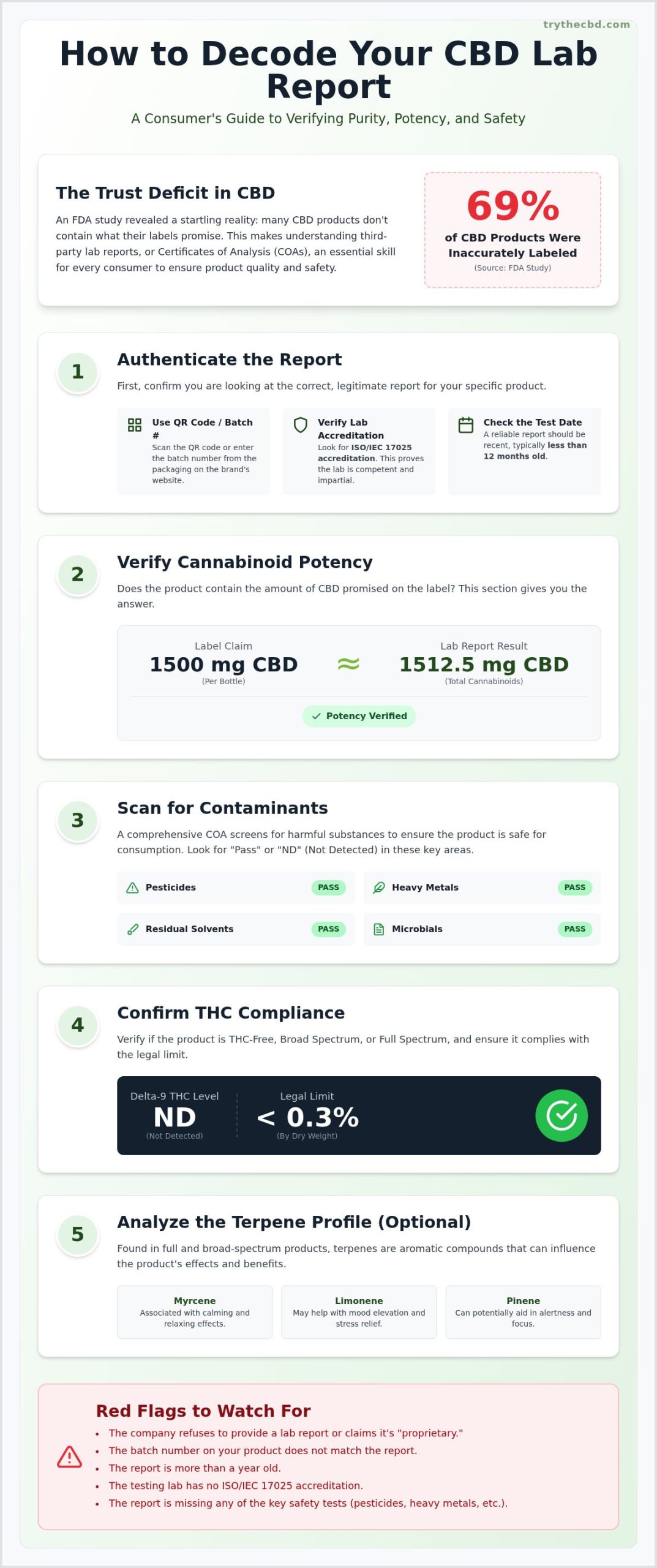
Did you know that an FDA study found that 69% of CBD products were inaccurately labeled, often containing incorrect cannabinoid levels or unlisted ingredients? Mastering the skill of Understanding CBD Lab Reports turns that uncertainty into expert knowledge, ensuring you never settle for a subpar product. You likely feel a sense of confusion when staring at technical jargon like LOQ or ND, or perhaps you worry about the hidden presence of heavy metals and pesticides in your supplements. It’s frustrating to wonder if your “THC-free” oil actually meets the strict total THC standards required in 2026.
We believe that transparency is a contract between a brand and its community. This guide will teach you how to decode a Certificate of Analysis (COA) so you can verify the purity, potency, and safety of any CBD product with total confidence. We will walk through the process of spotting red flags, matching batch numbers, and ensuring your product meets the rigorous ISO 17025 accreditation standards. By the end, you’ll have the peace of mind that comes from knowing exactly what you’re putting into your body.
Key Takeaways
- Learn how to authenticate a Certificate of Analysis by using batch-specific QR codes to link your product directly to its third-party laboratory results.
- Master the art of understanding cbd lab reports to verify that the cannabinoid potency in the bottle matches the milligram count promised on the label.
- Identify potential safety risks quickly by scanning the “Pass/Fail” columns for heavy metals, pesticides, and residual solvents to ensure your wellness routine remains pure.
- Determine if a product is truly THC-free or full-spectrum by checking the Delta-9 concentrations against the strict 0.3% legal limit.
- Use detailed terpene profiles found in modern COAs to select specific products that align with your desired outcomes, such as enhanced focus or deeper relaxation.
What is a CBD Lab Report (COA) and Why Is It Essential?
A Certificate of Analysis (COA) serves as the ultimate proof of a product’s integrity. It is a verified document issued by an accredited laboratory that details the exact chemical makeup of a hemp extract. Because the FDA hasn’t yet established a formal regulatory pathway for CBD marketing, the industry relies on a system of self-policing. This makes understanding cbd lab reports a vital skill for any consumer. Without this document, you’re essentially taking a brand’s word at face value; a risky move considering a 2023 FDA study found that only 31% of products were accurately labeled.
Independent third-party verification is the benchmark of quality. While some companies perform in-house testing, these results can be biased or incomplete. An external, ISO-accredited lab provides an impartial audit of what’s actually inside the bottle. This rigorous process protects you from “CBD ghosting,” a deceptive practice where products contain trace amounts of hemp but zero actual CBD. By demanding a COA, you ensure that the milligram count on the label matches the reality of the extract.
The Trust-But-Verify Model of CBD Wellness
Labels and marketing claims can be persuasive, but they don’t replace hard data. In 2026, savvy consumers prioritize transparency over flashy packaging. There’s a profound emotional benefit to this data-driven approach; it replaces the anxiety of the unknown with the calm reassurance of scientific proof. Try The CBD adopts this model by providing batch-specific COAs for every product, from CBD oils and tinctures to topicals. This transparency bridges the gap between high-altitude Colorado hemp farms and your personal wellness routine, ensuring you never have to guess about purity.
Key Components of a Standard Lab Report
Every legitimate report follows a structured layout designed for clarity. The header contains the lab’s name, their accreditation credentials, and the date the test was performed. You should always look for the Sample ID and Batch Number, which must match the code printed on your product’s packaging or QR code. This link ensures the data you’re reviewing applies specifically to the bottle in your hand. Most reports present this information in a clean, tabular format, making it easy to scan for potency and safety markers at a glance. Recognizing these sections is the first step toward total confidence in your purchases.
How to Find and Authenticate a Genuine COA
Finding a lab report shouldn’t feel like a scavenger hunt. In a transparent market, the path from the bottle to the data is direct and clearly marked. Most reputable brands now include a QR code on their packaging, a feature that has become a regulatory requirement in several states by 2026. When you scan this code, it should lead you directly to a batch-specific document rather than a generic homepage. If your product lacks a QR code, look for a batch number printed near the expiration date. You can usually enter this number into the brand’s online database to pull up the specific results for that harvest.
Authentication is the next critical step in understanding cbd lab reports. A genuine report must feature the credentials of the testing facility, specifically ISO/IEC 17025 accreditation. This international standard proves the lab’s technical competence and impartiality. If a brand refuses to provide a current report or claims the data is “proprietary,” consider it a significant red flag. Transparency isn’t optional in wellness; it’s the foundation of safety. You can explore a full range of verified CBD products where these reports are always a click away.
Scanning for Success: The Digital Trail
To verify your product, start by opening your smartphone camera and scanning the QR code on the label. Once the PDF loads, your first task is to cross-reference the batch number on the bottle with the one listed at the top of the report. Next, check the testing date. A common industry pitfall is the use of “evergreen” lab reports, where a company uses a single successful test from years ago to represent all future batches. Because hemp is a bioaccumulator and crops vary by season, a report older than 12 months is often an unreliable indicator of what’s currently in your hands.
Reputable Labs vs. ‘Dry Labbing’ Risks
The term “dry labbing” refers to the fraudulent practice of generating a report without actually performing the chemical analysis. This shortcut saves money for unscrupulous manufacturers but puts consumers at risk of ingesting contaminants. To avoid this, only trust reports from well-known, accredited laboratories in the US. These facilities undergo rigorous audits to ensure their equipment is calibrated and their methods are sound. Try The CBD mitigates these risks by ensuring every single batch is independently validated by ISO-accredited partners, providing a steady hand for those seeking reliable lifestyle enhancement.
Decoding the Cannabinoid Profile: Potency and Spectrum
The cannabinoid profile is the heart of the document, providing a chemical snapshot of what you are consuming. When understanding cbd lab reports, you will first encounter two primary columns: Weight % and Concentration, often measured in mg/g. To calculate the total CBD in your bottle, multiply the concentration by the total weight or volume of the product. For instance, if a 30ml tincture shows a concentration of 50mg/g, you are holding a high-potency extract. This section also confirms the legal status of your hemp. Following the Texas “Total THC” rule implemented in March 2026, labs now report the sum of Delta-9 THC and THCA to ensure the product remains below the 0.3% federal limit.
Confirming the spectrum of your product requires a close look at the presence of minor cannabinoids. A Full Spectrum report will display a variety of compounds alongside a legal trace of THC. In contrast, a Broad Spectrum report should show those same minor players but list THC as ND, which stands for “Not Detected.” If the report only shows CBD with zeros across every other row, you are looking at a CBD isolate. This data ensures the product in your hand matches the marketing on the box.
Verifying the Milligram Count on the Label
To verify if the bottle matches the label, look at the total milligrams of CBD reported for the entire sample. It is rare for a product to hit the exact milligram count perfectly; therefore, the industry accepts a variance of ±10% as the standard for accuracy. If your 1000mg bottle shows 1040mg on the COA, it is considered accurately labeled. During your review, you might see the term “LOQ” next to certain cannabinoids. LOQ is the lowest concentration at which a lab can reliably record a value. If a cannabinoid is present but falls below this threshold, the lab cannot ethically report a specific number, ensuring the data remains scientifically sound.
The Cannabinoid ‘Minor’ Players
A high-quality extract often features a diverse profile of minor cannabinoids like CBG, CBN, and CBC. These compounds work in harmony with CBD to create the entourage effect, a synergistic interaction that may enhance the overall wellness benefits of the plant. When you scan a report and see these minor players, it signals a gentle, sophisticated extraction process that preserved the hemp’s natural integrity. You can Explore our Full Spectrum CBD Oil options to see how a robust cannabinoid profile translates into a premium product experience.

Safety tests are the final hurdle a product must clear before it reaches your shelf. When understanding cbd lab reports, the most efficient starting point is the “Pass/Fail” column. This summary gives you an immediate verdict on whether the batch meets established safety thresholds for contaminants. A “Pass” indicates that the levels of harmful substances are either non-existent or fall safely below the limits set by state regulators. If you see a “Fail” in any category, it’s a non-negotiable indicator that the product is unsafe for consumption.
Comprehensive reports screen for a specific quartet of heavy metals: lead, arsenic, cadmium, and mercury. These toxins are particularly dangerous because they can accumulate in the human body over time. Pesticide screening is equally critical, especially as large-scale hemp farming increases. By 2026, many states have tightened these requirements, mandating checks for dozens of chemical agents. Another layer of understanding cbd lab reports involves checking the residual solvent results. This ensures the extraction process was clean. While CO2 extraction is the gold standard for purity, ethanol is also common; however, both must be purged completely to avoid leaving behind chemical residues that could irritate the body.
Why Hemp Quality Starts in the Soil
Hemp is a powerful bio-accumulator, meaning it acts like a sponge for everything in its environment. While this makes it an excellent crop for soil remediation, it presents a challenge for wellness products because the plant can absorb heavy metals or toxins from the earth. This is why soil testing and sourcing are vital for your safety. Sourcing from high-altitude Colorado farms offers a distinct advantage, as the clean air and controlled agricultural standards result in a naturally purer harvest. Try The CBD maintains rigorous standards to prevent contamination, ensuring that the natural integrity of the plant is preserved from the moment the seed hits the ground.
Mycotoxins and Microbials: The Hidden Dangers
Beyond chemicals, biological contaminants like mold, yeast, and E. coli pose significant health risks. These microbials can develop during the drying or storage phases if moisture levels aren’t perfectly controlled. These tests are especially important for CBD for pets, as animals can be more sensitive to certain mycotoxins than humans. A “Fail” in this section means the batch could cause illness and should be discarded. You can shop with total confidence by choosing third-party verified CBD products that have cleared every safety hurdle with a perfect record.
Using Lab Reports to Choose the Best CBD Products
Once you have mastered the technical jargon, the COA becomes a powerful tool for personal optimization. Beyond basic safety, the terpene profile serves as your roadmap to specific wellness outcomes. If your report shows high levels of linalool, you are likely looking at a calming extract; conversely, a profile rich in limonene or pinene suggests a more uplifting, focus-oriented experience. This level of detail is what separates premium offerings from budget alternatives. In early 2026, budget-tier CBD often sells for $0.03 to $0.04 per milligram, but these products frequently skip the terpene analysis or comprehensive contaminant screening. Investing in premium products, which typically range from $0.08 to $0.10 per milligram, ensures you are paying for the rigorous transparency that protects your health. understanding cbd lab reports allows you to justify these costs by seeing exactly what your money is buying: purity, precision, and scientific proof. A professional report should look clean, be easy to read, and come from an identifiable, third-party facility.
Before you complete any purchase, use this safety-first checklist to verify the product’s integrity:
- Does the QR code link directly to a batch-specific PDF?
- Is the testing facility ISO/IEC 17025 accredited?
- Does the total CBD potency fall within the acceptable 10% variance of the label?
- Are there clear “Pass” results for heavy metals, pesticides, and microbials?
- Is the report less than 12 months old?
Matching the Report to Your Wellness Goals
Choosing between CBD Oil and Tinctures becomes much simpler when you can read the cannabinoid ratios yourself. For instance, if you’re seeking better rest, you should look for a COA that shows a measurable concentration of CBN alongside the CBD. If you’re managing daily stress, a high-CBD, full-spectrum profile with diverse minor cannabinoids like CBG or CBC is often the ideal choice. You can Browse our curated CBD Bundles to find pre-selected combinations that have already been vetted for specific lifestyle goals, ensuring you get the most out of the entourage effect.
Conclusion: Making Transparency Your Priority
Reading the COA is the single most important step in your wellness journey. It transforms you from a passive consumer into an informed advocate for your own health, protecting you from the 69% of products that the FDA found to be inaccurately labeled. At Try The CBD, we believe that transparency isn’t just a feature; it’s a fundamental right. Every batch we produce is tested by independent, accredited labs, and every result is shared openly with our community. When you prioritize data over marketing, you ensure your path to well-being is built on a foundation of trust and safety. Shop our lab-verified CBD products today and experience the difference that total transparency makes for your peace of mind.
Empower Your Wellness Journey with Data
You now possess the essential tools to navigate the world of hemp extracts with total confidence. By mastering the art of understanding cbd lab reports, you can quickly verify that your chosen product is free from heavy metals and contains the exact milligram count promised on the label. Always remember to scan for that batch-specific QR code to ensure the data you’re reviewing matches the specific bottle in your hands. This simple step transforms you from a casual shopper into an informed advocate for your own well-being.
Transparency isn’t just a buzzword; it’s a standard we uphold through every stage of our production process. Our commitment to quality begins with high-altitude Colorado hemp and continues through rigorous third-party ISO-accredited testing for every single batch we release. This meticulous approach provides the calm reassurance you deserve when choosing natural solutions for your lifestyle enhancement. We invite you to step into a partnership where your health is the priority and every claim is backed by scientific proof.
Secure your wellness with lab-verified CBD; Shop Now. Your journey toward a more reliable and transparent wellness routine starts with a single, verified choice.
Frequently Asked Questions
What does ‘ND’ mean on a CBD lab report?
ND stands for “Not Detected,” meaning the laboratory equipment could not find any measurable amount of a specific compound in the sample. This result is common in broad-spectrum or isolate products where THC is removed to levels below the limit of quantitation. It provides reassurance for those seeking a THC-free experience while maintaining a clean wellness routine.
How do I know if a CBD lab report is fake?
A genuine report always includes the testing facility’s contact information and a verifiable license or accreditation number. You can authenticate the document by contacting the lab directly or using their online portal to cross-reference the batch ID. Red flags include blurry logos, inconsistent fonts, or the absence of an ISO 17025 accreditation seal.
Is a 0.3% THC level on a lab report enough to get me high?
A 0.3% concentration of Delta-9 THC is generally considered non-intoxicating for the average user. This threshold is the federal legal limit for hemp-derived products, designed to offer the benefits of the entourage effect without the psychoactive high. While individual sensitivity varies, this level remains the industry standard for maintaining a clear head and functional lifestyle.
Why is my CBD oil lab report from a different state than where it was grown?
It’s common for hemp grown in Colorado to be sent to specialized laboratories in other states for analysis. Brands often select facilities based on their specific technical expertise or ISO certification status rather than geographic proximity. The most important factor is the lab’s impartiality and its ability to provide accurate, third-party verification of the product’s purity.
How often should a CBD company update their lab reports?
Reputable companies update their reports with every new production batch. Because hemp is an agricultural product, each harvest can have slight variations in cannabinoid and terpene levels. understanding cbd lab reports involves looking for a test date within the last 12 months to ensure the data accurately reflects the specific bottle you are currently using.
What is the difference between a potency test and a full-panel lab report?
A potency test only measures the concentrations of cannabinoids like CBD and THC. In contrast, a full-panel report is far more comprehensive, including critical safety screenings for pesticides, heavy metals, microbials, and residual solvents. You should always prioritize a full-panel report to verify that your product is both effective and free from hidden environmental contaminants.
Does every bottle of CBD need its own QR code?
Every bottle should feature a QR code that links directly to the specific batch results for that production run. While the code is identical for all bottles within the same batch, it must lead to the data for that exact harvest. This digital trail is essential for understanding cbd lab reports and ensuring the brand maintains a high level of transparency.
What should I do if a product fails a heavy metals test?
You should immediately stop using the product and contact the manufacturer for a full refund. A failure in the heavy metals section indicates that lead, arsenic, or mercury levels exceed safe consumption limits. Reputable brands will pull these batches from the shelf entirely, as your safety and peace of mind should always be their primary concern.
