

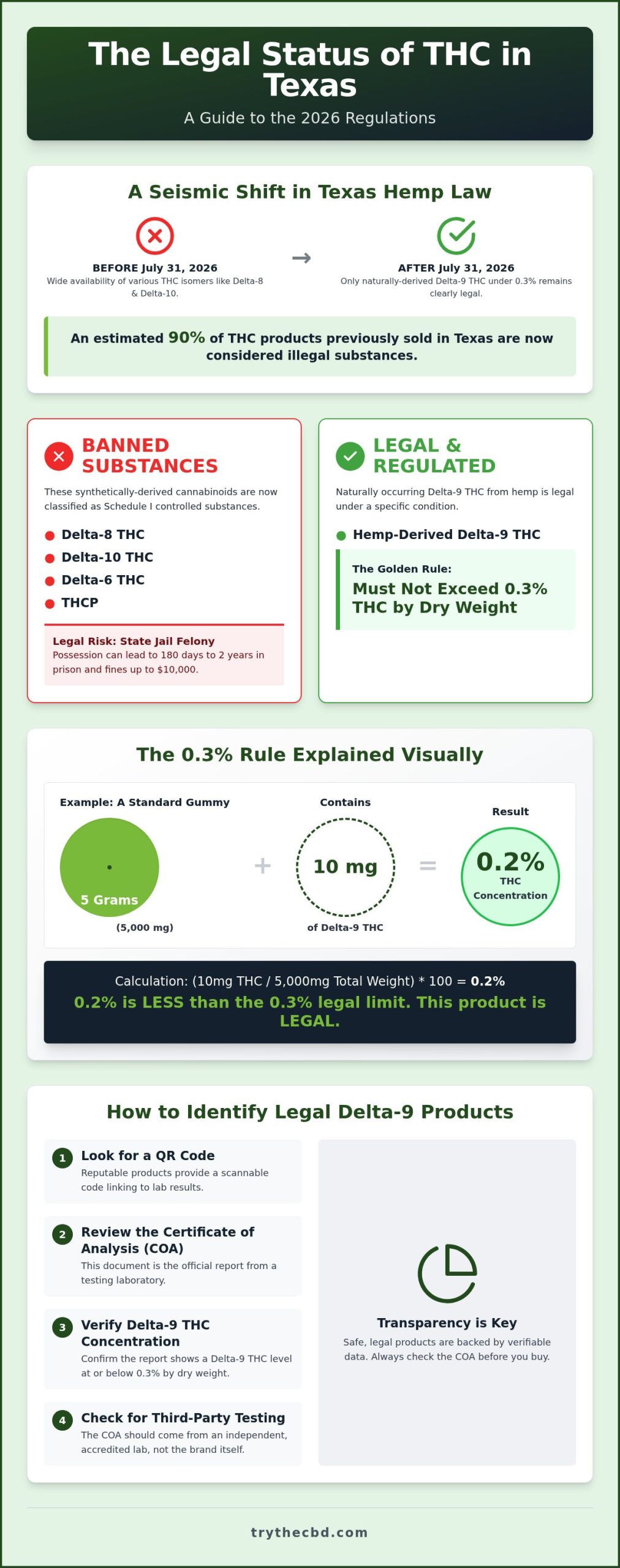
As of July 31, 2026, cannabis experts estimate that up to 90 percent of the THC products previously available in Texas have been removed from circulation or reclassified as illegal substances. This sudden shift, triggered by a May 2026 Texas Supreme Court decision, has left thousands of residents wondering: is delta 9 legal in texas today? If you feel overwhelmed by conflicting news reports or fear the legal repercussions of possessing hemp products, your concerns are completely valid. The landscape has changed rapidly, and the stakes for staying informed now include avoiding potential felony charges.
We’re here to provide the clarity and calm reassurance you need to move forward safely. This guide offers the definitive answer on the legality of hemp-derived cannabinoids in the Lone Star State following the recent bans on synthetic isomers like Delta 8 and Delta 10. You will learn exactly how the 0.3 percent THC rule applies to your favorite products and how to distinguish between compliant options and prohibited substances. We also preview the upcoming federal changes scheduled for November 2026, ensuring you remain a knowledgeable and protected consumer in a complex market.
Key Takeaways
- Learn why naturally occurring Delta 9 remains the legal gold standard for Texans following the July 31, 2026, enforcement of bans on synthetic isomers.
- Discover the technical answer to is delta 9 legal in texas by mastering the 0.3% THC dry weight rule that separates compliant wellness products from restricted substances.
- Understand the critical differences between federally legal hemp and the Schedule I controlled substances now prohibited under updated state regulations.
- Access a practical compliance checklist for identifying safe products using QR codes and third-party Certificates of Analysis (COAs).
- Identify reliable methods for sourcing high-quality, lab-tested Delta 9 gummies that emphasize transparency and agricultural integrity.
Understanding the 2026 Texas Hemp Product Ban
The regulatory environment for hemp in Texas underwent a seismic shift in 2026. While many consumers were caught off guard, the Texas Department of State Health Services (DSHS) moved forward with strict reclassifications that fundamentally altered what’s available on store shelves. The central question for many residents is delta 9 legal in texas today? As of August 2026, hemp-derived Delta 9 THC remains legal in Texas as long as the concentration does not exceed 0.3% on a dry-weight basis. This distinction is vital for those seeking natural wellness solutions without crossing legal boundaries.
The DSHS acts as the primary gatekeeper for consumable hemp products in the state. By re-implementing rules that were previously tied up in court, they’ve effectively narrowed the market to favor purity and natural sourcing. It’s a move toward stricter oversight, requiring businesses to adhere to high licensing fees and rigorous labeling standards. For the consumer, this means the era of “anything goes” in the hemp market has ended, replaced by a system that prioritizes verified safety and specific chemical profiles.
What Exactly Was Banned in July 2026?
On July 31, 2026, the DSHS began full enforcement of rules that classify several popular cannabinoids as Schedule I controlled substances. This list includes Delta-8, Delta-10, Delta-6, and THCP. These compounds are now legally equivalent to prohibited narcotics in the eyes of the state. The reclassification followed years of legal uncertainty and a pivotal Texas Supreme Court ruling in May 2026 that allowed the state to enforce its 2021 ban on these isomers. For consumers, possessing these products now carries the risk of a state jail felony. This can result in 180 days to two years in prison and fines reaching $10,000. Lawmakers targeted these specific variants because they’re often created through chemical synthesis rather than being extracted directly from the plant in significant quantities.
Why Delta 9 THC Remains the Exception
You might wonder why Delta 9 escaped this sweeping crackdown. The primary reason lies in the distinction between naturally occurring compounds and those that are synthetically derived. The history of Cannabis in Texas shows a slow but steady move toward accepting low-THC hemp, codified by the 2019 House Bill 1325. Because Delta 9 is the primary psychoactive component found naturally in the hemp plant, it’s regulated based on concentration rather than being banned outright as a “synthetic” isomer. The Texas Supreme Court’s May 2026 decision focused on the state’s right to regulate manufacturing processes that convert CBD into other forms of THC. Since compliant Delta-9 gummies and oils are harvested from the plant and kept within the 0.3% federal threshold, they remain a legal, accessible option for residents. This “low-dose” Delta 9 was specifically excluded from the ban, maintaining its status as the gold standard for legal hemp in the state.
The 0.3% Rule: Why Hemp-Derived Delta 9 is Legal
Understanding the current legal landscape requires a look at the 2018 Farm Bill. This federal legislation redefined industrial hemp as any part of the Cannabis sativa L. plant containing no more than 0.3 percent Delta-9 THC on a dry-weight basis. Texas mirrored this federal stance with the passage of House Bill 1325 in 2019. This alignment between state and federal law is the primary reason residents still ask, is delta 9 legal in texas? The answer is a definitive yes, provided the product meets these specific concentration requirements. To dive deeper into the science of the compound, you can read our guide on What Is Delta 9?
Understanding Dry Weight Concentration
The “dry weight” rule is a mathematical safeguard that allows for effective wellness experiences within legal limits. Under Texas state law, these items are categorized as Consumable Hemp Products (CHPs). Let’s look at a simple math example to clarify how this works. A standard wellness gummy might weigh 5 grams, which equals 5,000 milligrams. If that gummy contains 10 milligrams of Delta 9 THC, the concentration is only 0.2 percent. This falls safely below the 0.3 percent threshold, making it a fully compliant hemp product. This calculation ensures that as long as the THC is naturally occurring and properly measured, the final product remains legal for purchase and possession.
Hemp-Derived vs. Marijuana-Derived THC
Biologically, the Delta 9 THC molecule is identical whether it comes from a hemp plant or a marijuana plant. However, the law focuses entirely on the source. Marijuana remains illegal for recreational use in Texas, and possessing it can lead to severe legal consequences. Sourcing THC from industrial hemp is the only path to legality in the state. If the plant contains more than 0.3 percent THC at harvest, it’s legally classified as marijuana; if it contains less, it’s industrial hemp.
This distinction is why choosing a transparent partner for your wellness journey is essential for your peace of mind. By focusing on high-altitude Colorado hemp, we ensure every product starts from a compliant source that respects the intelligence of our customers. You can explore our full range of compliant hemp products to see how these rigorous standards translate into reliable solutions. Understanding this source-based distinction is key to confirming that is delta 9 legal in texas when you choose the right products.
Delta 9 vs. Delta 8 and Delta 10: The Legal Divide
The core difference between these compounds lies in their molecular structure and how they’re produced. Delta 9 THC occurs naturally in significant amounts within the cannabis plant. In contrast, Delta 8 and Delta 10 are minor cannabinoids. To create the high concentrations found in retail products, manufacturers typically use a chemical process to convert CBD into these isomers using various acids and solvents. Texas lawmakers and the DSHS have targeted this specific conversion process. They view the resulting products as “synthetically derived” rather than natural agricultural extracts. This distinction is the primary driver behind the recent shift in the market.
While alt-cannabinoids like Delta 8 enjoyed a period of rapid growth, their legal foundation was always fragile. They relied on a narrow interpretation of the 2018 Farm Bill that many states have now rejected. Delta 9, however, benefits from a much more stable regulatory status. Its legality is rooted in the primary definition of industrial hemp itself. Because it remains protected by both federal and state definitions of industrial hemp, naturally occurring Delta 9 is the safest legal choice for Texans seeking THC products.
Comparison Table: Legal Status in Texas (2026)
| Cannabinoid | Legal Status | Notes |
|---|---|---|
| Delta 9 THC | Legal | Must be hemp-derived and stay under 0.3% dry weight. |
| Delta 8 THC | Banned | Reclassified as a Schedule I controlled substance July 31, 2026. |
| Delta 10 THC | Banned | Prohibited under the DSHS synthetic isomer ban. |
| HHC | Banned | Included in the 2026 reclassification of THC variants. |
| CBD | Legal | Fully compliant and widely available across Texas. |
The Risks of Possessing Banned Cannabinoids
The transition from a legal gray area to a hard ban has serious implications for consumers. Possession of Delta 8 or Delta 10 is no longer a minor infraction. It’s now treated as a state jail felony. If you’re caught with these substances, you could face 180 days to two years in prison and fines reaching $10,000. These penalties highlight why the question of is delta 9 legal in texas is so critical for your personal safety. It’s no longer just about wellness; it’s about staying on the right side of the law.
We recommend a thorough check of your current supply. Clear your cabinets of any products labeled as Delta 8, Delta 10, or THCP to avoid unnecessary legal risks. To maintain your wellness routine safely, focus on brands like Try The CBD that specialize exclusively in legal, naturally occurring Delta-9 gummies. By choosing products backed by third-party lab results, you can enjoy the benefits of hemp with total confidence in their compliance.

How to Identify Legal Delta 9 THC Products in Texas
Identifying compliant options requires a meticulous eye for detail. While the legal framework clarifies that is delta 9 legal in texas under specific conditions, the burden of proof often rests on the product label. Texas Department of State Health Services (DSHS) regulations require specific information for every Consumable Hemp Product (CHP) sold in the state. If you are unsure where to begin, our guide on How to Buy CBD Online provides a deep dive into sourcing standards. For a quick verification, follow this Texas Compliance Checklist:
- QR Code or Barcode: Must link directly to a batch-specific lab report.
- Manufacturer Information: The label must display the company name and physical address.
- Batch Number: This allows you to track the specific production run of your product.
- THC Concentration: The label must clearly state the Delta 9 THC content is 0.3% or less.
The Anatomy of a Certificate of Analysis (COA)
A Certificate of Analysis is your most valuable tool for ensuring safety and legality. When you open a lab report, look for the “Potency” section first. You’ll often see the term “LOQ,” which stands for Limit of Quantitation. This represents the lowest concentration the laboratory equipment can reliably detect. If a cannabinoid like Delta 8 is listed as “<LOQ,” it means the product is effectively free of that banned isomer. Beyond potency, a comprehensive COA should include “Pass” results for pesticides, heavy metals, and residual solvents. These tests confirm the agricultural integrity of the hemp and ensure no harmful chemicals were introduced during the extraction process.
Red Flags to Avoid When Shopping
Gas station shelves and convenience stores are notoriously unreliable sources for hemp products. These retailers often carry items that lack proper DSHS-mandated labeling, placing you at significant legal risk. Avoid any product that makes exaggerated health claims or lacks a scannable QR code. If a brand cannot provide a transparent batch history, it’s a sign they may not be adhering to the strict testing protocols required in 2026. Choosing established Colorado-based brands offers a layer of security, as these companies operate under some of the most rigorous agricultural standards in the country. You can confidently shop for lab-verified hemp products that meet every Texas regulatory standard, ensuring your wellness journey remains both safe and legal.
Sourcing Lab-Tested, Compliant Delta 9 Gummies
Finding a reliable partner in the wake of the 2026 market shifts is essential for your peace of mind. While the answer to is delta 9 legal in texas remains a clear yes, the source of your products determines whether you stay on the right side of the law. Try The CBD has served as a trusted bridge between high-quality production and consumer wellness since our founding in 2017. We act as a meticulous guardian of quality, ensuring that every batch we produce adheres strictly to the 0.3 percent THC threshold. This commitment allows us to provide consistent, compliant solutions to residents in all 50 states without the uncertainty often found in local retail environments.
Our role is to simplify the complex world of hemp regulations for you. We provide a steady hand in a specialized market, prioritizing transparency through rigorous verification. By focusing on naturally occurring cannabinoids and avoiding the synthetic isomers that triggered the July 2026 bans, we offer a path to wellness that is both effective and fully legal. National shipping from our Colorado facility directly to your Texas home ensures you have access to the same high standards regardless of local inventory fluctuations.
Why Colorado Hemp Standards Matter for Texans
The origins of your hemp products play a vital role in their purity and effectiveness. We utilize high-altitude Colorado hemp, which benefits from unique environmental stressors that encourage the development of robust cannabinoid profiles. This agricultural foundation is supported by our rigorous multi-stage quality control process. By the time you Shop Delta 9 THC Gummies from our collection, they’ve been verified by third-party laboratories for both potency and safety. Our extensive catalog of CBD Edibles reflects a commitment to natural origins and scientific verification, offering you a variety of ways to enhance your daily lifestyle with confidence.
Safe and Discreet Delivery to Your Door
We understand that receiving hemp products by mail can feel uncertain given the recent legislative changes. However, because our offerings are derived from industrial hemp and maintain a dry-weight concentration below 0.3 percent, they’re protected by federal law for interstate shipping. We’ve perfected a delivery system that is both efficient and private. Every order is shipped from Colorado to Texas in plain, professional packaging that protects your privacy while ensuring your products arrive in pristine condition. This methodical approach allows you to skip the high-risk retail options and receive premium, lab-tested wellness solutions directly at home. You can browse the full range of compliant Delta 9 and CBD products today to find the natural solutions that best fit your personal journey toward well-being.
Staying Compliant in the New Texas Hemp Market
The legal landscape for hemp in the Lone Star State is more complex than ever; however, your path to wellness doesn’t have to be. While the 2026 reclassifications have removed many synthetic options from the market, the definitive answer to is delta 9 legal in texas remains a resounding yes for naturally occurring, low-dose products. By prioritizing transparency and agricultural integrity, you can continue to enjoy the benefits of hemp without the fear of legal repercussions. We invite you to partner with a provider that respects your intelligence and your safety.
Our offerings are naturally derived from organic hemp and strictly compliant with 2018 Farm Bill standards, ensuring every batch meets the rigorous 0.3 percent THC threshold. You deserve the peace of mind that comes from meticulous verification and 3rd-party lab testing. Take the next step in your personal wellness journey by choosing products that prioritize both purity and compliance. Shop Lab-Tested, Texas-Compliant Delta 9 Gummies and experience the difference that professional standards make. Your well-being is a journey, and we’re honored to be your steady hand in this specialized market.
Frequently Asked Questions
Is Delta 9 THC legal in Texas right now?
Hemp-derived Delta 9 THC is legal in Texas as long as its concentration remains at or below 0.3 percent by dry weight. This compliance is established by the 2018 Farm Bill and mirrored in Texas House Bill 1325. While other isomers have faced recent restrictions, naturally occurring Delta 9 remains protected under state definitions of industrial hemp. This is why the answer to is delta 9 legal in texas remains yes for informed consumers.
What happens if I am caught with Delta 8 in Texas?
Possession of Delta 8 is now classified as a state jail felony in Texas following the July 31, 2026, enforcement date. If you’re caught with these prohibited substances, you could face 180 days to two years in prison and fines reaching $10,000. This strict reclassification by the DSHS treats Delta 8 as a Schedule I controlled substance. It’s vital to clear your inventory of any banned isomers to avoid these severe legal consequences.
Can I order Delta 9 gummies online and have them shipped to Texas?
You can legally order hemp-derived Delta 9 gummies online for delivery to your Texas address. Because these products meet the federal and state threshold of 0.3 percent THC, they’re considered legal agricultural commodities. Reputable brands use professional, discreet packaging to ensure your order arrives safely. Sourcing from established Colorado-based experts provides an extra layer of security, as these products undergo rigorous third-party testing to confirm they meet every Texas regulatory requirement.
Is there an age requirement to buy Delta 9 in Texas?
The legal age to purchase any consumable hemp product in Texas is 21 years old. This requirement applies to all retail and online transactions involving Delta 9 gummies, oils, or edibles. Retailers are mandated to verify age at the point of sale to maintain their state registration. Whether you’re shopping at a local licensed store or ordering through a transparent online partner, you must provide valid identification to prove you meet this age threshold.
Will Delta 9 show up on a drug test in Texas?
Yes, Delta 9 THC will almost certainly trigger a positive result on a standard drug screening. Most drug tests look for the presence of THC metabolites and don’t distinguish between hemp-derived products and marijuana. Even though your product is legally compliant under Texas law, the chemical markers are identical. If you’re subject to frequent testing for employment or legal reasons, it’s essential to consider this risk before incorporating any THC products into your routine.
How many Delta 9 gummies can I legally possess in Texas?
There is no specific limit on the number of compliant Delta 9 gummies you can possess as long as they meet the 0.3 percent THC dry weight rule. Since these are classified as Consumable Hemp Products rather than controlled substances, they don’t carry the same weight limits as marijuana. However, you should always keep your products in their original packaging with the QR code visible. This documentation serves as immediate proof of the product’s legal status.
What is the difference between Delta 9 and marijuana in the eyes of Texas law?
The legal distinction rests entirely on the THC concentration and the plant’s origin. Under Texas law, cannabis containing 0.3 percent or less Delta 9 THC by dry weight is classified as industrial hemp. Anything exceeding that threshold is legally defined as marijuana, which remains illegal for recreational use. While the molecules are identical, the legal status of your product depends on whether it was harvested from a compliant hemp crop and remains within the specific potency limits.
Are Delta 10 products also banned in Texas?
Yes, Delta 10 products are currently banned in Texas as of the July 31, 2026, regulatory update. The Texas Department of State Health Services reclassified Delta 10 and other synthetic THC isomers as Schedule I controlled substances. This means the sale and possession of Delta 10 carry the same felony risks as Delta 8. While residents often ask is delta 9 legal in texas, it’s the only psychoactive hemp cannabinoid that remains protected and legal for retail sale.
