

What if the reason your CBD feels ineffective has nothing to do with the hemp plant itself, but everything to do with the specific “how” and “when” of your daily routine? It’s incredibly discouraging to invest in wellness products only to find yourself wondering why that promised sense of calm or relief hasn’t arrived yet. You aren’t alone in this frustration. Many people find themselves confused by conflicting dosage advice or discouraged by lackluster results from low-quality products. If you’re currently staring at a bottle of oil and questioning your purchase, understanding what to do if cbd isn’t working is the first step toward reclaiming your wellness journey.
You deserve a routine that actually delivers on its promises. In this guide, we’ll bridge the gap between complex cannabinoid science and your personal experience to help you achieve the results you expect. We’ll show you how to identify high-altitude, Colorado-grown quality and how to adjust your approach for maximum biological impact. From decoding third-party lab results to finding your ideal milligram strength, you’ll gain a clear, actionable plan to fix your routine and finally experience the reliable support that pure CBD can provide.
Key Takeaways
- Understand that CBD acts as a modulator rather than a high-inducing compound, focusing on the subtle absence of tension rather than a dramatic physical sensation.
- Learn exactly what to do if cbd isn’t working by identifying your “sweet spot” on the dose-response curve and adjusting for your specific metabolism.
- Discover how to distinguish genuine, high-potency Colorado hemp from ineffective products that lack actual cannabinoid content or transparent lab testing.
- Identify biological barriers like first-pass metabolism and why pairing your dose with healthy fats is essential for proper systemic absorption.
- Master the 48-hour tolerance reset and delivery method shifts to clear your receptors and restore the efficacy of your daily wellness routine.
Managing Expectations: What CBD Should (and Shouldn’t) Feel Like
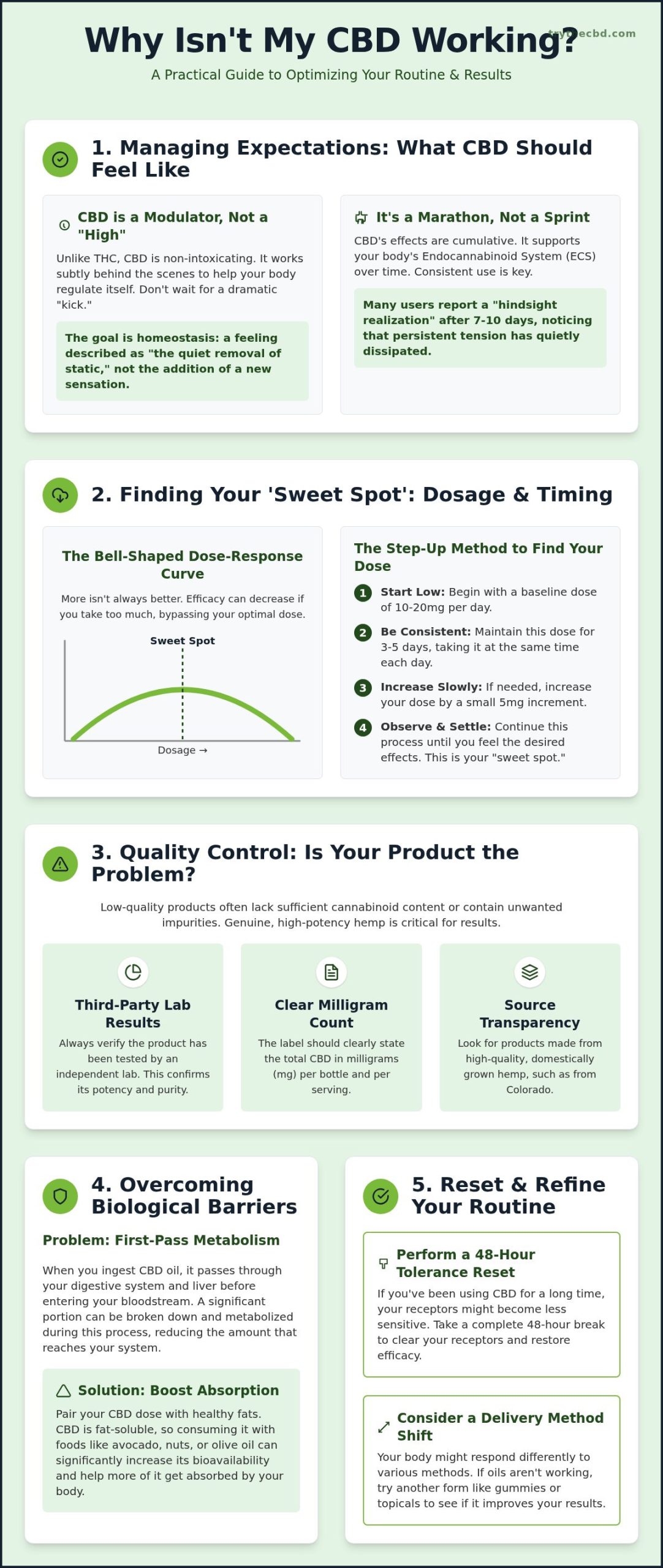
If you’ve ever wondered what to do if cbd isn’t working, the answer often starts with a shift in perspective. Unlike many traditional supplements or pharmaceuticals, CBD doesn’t usually announce its presence with a sudden burst of energy or a heavy physical sensation. It’s a modulator, which means it works behind the scenes to help your body regulate itself. This subtle nature is why many first-time users feel underwhelmed, they’re waiting for a “kick” that isn’t supposed to happen.
For those familiar with Delta-9 THC gummies, the experience is vastly different. While THC is psychoactive and creates a noticeable “high,” CBD is non-intoxicating. For a comprehensive overview of CBD and its chemical properties, scientific records confirm it lacks the binding affinity for CB1 receptors that produces a high. Think of CBD as the “absence of a feeling.” You might not feel “something” happen, but you might notice that you aren’t as irritable during your commute or that your mind isn’t racing at midnight. It’s about the quiet removal of static rather than the addition of a new sensation.
The Role of the Endocannabinoid System (ECS)
Your body maintains an internal balancing act through the ECS, a complex network of receptors and enzymes. CBD supports this system by interacting with receptors to prevent the breakdown of your body’s own endocannabinoids, essentially helping your system work more efficiently. Some individuals may experience what researchers call endocannabinoid deficiency. In these cases, the system is so depleted that it takes weeks of consistent use to correct the imbalance. It’s a cumulative process where CBD supports your neurotransmitters rather than overriding them.
Subtle vs. Immediate Effects
A common misconception is that CBD works like an aspirin, providing relief within thirty minutes. However, CBD is a marathon, not a sprint. You might experience a “hindsight realization” after seven to ten days of using full spectrum CBD oil, suddenly noticing that the persistent tension you’ve carried for months has quietly dissipated. Homeostasis is the primary goal of any CBD routine. If you are looking for what to do if cbd isn’t working after just one dose, the solution is often simple: give your biology time to respond and build a foundation.
Finding Your Sweet Spot: A Guide to CBD Dosage and Timing
Finding your ideal dose is more of an art than a science. Unlike many supplements where a higher amount yields a stronger result, CBD often follows what researchers call a Bell-Shaped Dose-Response Curve. This means that efficacy increases with the dosage only up to a specific point. If you exceed that peak, the benefits may actually begin to taper off. If you’re currently wondering what to do if cbd isn’t working, you might be surprised to learn that you’ve simply bypassed your body’s optimal “sweet spot” by taking too much, or perhaps you haven’t yet reached the threshold required for your biology.
Your body’s chemistry is entirely unique. Factors like body weight, metabolic rate, and the specific severity of your wellness needs dictate how much of the compound you actually require. A person with a faster metabolism may process cannabinoids more quickly, necessitating more frequent or higher doses. Consistency is the other half of the equation. Your system needs a steady supply to maintain balance, so taking your dose at the same time every day is essential. To truly master your routine, maintain a CBD Journal for 30 days. Record the time, the milligram count, and how you feel. This data provides the clarity needed to make informed adjustments rather than guessing.
The Step-Up Method for Beginners
The most reliable way to find your ideal amount is the Step-Up Method. Start with a baseline dose, typically between 10 to 20mg, and maintain this for three to five days. If you don’t experience the desired effects, increase the amount by a small 5mg increment. Continue this steady progression until you reach your saturation point. You’ll know you’ve found it when increasing the dose no longer provides additional relief or when you feel the specific “calm” you’ve been seeking. Because FDA regulation of CBD products is still evolving, always rely on the clear milligram counts found on transparent labels to guide these adjustments.
Delivery Methods and Bioavailability
How you take CBD is just as important as how much you take. Bioavailability refers to the percentage of CBD that actually enters your bloodstream. Ingestion methods, like gummies, must pass through the digestive tract, which can lower the effective dose. In contrast, sublingual application using How to Use CBD Tincture Drops for Maximum Effect allows the compound to enter the bloodstream through the small capillaries under the tongue. This method often works faster and more efficiently than edibles. If you find your current method isn’t delivering, you might consider browsing different high-quality CBD options to see if a change in delivery format makes the difference you need.
Purity and Potency: How Product Quality Affects Your Results
When you’re investigating what to do if cbd isn’t working, the first place to look is the label of your bottle. A pervasive issue in the current market is the confusion between hemp seed oil and actual CBD oil, often referred to as the “Amazon Scam.” Platforms like Amazon currently prohibit the sale of CBD, leading many sellers to market “hemp oil” with astronomical milligram counts that actually refer to the weight of the hemp seeds, not the cannabinoid content. Hemp seed oil is a wonderful culinary product, but it contains zero CBD and will never provide the wellness benefits you’re seeking.
Beyond the seed oil confusion, potency itself is a common barrier. Many retail products offer low-potency concentrations, often under 250mg per bottle. For most adults, these concentrations are too diluted to reach the therapeutic threshold. According to what science says about CBD, the purity and concentration of the extract are paramount for efficacy. This is why we prioritize Colorado-grown hemp. The high-altitude climate and rigorous soil standards in Colorado produce plants with superior cannabinoid density and a cleaner profile. To ensure you are receiving a legitimate, potent extract, you can browse the Try The CBD products for lab-verified tinctures that list exact milligram counts clearly.
How to Read a Certificate of Analysis (COA)
A Certificate of Analysis is your only objective proof of quality. To verify your product, locate the “Potency” section of the COA to ensure the milligram count of CBD matches what is printed on your bottle. Transparency doesn’t stop at cannabinoids. You must also check the “Heavy Metals” and “Pesticides” sections to ensure the batch has received a “Pass” status. Hemp is a bioaccumulator, meaning it absorbs everything from the soil it grows in. A missing COA is a significant red flag; if a company cannot provide third-party verification for every batch, they’re asking you to trust them without evidence.
Extraction Methods: CO2 vs. Solvents
The method used to pull CBD from the plant material dictates the final purity. CO2 extraction is the industry gold standard because it uses pressurized carbon dioxide rather than harsh chemicals. Cheap oils often rely on solvent-based extraction using butane or ethanol, which can leave behind residual toxins that might block benefits or cause unwanted side effects. Clean extraction ensures the preservation of beneficial terpenes. These aromatic compounds work in tandem with CBD to enhance its effects, provided they aren’t destroyed by high-heat or chemical processing. Choosing a CO2-extracted product ensures you are getting a clean, holistic representation of the plant’s potential.

Biological Barriers: Why Your Body Might Be Resisting CBD
Sometimes the obstacle between you and the results you desire isn’t the product quality, but your own unique physiology. When you consume CBD, it must navigate a complex biological path before it can interact with your endocannabinoid system. A primary hurdle is “first-pass metabolism.” This process occurs when your liver breaks down the compound before it ever reaches your systemic circulation. If your liver is particularly efficient at processing cannabinoids, you might find that very little of the active ingredient actually makes it to your bloodstream. If you are currently researching what to do if cbd isn’t working, understanding how to bypass or support these metabolic processes is essential.
Another critical factor is the “Entourage Effect.” This scientific theory suggests that cannabinoids work more effectively when they are consumed together rather than in isolation. For many individuals, a pure CBD isolate lacks the necessary “keys” to fully unlock the body’s receptors. Switching to a Full Spectrum CBD Oil can often break through a plateau. By including a complete profile of minor cannabinoids and terpenes, you provide your body with a holistic toolkit that enhances the primary compound’s impact.
Full Spectrum vs. Broad Spectrum vs. Isolate
The choice between extract types can determine your success. Full Spectrum products contain trace amounts of THC (less than 0.3%), which many users find necessary to “activate” the CBD through synergistic interaction. However, if you have a specific sensitivity or workplace requirements, Broad Spectrum offers a middle ground by providing most plant compounds without the THC. If you aren’t seeing results with one, it may be time to see the comparison in Full Spectrum CBD Tincture vs. Broad Spectrum to decide which profile aligns with your biology. Different bodies respond to different cannabinoid ratios, and finding yours is a key part of the troubleshooting process.
Optimizing Absorption with Healthy Fats
CBD is lipophilic, meaning it is “fat-loving.” It does not dissolve in water; it requires fat to be transported effectively through your digestive system. Taking your dose on an empty stomach often results in poor absorption because there is no carrier to help the CBD bypass the harsh environment of the gut. To maximize bioavailability, pair your routine with healthy fats like MCT oil, avocado, or a handful of nuts. This simple adjustment can significantly increase the amount of CBD that reaches your blood. Additionally, be mindful of lifestyle factors; excessive caffeine or alcohol can overstimulate or dampen your receptors, making it harder for your system to reach the state of balance you’re chasing.
If you’re ready to try a more potent, biologically available approach, you can explore our full range of lab-tested CBD products to find the right delivery method for your needs.
The Optimization Roadmap: How to Reset Your CBD Routine
If you have already adjusted your dosage and verified your product quality but still aren’t seeing results, it’s time for a systematic reset. Most people simply keep increasing their dose without realizing that their receptors might need a brief pause to regain sensitivity. Knowing what to do if cbd isn’t working often involves stepping back before you can move forward effectively. A structured roadmap helps you clear the “noise” from your system and reintroduce cannabinoids in a way that your body can actually utilize.
Instead of sticking to a single delivery method, consider a multi-angle approach. By combining oral tinctures with topicals, you provide support that addresses wellness from both the inside and outside. You can explore CBD Bundles to see how these combinations create a more comprehensive wellness reset. This strategy ensures that your system is supported from multiple biological entry points, increasing the likelihood of reaching that desired state of calm.
Step 1: The Clean Break
The first stage of your roadmap is a 48-hour tolerance reset. During this 2 to 3 day washout period, you should pause all CBD intake entirely. This break allows your endocannabinoid receptors to clear and recalibrate, preventing the desensitization that occurs with long-term, high-dose use. It’s also a vital time to evaluate your baseline symptoms. Without any cannabinoids in your system, you can more accurately assess the severity of your needs and prepare your body for a fresh start with high-altitude, Colorado-grown hemp.
Step 2: The Potency Pivot
Many users find that moving from low-dose edibles to a high-potency tincture finally solves the “it doesn’t work” problem. If you’ve been using 250mg or 500mg bottles, moving to a 1000mg or 3000mg tincture provides the concentration necessary to break through a biological plateau. When you calculate the cost-per-milligram, higher potency options often provide better long-term value because you need less total volume to achieve the same milligram count. Using a CBD Oil Starter Kit is an excellent way to find your new baseline with a more concentrated formula while maintaining the transparency of lab-verified results.
Reclaiming Your Path to Wellness
Finding the right balance with CBD is a journey that requires patience and high-quality ingredients. By understanding the subtle nature of the endocannabinoid system and optimizing your routine through proper timing and fat intake, you can move past the frustration of ineffective results. Whether you need a 48-hour tolerance reset or a shift to a higher potency tincture, having a clear plan is essential for what to do if cbd isn’t working.
We are here to partner with you in this transition by providing the transparency you deserve. Our Colorado-grown, non-GMO hemp is backed by over 5,000 verified 5-star reviews, ensuring you receive the purity and potency promised on the label. With third-party COAs available for every batch, you never have to guess about the integrity of your routine. You can troubleshoot your routine with our Lab-Tested CBD Starter Kits today. Your journey toward lasting calm and relief is within reach, and we’re committed to helping you find the “sweet spot” that works for your unique biology.
Frequently Asked Questions
How long does it take for CBD oil to actually start working?
Sublingual tinctures typically take 15 to 45 minutes to enter the bloodstream. However, cumulative effects may take several days or weeks of consistent use to become noticeable. If you’re wondering what to do if cbd isn’t working after one dose, remember that the body often needs time to adjust its endocannabinoid tone. Consistency is more important than immediate results when seeking long-term wellness benefits.
Can you be naturally immune to the effects of CBD?
While true “immunity” is rare, individual genetics and the density of your cannabinoid receptors significantly influence your response. Some people have naturally high levels of endocannabinoids, meaning they may not feel a dramatic shift when adding external CBD. Others may have metabolic variations that process the compound too quickly. In these cases, adjusting the delivery method or increasing the potency is often the best solution.
What should I feel when I take a high-quality CBD tincture?
You should experience a subtle sense of “unwinding” rather than a heavy physical sensation or mental fog. Many users describe the feeling as the quiet absence of tension or a more manageable response to daily stressors. High-quality Colorado-grown tinctures provide a clean experience without the grogginess associated with low-grade extracts. If the promised calm feels absent, it’s likely time to re-evaluate your specific dosage.
Why did my CBD work at first but then stopped being effective?
This phenomenon is usually attributed to receptor desensitization or “tolerance” build-up. When receptors are constantly flooded with cannabinoids, they may become less responsive over time. A 48-hour tolerance reset can help clear your receptors and restore sensitivity. Once refreshed, you can often return to your original dose and experience the same level of relief and balance you felt when you first started your routine.
Is it better to take CBD oil on an empty stomach or with food?
It’s significantly better to take CBD with a meal containing healthy fats. Because CBD is lipophilic, it requires fat to bypass first-pass metabolism in the liver and reach your bloodstream effectively. Pairing your tincture with avocado, nuts, or MCT oil can increase bioavailability by several times compared to taking it on an empty stomach. This simple dietary adjustment is often the missing piece in a successful routine.
Can other medications I’m taking interfere with my CBD results?
Yes, certain medications that are processed by the cytochrome P450 enzyme system in the liver can interact with CBD. This interaction can either slow down or speed up how your body metabolizes both the medication and the CBD. If you find your routine ineffective, it’s essential to consult with a healthcare professional to ensure there are no contraindications. They can help you determine the safest timing for your wellness supplements.
How do I know if I bought fake CBD oil from a marketplace like Amazon?
Amazon currently prohibits the sale of CBD, so products listed there are almost always hemp seed oil. To verify your product, check for a third-party Certificate of Analysis (COA) that lists the actual milligram count of CBD. If the label only mentions “hemp oil” and lacks a verified cannabinoid profile, it likely contains no active CBD. Genuine products will always feature transparent labeling and high-altitude Colorado sourcing.
Should I switch from CBD gummies to oil if I’m not seeing results?
Switching to a sublingual oil is a smart move if gummies aren’t delivering results. Tinctures offer higher bioavailability because they bypass much of the digestive process, entering the blood through capillaries under the tongue. If you’re still questioning what to do if cbd isn’t working, moving from an edible to a high-potency tincture allows for more precise dosing and faster onset, helping you break through a biological plateau more effectively.
