

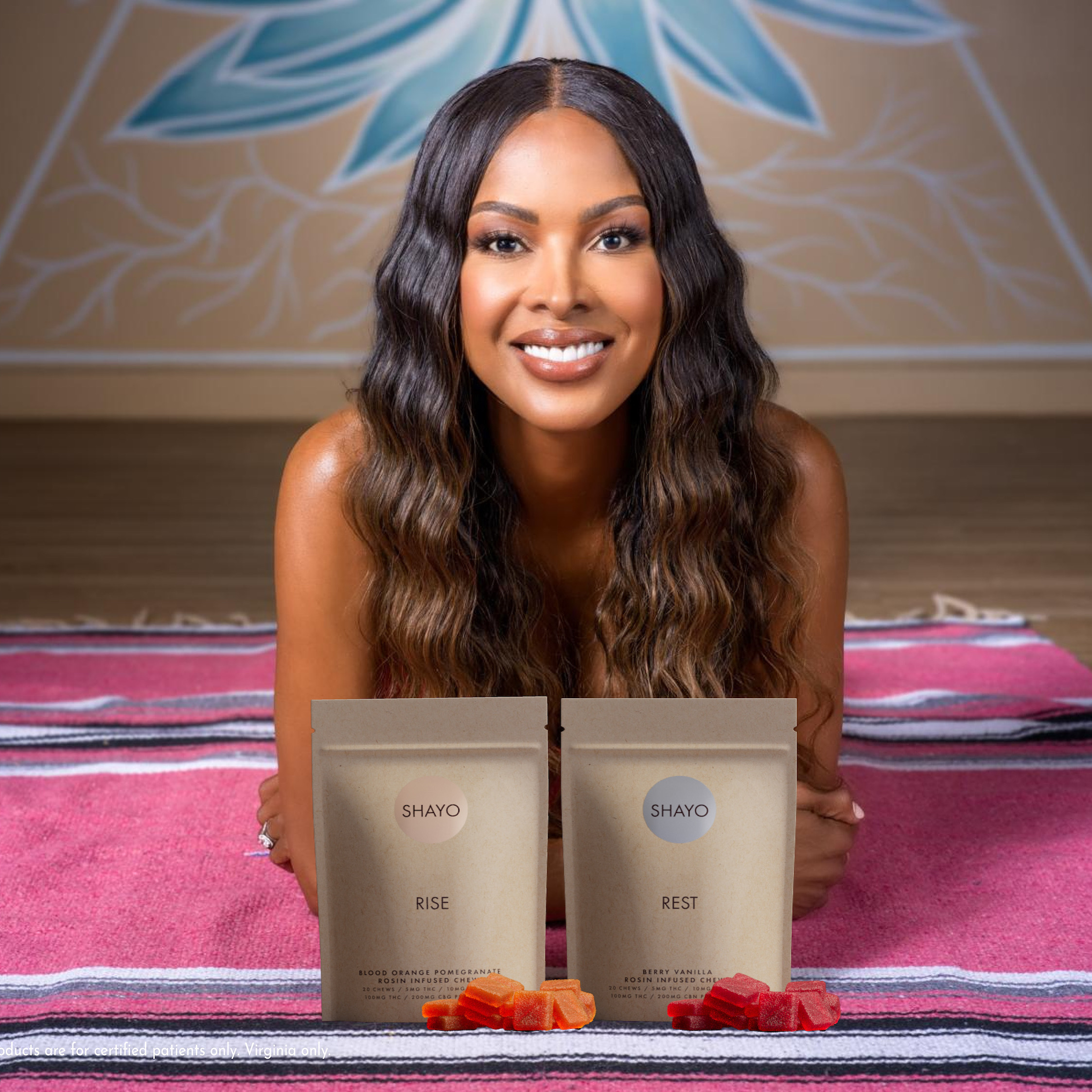
Before cannabis, Stacey Rusch spent years learning how to hold an audience, whether the room contained yoga students, morning-news viewers, QVC shoppers, or a table full of Real Housewives.
There is a 2021 résumé still circulating online that explains Stacey Rusch better than most reality-TV biographies ever could.
It is from years before SHAYO and before The Real Housewives of Potomac turned her particular cadence, optimism, and pearl-clutching composure into Bravo fodder. Under “Skills,” Rusch lists sales experience, improvisation, storytelling, live performance, health and wellness, and the ability to make guests comfortable on air. Her work history jumps from Washington television to QVC to yoga instruction. Among her former yoga clients: the White House Athletic Center, American University, the CIA, and NASA.
Read five years later, it feels less like an old TV résumé than a blueprint. Rusch has spent years learning how people connect to a person, a product, and a story. Now she has brought those skills somewhere considerably messier than a television studio: cannabis.
“The joy of connection!” Rusch tells High Times when asked what connects the various versions of her career. Later in the same answer, she puts it another way: “my passion is and always will be making a positive connection.”
That may sound relentlessly sunny. With Rusch, relentless sunniness appears to be part of the point.

Before the Housewives, There Was the Pitch
Selling something on live television is a strange art. There is no edit to save you, no dead air to disappear in post, and no room to suddenly discover that you don’t know what you’re talking about. Rusch’s résumé says her QVC work was live and unscripted, requiring detailed product knowledge and the ability to improvise.
In a 2025 interview with Vulture, Rusch described the machinery behind that ease: hours spent learning brands and products before going live, then drawing on her own life to make whatever was on the table feel familiar. It is easy to joke about QVC. It is harder to deny the training.
Before Rusch ever had a cannabis company, she had learned how to translate products for people who might know nothing about them. Before reality TV, she knew how to speak directly into a camera without a script. Before either, she taught yoga.
The yoga chapter matters because few words in commercial cannabis have been stretched thinner than “wellness.” Plenty of brands discover it at roughly the same moment they discover a market segment.
Rusch has a stronger claim to the territory. Her yoga work predates SHAYO by years, and her old résumé identifies her as a health and wellness expert while listing teaching work with institutions ranging from American University to NASA and the CIA.
“My intention was to start a wellness company,” she says. “As a former yoga teacher, I wanted to develop products that help people live a fuller, more joyful life.”
SHAYO centers on two rosin-infused fruit chews: Rise, a Blood Orange Pomegranate chew with a 1:2 THC-to-CBG ratio, and Rest, a Berry Vanilla chew with a 1:2 THC-to-CBN ratio. The brand’s current lineup also includes one-gram all-in-one vapes under the Rise and Rest names.
The more interesting question isn’t whether cannabis needs another wellness brand. It’s why Rusch believed her own history gave her a credible reason to build one.


Stacey Rusch Is Very Good at Being Stacey Rusch
Reality television introduced a different problem. On QVC, polish is competence. On Housewives, polish can become evidence against you. Rusch’s unusually formal delivery and relentlessly composed personality quickly became part of her character on Potomac. Her castmates have repeatedly questioned whether the Stacey they see on camera is a performance, extending that suspicion to her relationships and even the timeline of her cannabis business.
Her professional history makes that tension easier to understand. Rusch has worked in professions where controlling the message is not deception. It is literally the job. Journalism rewards preparation. QVC rewards fluency. Yoga rewards calm. Reality television rewards the moment when somebody loses all three. Rusch sees the distinction.
“Reality TV is different in that you have to let go of telling a story and live the story,” she says. “You cannot be prepared. There are no scripts or teleprompters. It’s organic in a way that’s both exciting and terrifying.”
That might be the most revealing thing she told High Times. For someone whose career has involved communicating with intention, Housewives asks her to surrender control and then turns that surrender into entertainment. Cannabis puts her back on more familiar ground. Here, she gets to decide what the story is.
Weed, Without the Apology
Cannabis still carries stigma, particularly for women whose public identities sit somewhere between family, television, and wellness. We asked whether there was anyone she worried about disappointing when she entered the industry.
“No.”
That was the entire answer. It lands harder than a paragraph about empowerment ever could. Rusch doesn’t present entering cannabis as rebellion. She doesn’t need a story about secretly smoking weed for decades to establish credibility, and she doesn’t perform an edgy reinvention now that cannabis is commercially useful. Her stated interest is much more consistent with the career she already had: wellness, connection, and women.
But SHAYO also places her inside a cannabis industry where access and ownership are much more complicated than celebrity entrepreneurship can make them appear.
Jushi Holdings launched SHAYO with Rusch in 2025, initially bringing its rosin-infused fruit chews into Virginia’s medical market before expanding the brand into Nevada’s adult-use market later that year. Jushi describes SHAYO as a brand “co-created” with Rusch. Rusch describes the relationship enthusiastically.
“In partnering with JUSHI I was able to do just that with the best quality of products and expert guidance in this ever changing industry,” she says.
That partnership matters because Virginia is no California. Non-medical cannabis sales remain illegal in the state, with regulated adult-use retail scheduled to begin July 1, 2027. Virginia’s medical cannabis system is divided among five geographic health service areas, each with a licensed pharmaceutical processor. Jushi holds the processor license for Northern Virginia, and those pharmaceutical processors are currently the only authorized growers and dispensaries of medical cannabis in the state.
SHAYO, in other words, wasn’t born in an open marketplace where anybody with a clever logo could rent a storefront and start moving gummies. It entered through one of the few existing gates. That context makes Rusch’s next ambition much more interesting.

What Does Ownership Mean When the Gates Are This Narrow?
“I made history as the first Black woman to own her own brand in Virginia,” Rusch tells High Times, “and now my duty is to continue to shape history by helping other entrepreneurs enter this space and thrive.”
Rusch, for her part, is increasingly interested in the structural side of the business. She says she is a member of the U.S. Cannabis Roundtable and has participated in two congressional briefings about her experience as an owner and advocate for women’s wellness.
“I’ve found solidarity in the excitement for change,” she says. “This is a pivotal time in the industry.”

For Virginia, that is literally true. The state is now building the rules for a recreational market scheduled to open next year, including licenses for retail stores, cultivation facilities, processors, delivery operators, and microbusinesses.
The next version of Virginia cannabis will have more doors. The harder question is who will be able to walk through them.
Joy Is Not the Same Thing as Naivety
Spend enough time with the language surrounding Rusch and eventually the word “joy” starts appearing everywhere. Rusch uses it. SHAYO uses it. Her professional history uses it. Even when asked what joy means when life decidedly does not cooperate, she refuses to abandon the premise.
“When life isn’t joyful, I find comfort in gratitude,” she says. “No matter your circumstance, you can always find something to be thankful for. I find solace in my faith.”
Then comes the line that could only belong to someone who agreed to join The Real Housewives:
“I know that God will always lead me back to who I am inherently – delusionally optimistic!”
There it is. The useful mistake would be to confuse optimism with softness. When asked what viewers misunderstand about her, Rusch describes a life far quieter than her television job suggests.
“I’m a Brave Housewife but I’m so lowkey,” she says. “Outside of the blessings of glitz and glamour that come with being on TV, I live in a small community of the best people. My weekends are filled with swim meets and sleepovers.”
That version of Stacey Rusch can coexist with the woman who mastered live television, volunteered her private life to Bravo, entered one of the most regulated industries in America, and now wants a seat in cannabis policy conversations.
Maybe that is the throughline. Not wellness. Not television. Not even cannabis. Rusch has made a profession out of walking into rooms where attention is currency and figuring out how to hold it.
The Next Thing She Wants to Sell Is Possibility
Celebrity cannabis has had enough famous faces dropped onto packaging. Rusch is more interesting when SHAYO is treated as another stop in a longer career rather than its culmination.
She was teaching yoga before wellness became a cannabis marketing category. She learned sales before influencers learned to call affiliate links entrepreneurship. She learned television before Bravo made the question of whether she was “performing” into part of her television persona.
Cannabis brings all of those histories together, but it also gives her something television never really could: the chance to build an asset that exists when the camera turns off. That appears to be the part she most wants to matter.
“I hope that my story of entrepreneurship will inspire more people to feel empowered to build brands,” Rusch says. “Especially people like me.”
Then she leaves very little ambiguity about how she sees the work ahead.
“I want to utilize my work, brand, and voice to change that.”
“And I will.”
Images courtesy of Stacey Rusch and SHAYO.
