

What if the “2,000mg” printed in bold on your bottle is actually a measurement of the entire container weight rather than the active hemp extract you need? With over 70% of consumers now demanding clear third-party lab results before making a purchase, learning how to read a CBD label has become the single most important skill for anyone seeking reliable wellness. It is easy to feel overwhelmed by technical jargon and fine print. You want to feel certain that your CBD Oils and Tinctures are free from hidden THC or heavy metals, yet the market often feels like a complex web of state regulations and shifting federal guidelines.
We believe that transparency is the foundation of trust. You deserve to know exactly what you are putting into your body without the guesswork of comparing different bottle sizes or accidentally buying hemp seed oil when you wanted CBD. This checklist provides a methodical approach to decoding every label you encounter in 2026. You will learn to calculate the precise cost per milligram, identify specific cannabinoid profiles, and use mandatory QR codes to access a Certificate of Analysis (COA) instantly. We are here to help you transform from a cautious shopper into a confident expert who can verify quality with a single scan.
Key Takeaways
- Distinguish between hemp seed oil and therapeutic CBD to ensure you’re not paying for a kitchen staple instead of a high-quality wellness supplement.
- Master how to read a cbd label by calculating the difference between total milligrams and the actual potency per serving for precise, effective dosing.
- Identify the nuances between Full Spectrum, Broad Spectrum, and Isolate to select the exact cannabinoid profile that meets your specific lifestyle needs.
- Learn to verify product purity by matching batch numbers to official third-party lab results through the gold standard of scannable QR codes.
- Understand why rigorous labeling standards are your best defense against hidden contaminants and inaccurate marketing claims in the 2026 market.
Why Understanding Your CBD Label Is Critical for Safety
The current regulatory environment puts you in the driver’s seat. Because the FDA has yet to establish a universal framework for marketing CBD as a dietary supplement, the responsibility of verifying safety and potency falls directly on your shoulders. A transparent label is more than just a list of facts; it’s a brand’s promise of integrity. When you master how to read a cbd label, you protect yourself from misleading marketing and ensure you’re investing in a product that actually contains the active compounds you seek. This verification process isn’t just about getting what you paid for; it’s about ensuring that every drop or gummy aligns with your personal health standards.
Hemp Seed Oil vs. CBD Oil: Don’t Get Fooled
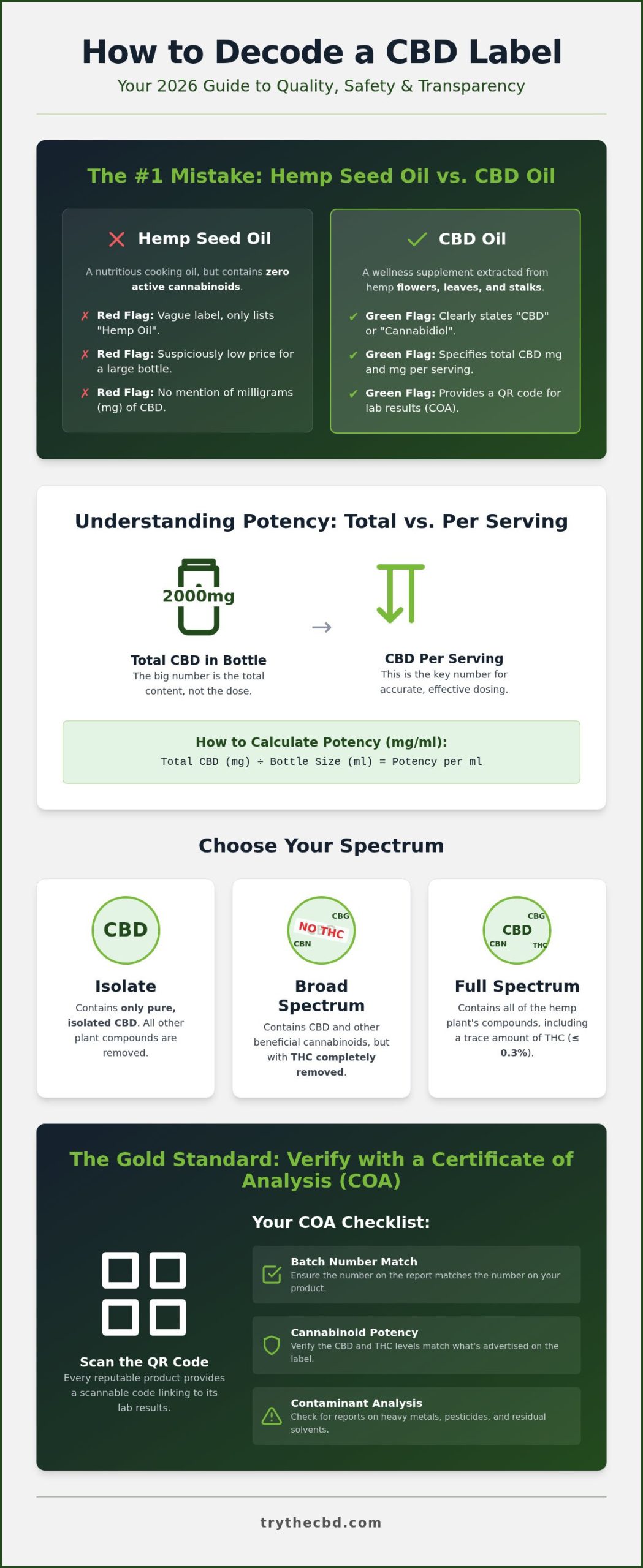
Many consumers are misled by products labeled simply as “hemp oil” or “hemp extract.” While Cannabidiol (CBD) is extracted from the flowers, leaves, and stalks of the hemp plant, hemp seed oil is derived exclusively from the seeds. It is a nutritious oil for cooking or skincare, but it contains zero cannabinoids. Low-quality brands often use clever imagery of hemp leaves to sell seed oil at a premium price. You can spot these “fakes” by looking for these red flags:
- Vague Ingredients: “Hemp oil” is listed as the only ingredient without any mention of CBD or milligram content.
- Suspiciously Low Prices: If a large bottle costs significantly less than industry averages for high-quality CBD, it’s likely just expensive seed oil.
- Missing Potency Data: Legitimate labels will always specify the concentration of active cannabinoids per serving.
A transparent label reflects a brand’s commitment to purity and high-altitude hemp standards. At Try The CBD, we ensure our CBD Oils and Tinctures clearly state the cannabinoid content so you never have to guess about the quality of your extract.
The Legal Landscape of Hemp Labeling in 2026
Compliance is the hallmark of a reputable provider in an evolving market. According to the 2018 Farm Bill and updated 2026 standards, hemp-derived products must maintain a Delta-9 THC concentration of no more than 0.3% on a dry-weight basis. Labels must clearly disclose this THC content to remain legally compliant and ensure consumer safety. Understanding these numbers helps you stay within national laws while ensuring your wellness routine doesn’t include unwanted psychoactive effects. You can learn more about the fundamentals in our guide on what CBD stands for. By checking the label for specific Delta-9 disclosures, you verify that the brand is following federal mandates and prioritizing your legal protection.
Calculating Potency: Total Milligrams vs. Serving Size
The most prominent number on a bottle is often the most misunderstood. When you’re learning how to read a cbd label, you must distinguish between the “Total CBD Content” and the “Serving Size.” Total content refers to the aggregate amount of cannabidiol in the entire container. While a 3,000mg bottle sounds impressive, its actual impact on your daily routine depends entirely on how much of that extract is delivered in a single dose. The serving size is the specific unit of measurement, such as one dropper of oil or a single gummy, that the manufacturer uses to define a standard dose. Focusing on the milligrams per serving ensures you maintain a consistent wellness regimen rather than guessing your intake based on the size of the packaging.
Calculating the actual value of your purchase requires a simple math formula. For oils, you divide the total milligrams by the total milliliters in the bottle. For edibles, you divide the total milligrams by the number of individual pieces. Knowing these equations is a vital part of learning how to read a cbd label for cost comparison. Although FDA regulation of CBD doesn’t currently approve these products as dietary supplements, they do mandate clear net quantity disclosures. This transparency allows you to determine exactly how much you’re paying for every milligram of active extract. If you want to explore a variety of concentrations, you can browse our full range of hemp-derived products to find the potency that fits your needs.
Reading Labels for CBD Oils and Tinctures
Most tinctures follow a 30ml standard bottle size, which serves as the baseline for concentration calculations. A 1,500mg bottle in a 30ml size provides 50mg of CBD per 1ml serving. To make this easy for the consumer, high-quality CBD Oils and Tinctures often feature graduated markings on the dropper. These lines allow you to see exactly where 0.25ml, 0.5ml, or 1.0ml sits, giving you total control over your serving. If the label doesn’t specify the mg per ml, always check the supplement facts panel on the back for a precise breakdown.
Deciphering Edibles and Delta-9 Gummy Labels
Edibles require a slightly different approach because the concentration is fixed per piece. When looking at Delta-9 Gummies or other edibles, the front label might display a large number like “750mg,” but this usually represents the entire jar. You’ll need to check the back panel to see if that translates to 25mg across 30 gummies. This is also where you’ll spot secondary cannabinoids. Labels for 2026 often highlight minor cannabinoids like CBN for nighttime use or CBG for daytime focus. Ensuring these are listed individually in the ingredients or supplement facts is a hallmark of a meticulously formulated product.
Full Spectrum, Broad Spectrum, or Isolate: Which Is on the Label?
The “spectrum” of a product describes the specific range of compounds extracted from the hemp plant. Identifying this on a label is vital because it dictates how the product interacts with your body. Every extract type offers a unique profile of cannabinoids and terpenes, which are the aromatic compounds responsible for a plant’s scent and potential benefits. When you see a label that mentions the “Entourage Effect,” it refers to the synergistic interaction where these various compounds work together to enhance the overall effectiveness of the CBD. Understanding these distinctions is a fundamental part of learning how to read a cbd label effectively.
You will generally encounter three main categories on a high-quality label. Full Spectrum contains the complete profile of the plant, including all cannabinoids and legal trace amounts of THC (up to 0.3%). Broad Spectrum offers a similar array of cannabinoids but has been processed to remove all detectable THC. Isolate is the purest form of CBD, typically 99% or higher; it contains no other plant compounds or terpenes. Each of these serves a different purpose in a wellness routine, and the label should make it clear which one you are holding.
Where to Find Spectrum Information
Reputable brands place spectrum information prominently on the front panel or within the “Ingredients” section. If you are looking for guidance on how to read a CBD label, start by checking the product title for these specific terms. A significant warning sign is a label that fails to specify the spectrum type at all. In most cases, if a brand doesn’t explicitly state the product is Full or Broad Spectrum, it is likely a CBD isolate. While isolates are effective for many, transparency requires a clear declaration of the extract’s origin. You can view our Full Spectrum CBD Oil to see how we clearly display these details for our customers.
Matching the Spectrum to Your Lifestyle
Your choice of spectrum should align with your professional requirements and personal wellness goals. If you work in a field with strict drug testing policies, you should prioritize “THC-Free” or “Isolate” labels to avoid any trace of THC. Conversely, Full Spectrum is often preferred for chronic support because the inclusion of multiple cannabinoids provides a more robust experience. Before you make a final selection, it’s helpful to review our guide on how to buy CBD online in 2026 to ensure you’re selecting a product that fits your lifestyle. We believe in acting as a steady hand, helping you navigate these choices with confidence and clarity.

Beyond the Front Label: COAs, QR Codes, and Ingredients
While the front of the bottle catches your eye, the real story lives in the fine print and the digital data attached to it. Learning how to read a cbd label requires looking past the branding to find the scannable QR code. This code is your digital gateway to the Certificate of Analysis (COA), a document that provides the raw data behind the marketing claims. In 2026, the most critical safety step is matching the batch number printed on your bottle to the report you see online. A generic lab report from three years ago doesn’t guarantee the safety of the oil you hold today. Each batch of high-altitude hemp is unique. You must verify that the specific lot number on your packaging corresponds exactly to the third-party testing results to ensure the integrity of your purchase.
When you open that COA, focus your attention on “The Big Three” of lab results: potency, pesticides, and heavy metals. You’re looking for a “Pass” rating across all contaminant screenings. Potency verification ensures the milligrams on the label match the actual cannabinoid concentration found in the lab. Beyond the cannabinoids, don’t ignore the ingredient list. Most CBD is suspended in a carrier oil like MCT, which is derived from coconuts, or Hemp Seed Oil. MCT is often preferred for its bioavailability, but you should always check for potential allergens if you have specific sensitivities. You can browse our third-party tested collection to see how we prioritize these rigorous standards across every product line.
How to Use a QR Code on a CBD Bottle
Open your camera app and scan the code. It’s that simple. The link should take you directly to a batch-specific page where you can locate your batch number and confirm the CBD percentage matches the label. A major red flag is a QR code that leads to a generic homepage or a “coming soon” message. This lack of transparency suggests the brand hasn’t actually tested that specific batch. At Try The CBD, we provide batch-specific transparency for every bottle, ensuring you have the exact data for the extract you are using.
Spotting Unnecessary Additives
The ingredient list also reveals the difference between a premium product and a mass-produced one. Look for natural flavorings rather than artificial sweeteners in your gummies or tinctures. If a label claims to be “Non-GMO” or “Organic,” those standards must be supported by the sourcing of every component, not just the hemp extract. For those using CBD topicals, always scan for common irritants or allergens that might affect sensitive skin. A meticulous brand will use clean, holistic ingredients that complement the natural benefits of the hemp plant without adding unnecessary chemicals.
Choosing Quality: How Try The CBD Sets the Standard
We invite you to apply your new expertise to our own packaging. Now that you understand the intricacies of how to read a cbd label, you can see why we prioritize meticulous detail in every design. Our labels aren’t just marketing tools; they’re functional documents that adhere to all 2026 US national guidelines for hemp products. We act as a trusted guardian of quality, ensuring that the technical “how” and “why” behind our production is visible to every customer. By providing a clear concentration breakdown and a direct-link QR code on every bottle, we remove the guesswork from your wellness journey. This commitment to transparency helps us serve as a reliable bridge between complex laboratory processes and your daily routine.
The foundation of our superior cannabinoid profile begins in carefully selected, pristine environments. We source our hemp from areas known for pure soil and optimal growing conditions, resulting in a non-GMO extract that maintains its integrity from seed to shelf. This focus on natural origins is reflected in our professional register. We don’t use slang or high-pressure sales tactics because we respect your intelligence as a consumer. Instead, we provide the structured presentation of facts you need to make an informed decision about your lifestyle enhancement. When you choose our products, you’re choosing a partner dedicated to consistency and reliability.
The Try The CBD Label Promise
Our promise is simple: what you see on the label is exactly what you’ll find in the bottle. We don’t hide ingredients behind vague terms like “proprietary blend” or “natural hemp oil.” Every batch undergoes rigorous third-party testing to verify potency and purity, ensuring your CBD Oils and Tinctures are free from contaminants. This methodical approach allows us to maintain a steady hand in a specialized market, providing you with the calm reassurance that your wellness tools are safe and effective. We also offer extensive educational resources to help you master how to read a cbd label across different formats, from topicals to edibles.
Ready to Experience Verified Quality?
We encourage you to explore our shop and put your label-reading skills to the test. Whether you are looking for a specific concentration or a broad-spectrum profile, our curated CBD Bundles offer comprehensive value for those seeking a structured approach to their health. These bundles are designed to simplify your initial experience, providing a variety of verified formats in one convenient package. We are here to support you with openness and transparency at every step. If you’re ready to move forward with a brand that values integrity as much as you do, shop our lab-verified CBD products today and feel the difference that premium-grade hemp can make.
Empower Your Wellness with Verified Transparency
Mastering the details on a package is the final step in securing a safe and effective wellness routine. You now have the tools to distinguish between misleading “hemp seed” marketing and genuine extract; you can also calculate exact potency per serving rather than relying on total bottle weight. Understanding the nuances of cannabinoid spectrums and verifying batch numbers against lab results ensures you’re never left guessing about what you put into your body.
By learning how to read a cbd label with precision, you can confidently navigate the 2026 market. We prioritize your trust by providing batch-specific QR codes on every bottle, which link you directly to 100% transparent third-party lab results. Our premium Colorado-grown hemp serves as the foundation for products that meet the highest national standards. We invite you to Shop Lab-Verified CBD Products and apply your new knowledge to find the perfect match for your lifestyle. Your journey toward better health deserves a partner who values integrity as much as you do. We’re here to guide you every step of the way.
Common Questions About Deciphering CBD Packaging
What is the most important thing to look for on a CBD label?
The most critical element is a scannable QR code that links to a batch-specific Certificate of Analysis. This verification confirms that the potency and purity claims on the packaging are accurate. While the front label provides a summary, the lab report is the only way to ensure the product is free from heavy metals and pesticides. Learning how to read a cbd label effectively starts with prioritizing this level of transparent, third-party proof.
Can I trust a CBD label if it doesn’t have a QR code?
You should exercise extreme caution if a label lacks a scannable QR code. In the current market, scannable links are the gold standard for transparency and are even legally required in states like Texas and California. Without a direct link to lab results, you have no way to verify if the contents match the label or if the product is safe from contaminants. A missing code is often a sign of a brand skipping essential quality control steps.
What does “hemp-derived” mean on a label?
“Hemp-derived” indicates that the CBD was extracted from industrial hemp plants containing no more than 0.3% Delta-9 THC on a dry-weight basis. This distinction is vital for legal compliance under the 2018 Farm Bill. Products labeled this way are distinct from those derived from marijuana, which contains higher THC levels. Choosing hemp-derived options ensures your wellness routine remains within federal guidelines while providing the natural benefits of the plant without unwanted psychoactive effects.
How do I calculate how much CBD is in one drop of oil?
To find the CBD content in a single drop, first determine the milligrams per milliliter by dividing the total mg by the bottle size. Since a standard 1ml dropper contains approximately 20 drops, you then divide the mg per ml by 20. For example, if your 1ml serving contains 50mg of CBD, each individual drop provides roughly 2.5mg. This calculation allows for meticulous dosing adjustments to suit your specific daily wellness needs.
Is there a difference between CBD and Cannabidiol on an ingredient list?
There is no functional difference between these terms; CBD is simply the common abbreviation for Cannabidiol. Some manufacturers use the full scientific name to appear more professional or to comply with specific international labeling standards. Whether you see “Cannabidiol” or “CBD” on the ingredient list, you are looking at the same active compound. The more important detail is the source of that Cannabidiol, such as whether it is listed as “Hemp Extract” or “CBD Isolate.”
What should I do if the lab report doesn’t match the label?
If the Certificate of Analysis shows a significant discrepancy in potency or fails a contaminant screen, you should avoid using the product. A variance of more than 10% between the label and the lab results suggests poor manufacturing consistency. Contact the brand’s customer support to ask for clarification on that specific batch number. Reputable companies will appreciate the feedback and provide a transparent explanation or a replacement from a more consistent batch for your peace of mind.
How can I tell if a CBD product is organic just by the label?
Look for the official USDA Organic seal or specific mentions of organic farming practices in the ingredient list. While many brands use “organic” as a marketing term, true certification requires rigorous soil and processing standards. If a label makes organic claims without a certification seal, check the brand’s website for details on their agricultural sourcing. Understanding how to read a cbd label for these certifications ensures you are getting a product free from synthetic chemicals.
Does the label tell me if the CBD will show up on a drug test?
The label won’t give a definitive “yes” or “no” regarding drug tests, but the spectrum type provides the necessary clues. Full Spectrum products contain trace amounts of THC that can accumulate and potentially trigger a positive result over time. If you face regular testing, you should prioritize labels marked as “Isolate” or “THC-Free Broad Spectrum.” Always cross-reference these claims with the COA to ensure the THC percentage is listed as “ND” or non-detectable for your safety.
