

As the cannabis culture continues to evolve, new compounds are being discovered and studied for their potential benefits and effects. One such compound that has recently gained attention is THCV (Tetrahydrocannabivarin). But what exactly is THCV, and is it legal in the UK? Let’s delve into the world of this intriguing cannabinoid.
Is THCV Legal in the UK?
THCV does produce psychoactive effects at high doses, meaning it falls under the restrictions of the Psychoactive Substance Act 2016, which applies to any psychoactive cannabinoid. This means that THCV is classified as a Class B drug in the UK, making it illegal to trade or possess.
| Cannabinoid | Psychoactive? | Legal in the UK? |
| THCV | YES | ILLEGAL |
| Δ⁹-THC | YES | ILLEGAL |
| Δ⁸-THC | YES | ILLEGAL |
| CBC | NO | LEGAL |
| CBD | NO | LEGAL |
| CBG | NO | LEGAL |
| HHC | YES | ILLEGAL |
| H4-CBD | NO | LEGAL |
In the United States, the legal status of THCV is tied to its source. If derived from hemp (cannabis plants containing less than 0.3% THC), it is legal thanks to the 2018 Farm Bill, which removed hemp from the Controlled Substances Act. However, if THCV is derived from cannabis plants containing more than 0.3% THC, it falls under the same legal restrictions as marijuana, which is federally illegal but legal for medical and/or recreational use in several states.
In Canada, where cannabis is legal for both medical and recreational use, cannabinoids like THCV are also legal. However, they must be purchased from a licensed retailer, and there are restrictions on how they can be marketed and sold.
In Australia, cannabis and its derivatives are generally considered illegal under the Narcotic Drugs Act 1967. However, exceptions exist for medical use and for products containing less than 2% of certain cannabinoids. The status of THCV under this law is unclear and would likely depend on its concentration and the specific product in question.
In many European countries, the legality of cannabis and its derivatives is complex and varies from one country to another. In some countries like the Netherlands, cannabis is decriminalised, and cannabinoids are generally tolerated. In others like France, cannabis and its derivatives are strictly controlled, with exceptions only for certain medical uses.
In Asia, most countries have strict laws against cannabis and its derivatives. In countries like Japan and Singapore, cannabis and cannabinoids are strictly illegal with severe penalties for possession, use, or trafficking.
Understanding THCV
Tetrahydrocannabivarin (THCV) is a minor cannabinoid, meaning it is found in relatively low concentrations in the cannabis plant, compared to major cannabinoids like THC and CBD. Despite its structural similarities to THC, THCV has distinct properties and a unique biosynthetic pathway.
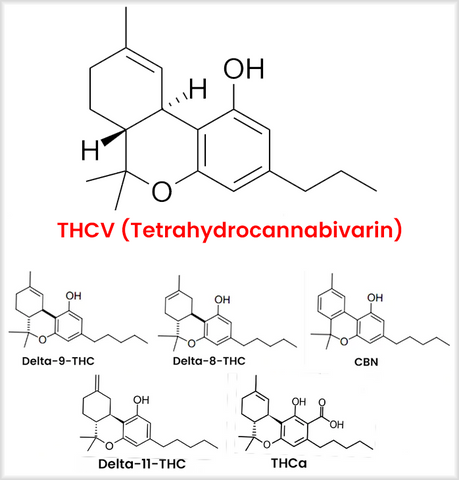
THCV’s create in the plant begins with the combination of geranyl pyrophosphate and divarinolic acid, two organic compounds that are part of the cannabis plant’s metabolic processes. This reaction forms cannabigerovarin acid (CBGVA), a compound that is structurally similar to cannabigerolic acid (CBGA), the precursor to THC and CBD. However, CBGVA has two fewer carbon atoms than CBGA, which contributes to the unique properties of the cannabinoids derived from it.
The next step in the biosynthesis of THCV involves the enzyme THCV synthase. This enzyme catalyses the conversion of CBGVA into tetrahydrocannabivarin carboxylic acid (THCVA). Enzymes are proteins that speed up chemical reactions in the body, and in this case, THCV synthase specifically facilitates the reaction that forms THCVA.
Finally, THCVA undergoes a process called decarboxylation to form THCV. Decarboxylation involves the removal of a carboxyl group from THCVA, which is facilitated by the application of heat or exposure to ultraviolet light. This process is common in the formation of many cannabinoids and is the reason why cannabis is often heated, such as in cooking or smoking, to activate its psychoactive and therapeutic effects.
In summary, the biosynthesis of THCV involves a unique pathway starting from CBGVA, facilitated by specific enzymes and processes, resulting in a minor cannabinoid with distinct properties. Despite its lower concentrations in the cannabis plant, ongoing research suggests that THCV may have significant therapeutic potential, making it a compound of interest in the field of cannabinoid science.
Effects of THCV
Tetrahydrocannabivarin (THCV) is a unique cannabinoid that has a distinct interaction with the body’s endocannabinoid system (ECS). The ECS has two primary receptors: CB1, which is predominantly found in the brain and central nervous system, and CB2, which is more commonly found in peripheral organs and cells associated with the immune system. THCV interacts with both of these receptors, but its effects vary depending on the dosage.
At lower doses, THCV acts as a CB1 antagonist. This means it binds to the CB1 receptors but blocks them, preventing other cannabinoids like THC (Tetrahydrocannabinol) from binding to these receptors. This blocking action can reduce the psychoactive effects typically associated with THC, leading to a less intense ‘high’. This property of THCV has led to interest in its potential use for conditions such as THC overconsumption and addiction.
Moreover, as a CB1 antagonist, THCV may also play a role in appetite control. Research has suggested that blocking CB1 receptors can suppress appetite and reduce food intake, making THCV a subject of interest for weight management and obesity-related research.
On the other hand, at higher doses, THCV acts as a CB1 agonist, similar to THC. An agonist is a substance that initiates a physiological response when combined with a receptor. In this case, THCV can activate the CB1 receptors, leading to psychoactive effects. Users have described these effects as uplifting, focused, and energetic, differentiating the THCV ‘high’ from the more relaxed state often associated with THC.
In addition to its interaction with CB1, THCV also binds to CB2 receptors, albeit with less affinity. This interaction is thought to contribute to its potential anti-inflammatory and pain-relieving properties, although more research is needed to fully understand these effects.
THCV’s unique dual role in the endocannabinoid system, acting as both an antagonist and agonist to CB1 receptors, makes it a particularly interesting cannabinoid. Its potential to both dampen psychoactive effects and produce them, along with its potential therapeutic properties, warrants further research into its potential medical applications.
Research on THCV
The therapeutic potential of THCV is an area of growing interest in cannabinoid research. Although the body of evidence is still developing, preliminary studies have indicated several potential health benefits associated with this minor cannabinoid.
One of the most promising areas of THCV research is its potential role in glycemic control. Some studies have suggested that THCV may help reduce blood sugar levels. This could be particularly beneficial for individuals with glucose intolerance, a condition often associated with obesity and type 2 diabetes. The mechanism by which THCV may influence blood sugar levels is not yet fully understood, but it is believed to involve the cannabinoid’s interaction with the endocannabinoid system, a complex cell-signalling system involved in maintaining bodily homeostasis.
In addition to its potential effects on blood sugar, THCV has also been studied for its potential appetite-suppressing properties. Unlike THC, which is known to stimulate appetite, early research suggests that THCV may have the opposite effect, potentially reducing hunger and promoting satiety. This property could make THCV a potential therapeutic option for weight management and obesity treatment.
However, it’s crucial to emphasize that much of the current understanding of THCV’s potential therapeutic benefits is based on animal studies. While these studies provide valuable insights, the effects observed in animals do not always translate directly to humans due to differences in physiology and metabolism. Therefore, more clinical trials involving human participants are needed to confirm these preliminary findings and to further explore the potential therapeutic applications of THCV.
Moreover, as with any potential therapeutic compound, the safety and efficacy of THCV must be thoroughly evaluated. Potential side effects, interactions with other medications, and optimal dosages are all factors that need to be considered in future research. As our understanding of THCV continues to evolve, it will be important to balance the enthusiasm for its potential benefits with a rigorous scientific approach to its study.
Conclusion
In conclusion, THCV is a fascinating compound with potential therapeutic benefits. However, much more research is needed to fully understand its effects and potential uses. As for its legal status in the UK, the law is not entirely clear, and it’s always best to consult with a legal expert if you’re unsure. As the cannabis landscape continues to evolve, it’s likely that we’ll see more clarity on these issues in the future.
