

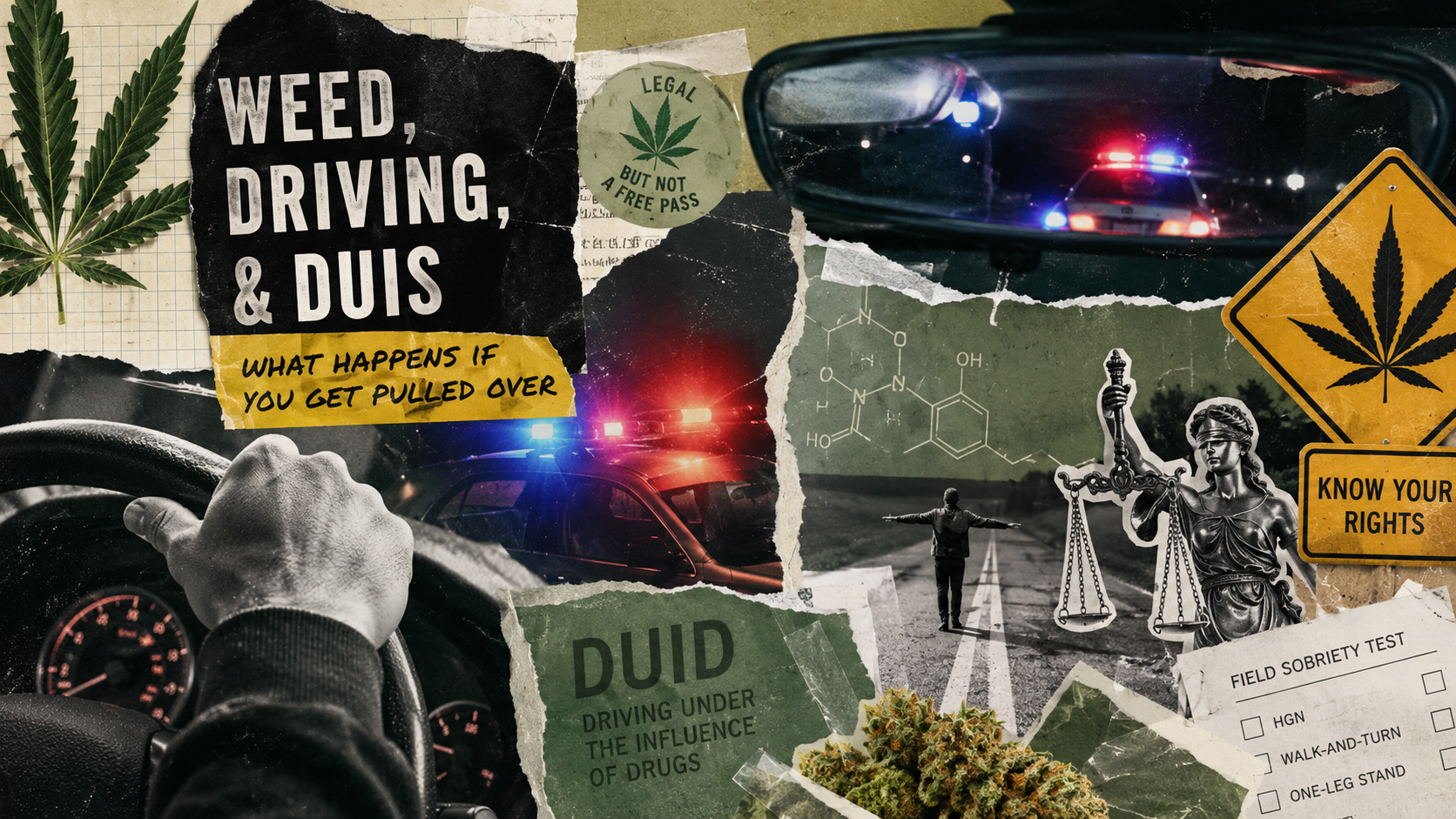
Driving under the influence of marijuana is illegal. Yet, with states having different criteria as to what constitutes driving under the influence of drugs (DUID), marijuana consumers need to be familiar with what “under the influence” really means. Unlike the nationally recognized standard for drunk driving (0.08% blood alcohol concentration, or BAC, in every state except Utah), there is no comparable nationwide standard for drug impairment. Additionally, limitations of drug-detecting technology and the fact that THC levels in the bloodstream vary depending on individual factors (such as metabolism and frequency of use) complicate the enforcement of DUID laws.
The majority of states, including California, Texas, Florida, and New York, have impairment-based DUID laws, which “require the driver to be under the influence of or affected by THC” (NCSL, 2024). This goes beyond the THC levels in the bloodstream and focuses on whether the driver is impaired. Several states, including Arizona, Pennsylvania, and Michigan, have zero-tolerance laws; the law “prohibits driving with any amount of THC and/or its metabolites in the body” (NCSL, 2024).
A small group of states, including Washington and Nevada,have specific per se laws, whereit is illegal to drive over the legal limit of detectable THC. These limits generally range from 2 to 5 nanograms per milliliter (ng/ml) of blood, and “once a person is shown to have reached or surpassed the legal limit, that person will be considered impaired by law” (NCSL, 2024). However, these limits are problematic as, depending on factors such as tolerance and metabolism, THC affects individuals differently. Colorado has a permissible inference law, meaning the jury, or a judge in a bench trial, is allowed to assume the driver was under the influence if the THC in their blood is at 5 ng/ml or above. However, unlike per se laws, drivers can raise affirmative defenses to show that, although they tested above the legal limit, they were not impaired.
THC Limits, Testing Methods, and Scientific Challenges
States vary in how they test for marijuana use. The most common methods for detecting THC or its metabolites involve blood, urine, or saliva testing. Alabama and Indiana have permanent or active oral fluid roadside testing programs; Michigan and Minnesota have begun piloting similar testing methods.
There is no scientific consensus as to the amount of marijuana consumption and subsequent THC blood level that indicates impairment for all consumers. Frequent marijuana users can test above the legal limit even if they are no longer intoxicated, due to a chronic build-up in the bloodstream.
A 2025 study from UC San Diego found that “heavy daily cannabis users performed normally after 48 hours of abstinence despite detectable THC in their blood” (Huss Law). A 2022 study showed that the impairment timeline contradicted current theories on prolonged cannabis impairment: “50% of regular users showed no significant impairment even during peak periods” (Huss Law). Even the National Institute of Justice has reported that “although THC has been proven to affect areas of the brain that control movement, balance, coordination, memory, and judgment – skills required for safe driving – THC levels in biofluids were not reliable indicators of marijuana intoxication” (National Institute of Justice, 2021).
What Happens During a Cannabis DUI Stop
So, what does being stopped by police for suspected DUID look like? If an officer pulls someone over for driving conduct that suggests intoxication or for violating traffic laws, they will speak with the driver and may suspect the driver has smoked marijuana. To form this opinion, officers may rely on “objective evidence such as the smell of marijuana, physical symptoms of marijuana intoxication, or the driver’s own admission to recent marijuana use” (Kraut Law Group).
To assist with the investigation, the officer may call in a Drug Recognition Expert (DRE), who specializes in recognizing the signs of drug intoxication. The DRE will administer field sobriety tests (FSTs) to determine whether to arrest the driver for a DUI. FSTs were originally developed and validated primarily for alcohol impairment, yet studies have shown that FSTs are “not effective in detecting marijuana intoxication” (National Institute of Justice, 2021). A landmark study in 2023 from UC San Diego indicated that “nearly half of completely sober drivers fail marijuana DUI field sobriety tests… trained law enforcement officers marked 49.2% of sober participants as ‘impaired’ despite consuming only placebo cannabis cigarettes” (Huss Law).
Why Field Sobriety Tests Don’t Work Well for Cannabis
There are fundamental design flaws in field sobriety tests as applied to cannabis detection. One part of the test, Horizontal Gaze Nystagmus (HGN), involves officers detecting eye-jerk reactions that are characteristic of alcohol use. However, “Cannabis rarely produces these same eye movement patterns, making HGN testing largely irrelevant for marijuana impairment” (Huss Law).
The balance and coordination components of FSTs, such as the walk-and-turn and one-leg stand tests, also raise reliability issues because many factors unrelated to cannabis impairment can influence people’s ability to pass them, such as stress, road surface conditions, weather, and health. The overarching conclusion is that “While alcohol-focused FSTs achieve approximately 88% accuracy for alcohol detection, the same tests demonstrate only 30% accuracy for cannabis impairment” (Huss Law).
Your Rights During a DUI Stop
It is essential to know your rights, including the right to refuse FSTs. The Fourth and Fifth Amendments of the Constitution protect against unreasonable searches and self-incrimination, respectively. FSTs are voluntary and designed for officers to gather evidence, and there are no automatic legal penalties for refusing them. For illustrative purposes only, a person might choose to say something along the lines of: “Officer, I respectfully exercise my constitutional right to remain silent and decline field sobriety tests. I do not consent to any searches. Am I free to leave, or am I being detained? If detained, I request to speak with an attorney immediately.” (This is a generalized example and not legal advice; laws and outcomes vary by jurisdiction and situation.)
However, it is crucial not to confuse FSTs with chemical tests. If arrested, the police will then ask the driver to submit to chemical testing. Most states have implied consent laws. If a driver refuses to complete a chemical test, it violates the implied consent arrangement: “almost every state imposes a mandatory driver’s license suspension on the driver” (Justia, 2025).
Since blood test results are not immediate, they are often not presented to the driver until the initial discovery packet at the defendant’s arraignment. Additionally, after arrest, DRE agents will use a standardized 12-step examination to identify the drugs impacting the driver. However, the accuracy of this process has proven inadequate. The overall accuracy of DRE evaluations is only 87.3% for cannabis, versus 94% for narcotics and 92.6% for stimulants. This makes cannabis “the weakest drug category for DRE evaluations, with nearly 22% of actually impaired cannabis users escaping detection” (Huss Law).
The Bottom Line
Although laws vary across states concerning what constitutes impairment for driving under the influence of marijuana, the evidence is clear: the current methods of detecting marijuana impairment are flawed and inaccurate. The important thing for cannabis consumers to know is that they have the constitutional right to refuse FSTs, and frequent or heavy users should be aware that they may test above certain THC limits even when they are no longer impaired.
Legal disclaimer: This article is for informational and educational purposes only and does not constitute legal advice. Laws and enforcement practices vary by jurisdiction, and the information presented may not reflect the most current developments.
Any examples provided—including statements a person might make during a police encounter—are illustrative only and do not guarantee any specific outcome.
Readers should not rely on this content as a substitute for professional legal counsel. For advice regarding your specific situation, consult a licensed attorney.
Sources:
