

Notes from the road, and where pre-rolls are taking us
Before you light up, think about what you reach for when you want a joint. A fat cone, a slim dog walker, an infused rocket, a glass tip blunt, a spliff cut with tobacco, a hand roll in thin paper that burns like a ribbon. None of those choices is random. They reflect culture, economics, legality, habit, and taste—compressed into something you can hold between two fingers.
Over the past eight years, working across the global cannabis supply chain, and the last six focused on pre-roll production, I started to notice something: the joint isn’t just a preference anymore. It’s a signal of where the market is going.
This is a story about that shift—how the joint is moving from ritual to product, and what that says about the future of cannabis.
Part One: When the Joint Was a Ritual
Not too long ago, a joint was craft. It was something you made, not something you bought. The value wasn’t just the flower, it was the moment around it. Someone always had papers. Someone always had a grinder. Someone always claimed they rolled the best. You could tell a lot about a person by how they rolled, and you could tell a lot about a group by how they passed it.
As an example, in my culture, if you roll it, you don’t light it, but you are always second to puff. This small gesture has a big social impact in a circle.
There’s a reason smoking persists even when healthier formats exist. It’s tactile. It’s social choreography. It has rhythm: the spark, the first pull, the glance to handoff. Even people who love vapes and edibles usually still understand this and crave it, because a joint is not only about consumption. It’s a culturally shared language.
I’ve always loved smoking, pretty much anything. From the age of 13, I’ve smoked boxed cigarettes, and when Israel raised taxes in the early 2000s, like most people around me, I switched to rolling tobacco. People will tell you they prefer it, and most do, but it began as an economic switch. The ritual adapted to the price.
What the Market Made Us Smoke
In the 90s and early 2000s, what we had in Israel was mostly “Hamsa” hash—low-quality traditional hash smuggled in from neighboring borders. To roll it, you had to heat it up and mix it with tobacco just to make it workable. Flower, when you could find it, cost $30 to $40 a gram and was hard to score. Those two realities shaped a generation of smokers, and you still feel it today; most people in Israel are used to rolling spliffs.
While working on this article, I asked smokers why they still prefer spliffs. The most common answer was that a pure joint “doesn’t burn well.” It’s one of those local misconceptions that sticks around long after the conditions that created it have changed.
That’s part of why I pay attention to joints as a format. A joint is where the practical and the cultural meet. It’s where a market’s constraints show up in plain sight. If cannabis is cheaper, joints get bigger and are full of surprises. If it’s stigmatized, they’re rolled fast and smoked quicker. If tobacco is normal, cannabis blends into it. If convenience wins, the hand roll starts disappearing.

When Pre-Rolls Meant Scraps
Not long ago, a pre-roll carried a bad reputation. In most markets, it was where the shake and trim leftovers, usually a mix of whatever didn’t make the cut for proper flower sales. Experienced consumers knew this, and many avoided pre-rolls entirely for that reason. If your dealer tossed a pre-roll into the bag as a freebie, you understood the logic immediately. It was a nice gesture, but also a convenient way to move the scraps. In many parts of the world, that’s still exactly how the format is treated. The pre-roll is a byproduct, not the main event.
One moment that stuck with me happened in 2019 at my first MJBizCon in Las Vegas. Late at night, under the replica Eiffel Tower, I stood with a small circle of international cannabis business people, swapping stories. One of them was a flower broker from California, at his peak, reached into his pocket and pulled out a pre-roll unlike anything I had seen before.
It was a diamond-infused, kief-coated pre-roll, sparkling under the lights like something between a cigar and a science experiment. At the time, that joint was pure craft. Someone had taken the traditional format and pushed it to an extreme. It was novel, rare, and clearly expensive. The kind of thing you passed around slowly because nobody wanted to waste it. Today, joints like that roll off automated production lines by the thousands.
That shift—from novelty to infrastructure—is a big part of the story.


Part Two: When Convenience and Consistency Became the Main Event
Five years forward, in December 2024, the same place: Las Vegas felt like the center of the cannabis business universe. I was presenting an automated pre-roll machine at MJBizCon, and I’ve been around enough conferences to know when there’s a trend shift. That week, my calendar was packed, and conversations turned into deals.
What stayed with me most was how clearly one category had taken over the conversation. Pre-rolls were no longer a side product or an afterthought. They had become a shorthand for market maturity, and for what the customer now expects.
The North American pre-roll game had leveled up fast. Better flower is going into cones. Better filters. Better packaging. Better hardware. Better processes. The conversations weren’t about whether pre-rolls would matter, they were about how to make them burn evenly, taste clean, and stay consistent at scale. Once a market gets used to a truly good pre-roll, the baseline changes. People stop accepting harsh, dry, canoeing sticks and start trusting the brands for consistent quality.
In 2025, I shifted my focus toward Europe and beyond. I spent the year moving through markets, visiting coffeeshops, clubs, processing facilities, breeders, and the people building systems behind the scenes. I wasn’t hunting for novelty. I was looking for patterns. The joint was my thread. What’s allowed? Who has access? What’s tolerated? What’s valued? What’s hidden? And what’s industrialized?
Spain: Where the Joint Stays Social
Spain became my home base, and it taught me quickly that clarity isn’t really the point here. There is a medical system, but it’s tight and limited. There is also a legal cultivation economy tied to export and pharmaceutical channels. And then there’s the part everyone talks about quietly, the private cannabis clubs.
The clubs are everywhere and nowhere at the same time. You don’t see billboards. You don’t see neon signs. You hear about them through people. They operate as private associations and sit in a legal gray zone that can vary by neighborhood, local authorities, and the moment.
Inside, the energy isn’t retail. My first real understanding of Spain didn’t come from reading laws. It came from sitting in these spaces and watching the rhythm. People arrived as if it were a living room. Someone rolled. Someone made tea. Someone opened a laptop. It felt like a community with an entrance fee and a set of unspoken rules.
On the production side, Spain can feel like the opposite of a standardized market. Cultivation often lives in micro circles, and quality travels through trust rather than branding. Traditional quality hash is deeply embedded in the culture, and the best of it is treated as a craft, refined and advanced by people who care about the details. Pre-rolls exist, but they’re rarely factory-perfect, and most of the time they’re made inside the clubs with some type of hash mix by hand.
I kept ending up at N7A, the club that became my home base. The offerings change constantly—small, but alive. Every Sunday, there’s a ritual that says more about Spain than any official explanation ever could: Teacher Sunday’s Joint. A heavy 1.1 to 1.4 gram roll, built around whatever wax or crumble is moving that week.
It’s made by Teacher—Carroll Bellari, an elementary school teacher for 17 years in Caracas, Venezuela, who has now lived in Madrid for 16 years and worked at the “House,” as she calls the club, for the past five.
“The joints are only for great people,” she says with a wink. “When I make joints, I sit somewhere around the house like I’m making arepas, weed and wax is just like amasado, water and cornflower, and I talk to people always as I do it… With the leftovers, the last joint is always a gift!” She explained. This isn’t a marketing move, but a communal moment.


The Netherlands: Where the Spliff Shapes the Supply Chain
I visited the Netherlands twice in 2025, and it felt like walking between two realities forced to share the same street. On one side are coffeeshops that helped shape modern cannabis culture decades ago. On the other is a government experiment attempting to turn a tolerated system into a regulated supply chain.
The Dutch paradox is famous for a reason. Coffeeshops can sell cannabis under strict tolerance rules, while cultivation and wholesale supply remain illegal. Sales happen at the front door. The supply comes through a back door that, legally speaking, doesn’t exist. Everyone knows it. Everyone lives with it. And for a long time, the system survived precisely because nobody pushed too hard on that contradiction.
That’s what the Controlled Cannabis Supply Chain Experiment is trying to fix. Since it began, it has already run into friction that comes with replacing an entire supply chain in real time. Shortages. Limited product diversity. Complaints from facility neighbors. Other challenges I haven’t seen firsthand. None of it is shocking. Building a new chain to replace one that has operated informally for decades was never going to be smooth.
If the experiment works, it won’t just normalize legal cultivation. It will introduce real transparency into production, and clearer genetic sources behind what people are buying, at a scale the Dutch market has never really had. Whether that happens depends less on policy language and more on whether the legal system can meet consumers where they already are.
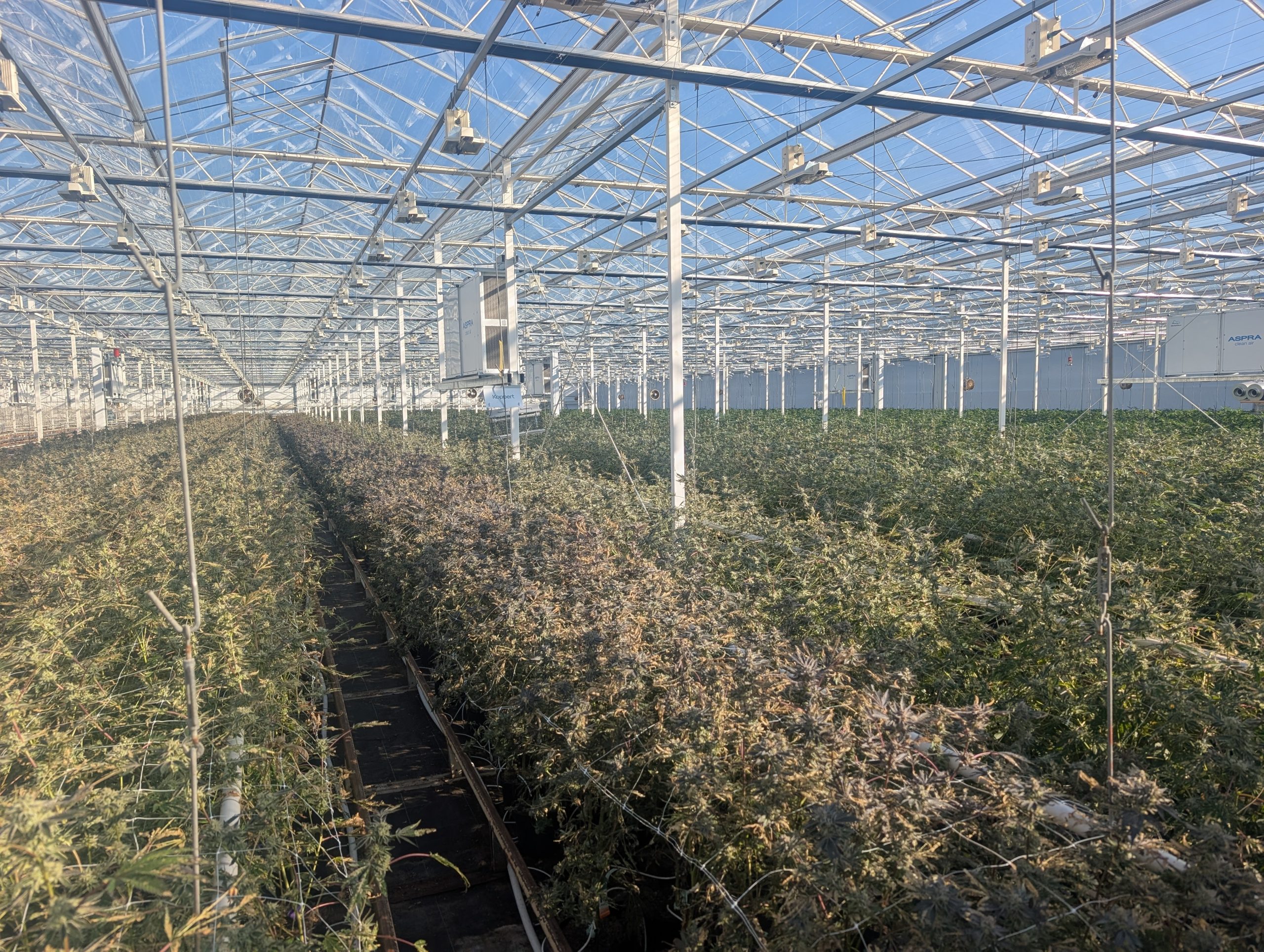
On my first visit, I toured CanAdelaar, one of the licensed producers participating in the experiment. What struck me wasn’t branding or hype, but sheer build. Big Dutch glasshouses, automation everywhere, and a focus on producing consistently at volume, because this pilot is meant to serve real demand.
That demand looks different here. In the Netherlands, spliffs are still the main seller. Clean, consistent one to one and a half gram rolls built around a culture that has always mixed cannabis with tobacco. The dryness of tobacco compared to flower makes that blend particularly suited for automated production, a small cultural detail that ends up shaping how industrial cannabis gets made. Even in professional circles, I was surprised by how many people still preferred spliffs over pure joints.
Later, we visited coffee shops set to participate in the experiment before the rollout fully kicked in. Some had already begun placing future legal brands directly on their menus. In a few cases, products were clearly marked as experiment-grown, sitting alongside traditionally sourced flower. Customers could see the difference in real time, a live test unfolding menu by menu.
Walking out of those shops, what became obvious is something the industry often forgets. Consumption habits are not a detail. They shape everything upstream. In the Netherlands, producers aren’t inventing behavior. They’re being asked to adapt to behavior that already exists.


Part Three: When the Joint Becomes Infrastructure
If you step back, the direction is hard to ignore. The joint is moving from ritual to retail, and then from retail to infrastructure. In more markets, more people will buy cannabis the way they buy everything else, ready to go, consistent, sealed, branded, and easy to use.
That doesn’t mean the joint loses its soul. It means the market will fight over what the joint is allowed to be.
In the future, the battleground won’t just be THC percentage or strain names. It will be burn quality, freshness, and trust. Packaging will matter more than most people want to admit, because pre-rolls are fragile. They dry out. They get crushed. Terpenes vanish if the seal is weak. Once cannabis is ground, its surface area increases dramatically, exposing more of the material to oxygen and accelerating terpene evaporation and cannabinoid degradation. The food industry solved staling with airtight barriers and oxygen control. Cannabis will borrow those lessons, not because it’s trendy, but because the joint is becoming a product that needs to survive a supply chain.
The other battleground is authenticity. Pre-rolls can be a premium craft format or the place where a market hides its leftovers. The path a market chooses reveals what it respects. It will tell you whether it’s building for consumers or building for margins.
And then there’s the tension that actually matters. Are we losing something when the joint gets industrialized? Maybe. Rolling is a skill, and like any skill, it fades when convenience takes over. The smoke circle can turn into a solo purchase. The ritual can become a transaction.
But there’s another way to read it. The joint has always been the most social format, and pre-rolls are often the easiest way for more people to participate. They lower friction. They remove the need for gear. They make sharing easier. They can also raise the standard, because once people get used to a joint that burns perfectly, there’s no going back.
What I’ve seen across markets is not one future. It’s multiple futures competing at once. Spain protecting the room. The Netherlands trying to close a loop without breaking the culture. North America turning quality into a baseline and pushing the format into mass adoption. Different systems, different histories, but the same status.
The Industrial Revolution of the Joint is here.
Photos courtesy of Ophir Nevo
This article is from an external, unpaid contributor. It does not represent High Times’ reporting and has not been edited for content or accuracy.
