

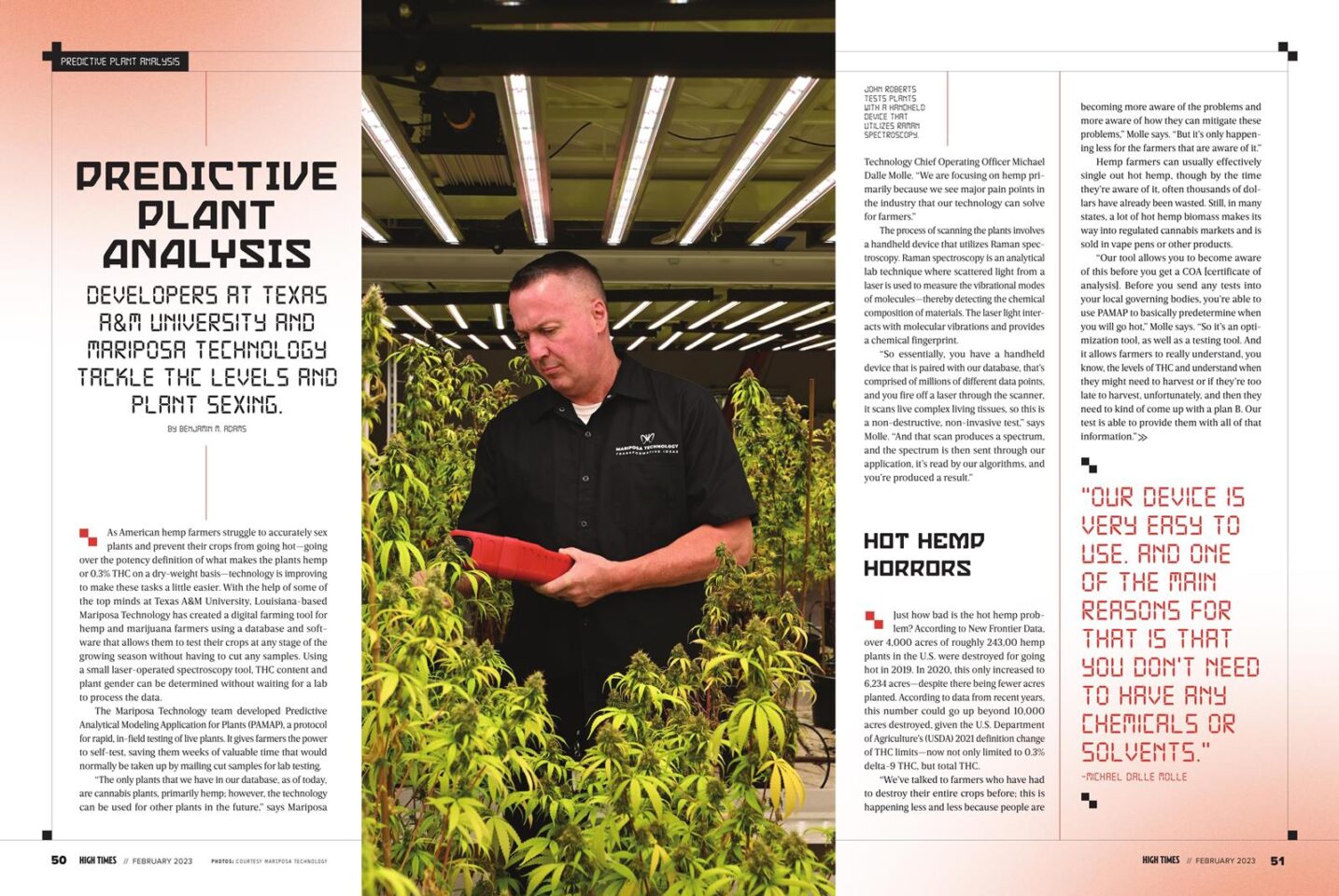
As American hemp farmers struggle to accurately sex plants and prevent their crops from going hot—going over the potency definition of what makes the plants hemp or 0.3% THC on a dry-weight basis—technology is improving to make these tasks a little easier. With the help of some of the top minds at Texas A&M University, Louisiana-based Mariposa Technology has created a digital farming tool for hemp and marijuana farmers using a database and software that allows them to test their crops at any stage of the growing season without having to cut any samples. Using a small laser-operated spectroscopy tool, THC content and plant gender can be determined without waiting for a lab to process the data.
The Mariposa Technology team developed Predictive Analytical Modeling Application for Plants (PAMAP), a protocol for rapid, in-field testing of live plants. It gives farmers the power to self-test, saving them weeks of valuable time that would normally be taken up by mailing cut samples for lab testing.
“The only plants that we have in our database, as of today, are cannabis plants, primarily hemp; however, the technology can be used for other plants in the future,” says Mariposa Technology Chief Operating Officer Michael Dalle Molle. “We are focusing on hemp primarily because we see major pain points in the industry that our technology can solve for farmers.”
The process of scanning the plants involves a handheld device that utilizes Raman spectroscopy. Raman spectroscopy is an analytical lab technique where scattered light from a laser is used to measure the vibrational modes of molecules—thereby detecting the chemical composition of materials. The laser light interacts with molecular vibrations and provides a chemical fingerprint.
“So essentially, you have a handheld device that is paired with our database, that’s comprised of millions of different data points, and you fire off a laser through the scanner, it scans live complex living tissues, so this is a non-destructive, non-invasive test,” says Molle. “And that scan produces a spectrum, and the spectrum is then sent through our application, it’s read by our algorithms, and you’re produced a result.”

Hot Hemp Horrors
Just how bad is the hot hemp problem? According to New Frontier Data, over 4,000 acres of roughly 243,00 hemp plants in the U.S. were destroyed for going hot in 2019. In 2020, this only increased to 6,234 acres—despite there being fewer acres planted. According to data from recent years, this number could go up beyond 10,000 acres destroyed, given the U.S. Department of Agriculture’s (USDA) 2021 definition change of THC limits—now not only limited to 0.3% delta-9 THC, but total THC.
“We’ve talked to farmers who have had to destroy their entire crops before; this is happening less and less because people are becoming more aware of the problems and more aware of how they can mitigate these problems,” Molle says. “But it’s only happening less for the farmers that are aware of it.”
Hemp farmers can usually effectively single out hot hemp, though by the time they’re aware of it, often thousands of dollars have already been wasted. Still, in many states, a lot of hot hemp biomass makes its way into regulated cannabis markets and is sold in vape pens or other products.
“Our tool allows you to become aware of this before you get a COA [certificate of analysis]. Before you send any tests into your local governing bodies, you’re able to use PAMAP to basically predetermine when you will go hot,” Molle says. “So it’s an optimization tool, as well as a testing tool. And it allows farmers to really understand, you know, the levels of THC and understand when they might need to harvest or if they’re too late to harvest, unfortunately, and then they need to kind of come up with a plan B. Our test is able to provide them with all of that information.”
Sexing Plants
In Volume 27, Issue 15 of the peer-reviewed journal Molecules, released in August 2022, Mariposa Technology co-founder and President John K. Roberts III and Molle joined five other co-authors—Nicolas K. Goff, James F. Guenther, Mickal Adler, Greg Mathews, and Dmitry Kurouski—to publish their study of using Raman spectroscopy to sex plants. The journal article demonstrated how they can determine hermaphrodite, male, and female hemp plants based on the detection of different amounts of carotenoids. Carotenoids, or tetraterpenoids, are yellow, orange, and red fat-soluble pigments found in certain plant varieties including cannabis.
The concentration of carotenoids is the greatest in female cannabis, and hermaphrodites demonstrate the lowest carotenoid content, with males in the middle. Specifically, the intensities of carotenoid vibrations detected via spectroscopy were much more intense in female plants than male plants and less intense in hermaphrodites.
“We believe that it’s the carotenoids in the plant,” Roberts says, explaining how they can tell the difference between males, females, and hermaphrodites. “But we haven’t determined it. We have proven that we can successfully do it 100% of the time from male and female plants and 98.7% of the time for monecious [hermaphrodite] plants. But the actual reason that we’re able to determine it is still somewhat of an open scientific question.”
Gender is controversial in the hemp plant world, leading to efforts to ban male hemp plants. In Oregon, Corvallis-based Oregon CBD has fought the state legislature to ban male hemp plants since 2014. The company said wind-blown pollen from a neighboring farm ruined its crops, amounting to an estimated $2.5 million in damages.
Cross-pollination from rogue males creates problems. It’s bad for hemp producers and processors focused on CBD and other non-psychoactive cannabinoids because a pollinated hemp crop loses up to half of its biomass and around 30% of its total cannabinoid content. For farmers focused only on fiber, it’s not as much of a big deal. If plant gender could be determined earlier, some of the damage might be mitigated.

What is Raman Spectroscopy?
Dmitry Kurouski, professor of biochemistry and biophysics at Texas A&M, specializes in Raman spectroscopy technology, using it for everything from identifying components of cannabis to crime scene analysis. For example, Kurouski demonstrated in a study that Raman spectroscopy could determine if a crime scene hair was dyed or natural hair color, something that’s always been a bit of a challenge for law enforcement.
Like with human hairs, Raman spectroscopy can also be used to determine components of cannabis. The laser excites molecules, causing them to vibrate differently from one another and produce different spectra in the readouts.
“A laser is fired, and it only has a millimeter-wide focal point,” Molle says. “So you’re firing a laser into a very concentrated area, and it creates excitation within the photons and the electrons. You then get a vibration that is picked up by the device and reader within the device. So the laser creates excitation, the device picks up that excitation and creates a spectrum based on the vibrations of those molecules. And that’s the reason why it’s such a precise instrument.”
The motivations behind technology in the world of cannabis go beyond just saving time and money. Hot hemp—especially in states with high altitudes susceptible to higher UV light, which is a trigger for THC production—is an ongoing problem.
Roberts explained that the piece of hardware that does the scanning has existed for about 10 years and is manufactured by Agilent Technologies, though until now, it hasn’t been used for cannabis. Agilent Technologies focuses primarily on ways to improve the overall laboratory workflow. The company was formed as a spin-off of Hewlett-Packard in 1999.
The same tools used previously for crime scene analysis turned out to be ideal for determining characteristics in cannabis as well.
“What happened was Professor Kurouski at Texas A&M, our collaborator and partner in this, discovered that this particular device, which is used for chemical identifications in a wide range of scenarios, had just the right laser, nanometer, and the power of the handheld device that eliminated background scattering from the spectra on live agricultural products,” Roberts explains.
The handheld scanning device is one thing, but it’s essentially worthless if you don’t have the correct data to compare readouts. Mariposa Technology plans to soon offer the handheld detection device via a subscription service following a software update.
“The hardware itself produces a numerical representation of what it’s scanning organic compounds and spectra that you can look at, but it tells you nothing unless you have a data set and a library available to refer and compare that,” Roberts says.
Beyond expediting the cannabis testing process, this technology can further revolutionize the cannabis testing industry by reducing its impact on the environment, given the new shortcuts around materials such as chemicals and solvents used by labs. It’s also a fix that can reduce transportation and other costs.
“What we’re doing is trying very hard to also reduce the carbon footprint of the cannabis testing industry at large,” Molle says. “Our device is very easy to use. And one of the main reasons for that is that you don’t need to have any chemicals or solvents. You don’t need gloves. There’s much less waste involved. There’s no transportation of samples, you know, with a licensed handler, none of that exists with us. So on top of all of the other things that we’re doing, we’re also hoping that we can make the cannabis industry just greener and more eco-friendly at large.”
This article was originally published in the February 2023 issue of High Times Magazine.
