

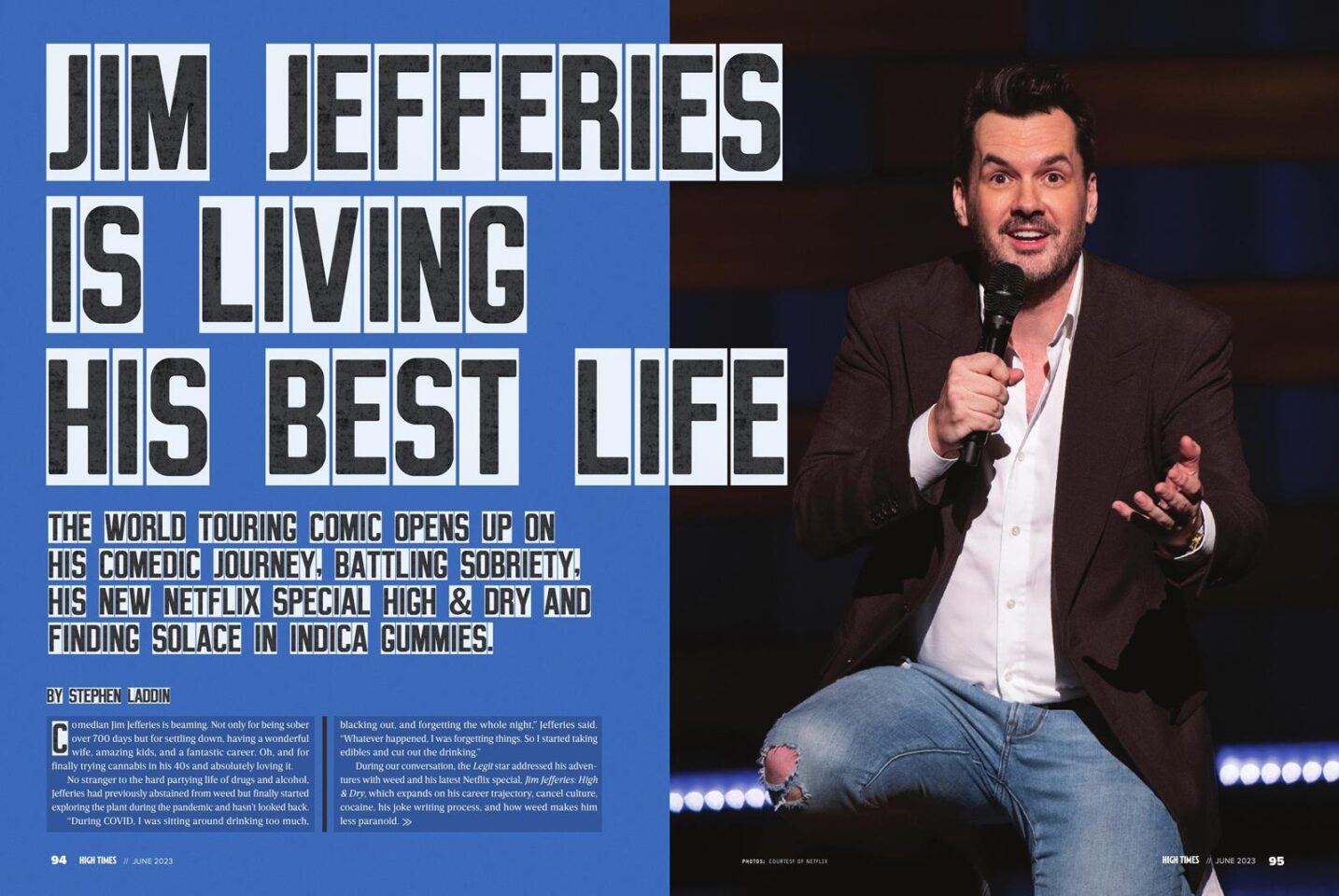
Comedian Jim Jefferies is beaming. Not only for being sober over 700 days but for settling down, having a wonderful wife, amazing kids, and a fantastic career. Oh, and for finally trying cannabis in his 40s and absolutely loving it.
No stranger to the hard partying life of drugs and alcohol, Jefferies had previously abstained from weed but finally started exploring the plant during the pandemic and hasn’t looked back.
“During COVID, I was sitting around drinking too much, blacking out, and forgetting the whole night,” Jefferies said. “Whatever happened, I was forgetting things. So I started taking edibles and cut out the drinking.”
During our conversation, the Legit star addressed his adventures with weed and his latest Netflix special, Jim Jefferies: High & Dry, which expands on his career trajectory, cancel culture, cocaine, his joke writing process, and how weed makes him less paranoid.

High Times Magazine: Growing up in Australia, did you always know you wanted to pursue comedy?
Jim Jefferies: I wanted to pursue stand-up comedy from the time I was 13 but didn’t tell my parents or anyone else out of fear I’d be told I wasn’t funny. I ended up pursuing musical theater at university because I knew I wanted to be an entertainer, and I thought as long as I could get into the arts maybe I could do stand-up later.
I did some open mic spots when I was 17 that didn’t work out very well, so I didn’t do it again until I was about 20 or 21. Now it’s been my full-time job for the past 24 years.
When were you able to finally share with your parents that you wanted to be a comic?
It came out of necessity. I was studying at the Western Australian Academy of Performing Arts—WAAPA—on a full ride scholarship and ended up getting nodules on my vocal cords and had to have surgery. While the recovery time now is about four days where you can’t talk, back then you couldn’t talk for about a month. I just decided, “Fuck this, these [vocal cords] will come back; I should stop being so gutless and just do the thing I actually want to do.” When I could talk again after the surgery, I went head-on into stand-up comedy and sort of forgot about the rest.
I don’t think anyone in my family or anyone really thought I’d be successful. I think they thought that I could have a job doing it, but you have to remember that in the late ’90s/early 2000s, there were two comedy clubs in Australia, so it wasn’t even an occupation. It wasn’t a matter of “if I could do it,” it wasn’t an actual job [at the time there]. We didn’t get HBO specials or anything like that. We had four TV channels and the only specials we had were Eddie Murphy: Delirious and Eddie Murphy Raw because they were cinematic releases and you could get them on video. Apart from that, I only really got to see stand-up comedy in five-minute bursts on late night shows in Australia when some comic was visiting. It was a dark time, man [laughs].
What helped you discover your own style and point of view?
I think the best motivation for anyone who wants to get into comedy is to see some people who are bad at it. I saw some people who were bad at it and I remember thinking, “I can do better than that.” If everyone I saw was awesome it would have seemed so unattainable, but it was the people who were doing it and getting paid who weren’t that good [that gave me confidence]. Not all of them, but the occasional act and you can still see them to this day. I was like, “I can definitely do better than that bloke.”
When I was studying musical theater, they always gave me the funny roles, so I was assured that I was funny, but I didn’t know if I could put together material and that type of stuff. But [everything that happened] just felt like it happened organically. I went up at one club, then I did it again and I did it again. I moved to England and I bullshitted my way into some clubs and I’ve just been doing it ever since.
I also found my social group. Before that, I was working as a bartender, a waiter, selling mobile phones—and then all of a sudden I found people who I felt a lot more similar to than I had before. I’m not going to give you a wanky answer like, “I never really fit in,” or anything stupid like that—because I fit in fine. Going to the Edinburgh Comedy Festival [for example], I remember being around all of these like-minded people and it was a real sort of eye-opener for me. My career is a product of the Edinburgh festival.
People will do things more through social media now—put up clips and try to get their five minutes on late night shows and that type of stuff. But when I was starting out in Britain, if you were an act that went to Edinburgh, you were a career act and you were really giving it a go. If you were a guy who would just hang around the clubs, you were just doing it to earn a bit of cash. But if you wanted to make a career out of it, you had to go to Edinburgh. Edinburgh was a place where all of the media came and saw you. You weren’t doing 15 or 20 minutes at a club, you had to do an hour. People were coming just to see you.
In America, you had a lot of comics who—in the early 2000s—were trying to get their five minutes so tight so they could get on Letterman. I was trying to make my 10 minutes so long that it could be an hour, and so that’s why I have this meandering, storytelling vibe to me because I had to work in the longform a lot more.
Which sounds like the opposite of what other comics were striving to do.
I think that’s why when I came to America, I stood out a little bit. I had a 30-minute story about muscular dystrophy and taking a friend to a brothel. People didn’t really do that back then. Now, with everyone trying to get specials, my style seems a little more commonplace these days.
I never thought I’d get any television or anything like that. I thought I’d become a little cult act at best. Now, I’m hosting a game show in Australia, so it’s all sort of turned around—things that I thought I’d never do.
My career was never an overnight success, it was a real gradual build. The people who just discover you always think it’s an overnight thing where you came from, but I was getting there one step at a time—just building, building, building. I think it was a more organic way to build an audience than today with the internet and I don’t know if the way my career happened could happen today.

Because of the way the comedy industry has changed?
Yeah, I wasn’t a good self-promoter or proactive in that way. I just thought, if I kept going up and crushing, more people would see me and more people would see me. All that mattered was how good I was on stage.
It was also a different era. There weren’t camera phones and stuff like that so you could be a bit of a—well, I was a drunk. So I’m drunk up there, I’m on cocaine, I’m acting like a fool. But everyone around me was sort of doing the same thing. It felt very normal. It felt like we were more like rock acts than anything else.
Now, you sort of get done for that. People would videotape it and you’d have to apologize or something.
So in many ways, you’re saying the career trajectory that you’ve had was a product of the times.
Yeah and strangely I was also a product of the internet in the sense that I got punched in the head and people noticed that. Then the gun control thing went viral, but I never put any clips up. I don’t even know how to load a clip to YouTube, but the internet did help me in the end. I’m not saying one’s better or one’s worse, I’m saying the environment that I grew up in was a much different environment than what comedy is now.
Everyone talks about backstage at The Comedy Store and they go, “There used to be drugs everywhere.” I heard it was painted black so when people dropped their cocaine they could find it. That’s not the culture anymore. The culture’s completely different. You’d be seen as sort of an outlier if you acted like that now.
I’m glad those days are over. I couldn’t have sustained them forever and now I’m in a much happier place. I wish I’d sort of got to where I am now in my life a lot sooner.
Was there a defining moment or set of experiences where you felt stand-up was the thing you were going to do for the rest of your life?
Probably when I first got into the London Comedy Store. It was such a coveted place to get into, was the hardest club to get into and I was still only maybe 22. I’d only been doing comedy for about a year and I got in there and I remember having the pressure of having to do this gig and all of the other comics were so well established and I just held my own. I didn’t look out of place, and I remember thinking, “I can actually do this now.”
There’s moments though where I thought I’d made it, like playing Carnegie Hall. When I played Carnegie Hall—and that was a decade ago—I remember thinking, “If it all just ends now, I can always say to somebody that I did Carnegie Hall.” But that wasn’t as important a moment for me as getting into the London Comedy Store.
In terms of where you are now, you’ve just released your latest Netflix special High & Dry, in which you talk pretty extensively about finding weed.
I never took weed in any form until my 40s and I always thought stoners were a bit of an odd group of people. I never liked smoking a joint and I still don’t like smoking a joint—I find it hard on the throat—but then edibles came into my life during COVID.
During COVID, I was sitting around drinking too much, blacking out and forgetting the whole night. Whatever happened, I was forgetting things. So I started taking edibles and cut out the drinking.
I haven’t had a drink in 700 days now but I’ve tried to give up alcohol three other times: Once for a year and two other times I went three months. There were also periods in my life where I had alcohol under control and I was drinking like a responsible person, but it always got away from me. When it got away from me, my behavior wasn’t good and my relationships with other people would disintegrate. But ever since weed came in, I’m a happier person. It really did change my life.
How does weed impact you now and what do you use it for?
Well I don’t do it every day—only about three days a week—and it helps me not be miserable.
It actually helps me with paranoia. Other people go the other way, but with me it seems to settle that down a lot, and it got me off antidepressants. I was on antidepressants on-and-off for a year—went back on them during quarantine—then got off them and just took weed and I haven’t gone back since.
I’ve got two young kids and it sure helps with watching Pixar movies. I used to have to muscle through those but now I’m like, “Go ahead, throw it on. Let’s watch [Finding] Nemo again.”

The colors and the plotlines become a lot more enticing.
Jim Jefferies: [Laughs] And you start seeing subplots. I get right into it.
Creatively, does weed aid your process?
I don’t go on stage high but I’ll take an edible after I get off stage and chill out. I do write a lot of jokes while high though, and then the next day I’ll look at them and go, “Well that’s not that funny.” But at least they make sense.
When I was drunk, I used to write some jokes down and they didn’t even make sense to me. I couldn’t even read the handwriting. Every now and again I’ll write a joke while high and read it back and go, “There’s something in it,” but most of my jokes—if based on something silly that happened—I’ll come up with them the day afterwards. I’m not going to say that weed helps my writing or that it helps my performing, but I don’t believe it hinders it in any way.
I will say this about alcohol—I had the best shows of my career while drunk. The best ones I ever did. But I also had the very worst ones I ever did—the ones that I’m ashamed of in that category. While sober, I’ve had excellent shows and some bad shows, but I’ve never had any fucking terrible ones. The problem with alcohol is that things fly out of your mouth very quickly and that’s good in comedy if they’re the right words. If they’re the wrong words, fucking hell.
You mentioned you may not come up with bits while high, but that an idea or seed of an idea will resonate the next day. How so?
A lot of the ideas are formulated [while high] and then the writing happens the next day. The only drug that can help you come up with real batshit crazy jokes is mushrooms. Batshit crazy jokes. When you write jokes on cocaine, you think everything is brilliant. When you write jokes on mushrooms, you think everything is on this higher level and that you’re thinking on a different plane from everyone else. When you write jokes on weed, everything’s silly, and silly’s not always that great.
Do you have a preference when it comes to strains?
I like to relax on indicas and end the day with them. I’m not a “wake up and take it” type of guy—if it’s on holiday, sure—and I don’t take a lot, only 20 milligrams.
For some, 20 milligrams is a solid amount.
Well I started at 10 and now I’ve moved on to 20, but I’ve done that stupid thing where you’re like, “I wonder what 50 feels like?” And then I’m like, “No, no—don’t do that again.” [Laughs] That’s too much for me. I’ve done that a couple of times where I’ve gone all in and then gone, “No, no. Too much for me.” I never go more than 30, and that’s if I’m looking to have a real good time.
Creatively, what inspired High & Dry and what do you hope people take from it?
This last special is a bit of a throwback. I was sort of doing a special where I thought, “I’m just going to say whatever I want,” because I’ve had specials where I got criticized for saying things that I thought were borderline. People are always going to say you should be canceled for this joke or canceled for that joke, so for this special I just thought, “Fuck it, I’ll just say whatever I like.”
My life is pretty good now. I have a lovely wife, I have great kids, I’m happy at home, and I have good friends. I’m not the angry young man I once was so I think I can get away with saying more risque stuff now because I’m slightly less confrontational.
When I was younger, I used to want to almost change people’s minds or give them things to think about. Now, I don’t think of it like that. I just want to say the things that I think are funny and my hope is that my fanbase has aged with me and has sort of gone through the same shit I’ve gone through. They’ve gotten married, they’ve had kids, they’ve done cocaine, and now they don’t do it anymore. Now they go to the doctor because they have hemorrhoids. I just want people my age to be able to relate to [the special] and for younger people to maybe see a dodgy uncle they once knew.
This interview was originally Updated in the June 2023 issue of High Times Magazine.
