



Nearly all life on Earth requires light to survive, and cannabis is no exception. While cultivators can certainly grow a plant with any common light source, cannabis plants will only thrive under specific spectrums and wavelengths that need to change depending on the stage of growth. Fortunately, it’s not difficult to manage light for optimal plant health and a robust harvest.
What is light and how do plants use it?
Light is a form of energy that produces different wavelengths based on the activity levels of particles emitted from the light source. This energy is defined by photons moving at different speeds, which produce varying wavelengths that appear as different colors to the human eye. When we see all the colors together, we see a white light that can vary from a red to a blue hue.
Plants have specialized pigments within cells to capture light that’s used to create chemical energy to help generate glucose, which is one of the key ingredients for new plant growth.
They primarily use light in the red and blue spectrum, but they can utilize light from other spectrums as well.
To promote photosynthesis, specialized cells in cannabis plants process certain wavelengths within the visible light spectrum, primarily seen by the human eye as red and blue. However, the intensity and spectrum of light should change as the plant moves through its different growth stages.
The various light spectrums
Light spectrum can be measured in one of two ways: temperature and color. The former is denoted in units called Kelvin (K), while the latter refers to a specific nanometer (nm) length used to describe the wavelength.
During the vegetative growth stage, cannabis plants prefer the blue spectrum of light, falling between 430 to 450 nm or near the 5,000 K temperature range. This hue resembles what the plants would experience throughout the summer months if grown outdoors under natural sunlight.
Once in the flowering stage, cannabis plants need light that’s deeper into the red spectrum, which mimics the type of light they would receive in the fall months if grown outdoors. This light falls within the 640 to 690 nm range and has a color temperature of approximately 2,000 K.
When plants receive too much light or even the wrong kind, the cells can become damaged and unable to absorb light energy. This can cause slowed plant growth and result in an overall reduction in yield and quality. Excessive amounts of light can also cause the breakdown of chlorophyll—if you see bleached or brown plant material, that’s a big sign to make adjustments.
How to measure light
Photosynthetically active radiation (PAR) is a total measurement of visible light. When PAR levels are high, there is more light in the visible spectrum available for plants to capture for photosynthesis. This measurement is expressed by micromoles per square meter per second and helps give growers a clear picture of how much light is available in the garden.
Another useful measurement for light is photosynthetic photon flux density (PPFD). The PAR measurement also relates to photosynthetic photon flux density, or PPFD, which is a measurement of how many photons fall in a given area over a period of time. Just like PAR, this unit of measurement is also expressed by micromoles per square meter per second.
Cultivators can use these two parameters to understand how much light energy is available in their grow space and also figure out where that energy is falling throughout the canopy. This will ensure the plants are getting precisely what they need and the facility is running at peak efficiency.
Growers use specially designed light sensors to measure PAR and PPDF. Apogee is considered one of the best in its class for research-grade devices, thanks to its overall accuracy, precision, and ease of use.
Light source options
Most cultivators use one of three types of lights: LEDs, high-pressure sodium (HPS), or metal halide (MH). While other bulbs may work, these provide the ideal levels for cannabis plant growth.
LEDs
Light emitting diodes, or LED lights, consist of many individual diodes mounted onto a heat sink, which defines the footprint of the light. All of the diodes are connected to a driver that controls how much power is delivered.
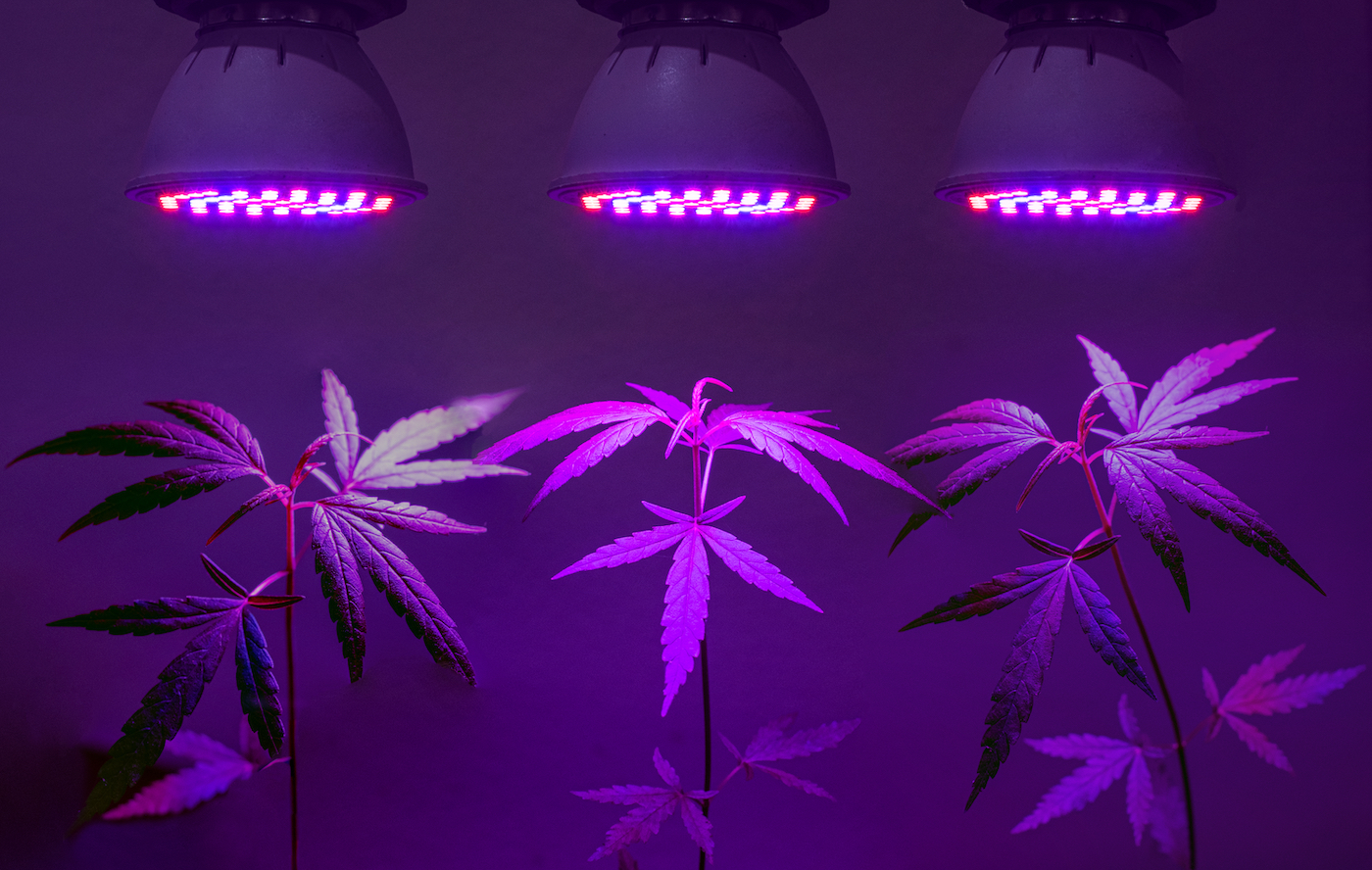
Each diode can have its own unique color that relates to a specific wavelength. Additionally, the direction of light emission has a higher level of control to provide uniform coverage in the canopy. This ensures plants get precisely what they need in terms of light, depending on the life cycle stage. LEDs that use more blue diodes than red diodes are used for vegetative growth, and lights that use more red than blue lights are used for the flowering stage.
LEDs are becoming more and more popular thanks to their perceived energy efficiency. The lights are dimmable and can be adjusted based on plant needs, meaning they don’t always need to run at full power. There are several tax credits in many markets available for installing LEDs, offsetting the initial investment and making them attractive to commercial cultivators.
High-pressure sodium and metal halide
High-pressure sodium and metal halide lights consist of a bulb that uses a specialized socket connected to a ballast that controls how many watts are delivered to the bulb. High-wattage HPS and metal halide bulbs are able to produce large amounts of PAR. HPS bulbs provide an ideal spectrum for flowering plants, while metal halide bulbs produce light that is optimal for plants in the vegetative cycle.
Both of these bulbs produce large amounts of heat, which requires careful consideration in grow room design to ensure adequate venting. Occasionally, these lights are air-cooled to help offset the warmer temperatures. While power bills may be higher, HPS and MH bulbs are able to provide high amounts of light energy to the plants and may be worth the extra expenditure.
Other bulbs and fixtures can be used for growing cannabis, including T5 light bulbs, incandescent, and compact fluorescent lamps (CFLs). These bulbs are listed with a temperature indicating if they have more red or blue spectrum light. While incapable of producing a high enough PAR output to supply plants with all the energy they need to thrive, they can be used for starting seeds, taking clones, and for early vegetative growth.
Light: the mother of all cannabis
Cannabis requires several elements to thrive, but light is one of the most important. And while plain old bulbs may do the trick, cultivators will fare far better using lights with track records of success. By dialing in light intensity and wavelengths, growers will see their plants produce better yields and terpene-rich buds—two crucial components of profitability in 2024.
