

What if taking CBD oil every day was one of the simplest, most consistent steps you could take toward better overall wellness? If you’ve found yourself wondering can you take CBD oil every day, you’re not alone. It’s one of the most common questions people have when they’re first exploring CBD, and the uncertainty around dosage, safety, and potential side effects can make getting started feel overwhelming.
That hesitation is completely understandable. The CBD market is crowded, information is often contradictory, and the last thing you want is to invest in a daily routine without knowing whether it’s actually working for you or whether it’s safe to maintain long-term.
The good news is that daily CBD use can be both safe and genuinely beneficial when you approach it with the right knowledge. In this article, you’ll learn what current research and expert guidance suggest about consistent CBD use, how to find a dosage that works for your body, what side effects to watch for, and how to identify high-quality, compliant products you can trust as part of your everyday routine.
Key Takeaways
- Yes, you can take CBD oil every day – and understanding how it interacts with your body’s endocannabinoid system is the foundation for making daily use work effectively for you.
- Research points to a range of potential benefits from consistent CBD use, including support for anxiety, pain management, and sleep quality, though individual responses vary.
- Starting with a low dose and adjusting gradually is the safest approach, and timing your intake – morning versus evening – can meaningfully influence the results you experience.
- Daily CBD use does carry some potential side effects worth knowing about, including fatigue and digestive changes, and certain medications may interact with CBD in ways that require attention.
- Choosing products that meet legal compliance standards and prioritize transparency in sourcing and testing is essential to building a daily routine you can trust long-term.
Understanding CBD Oil: What It Is and How It Works
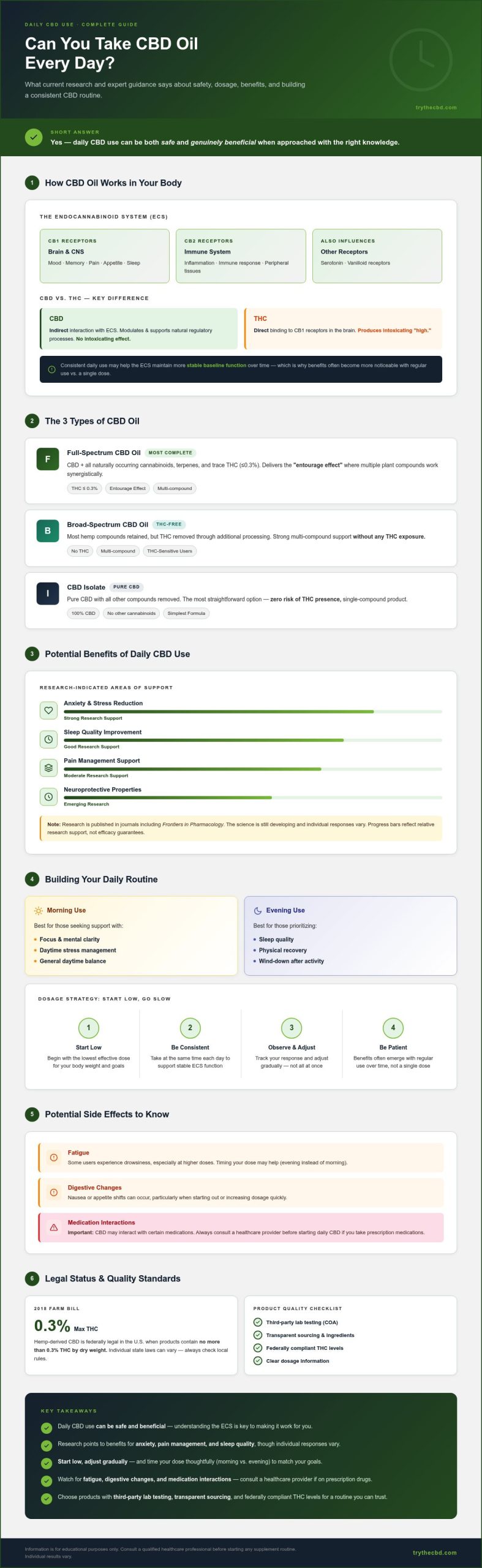
CBD oil begins its journey in the hemp plant. Cannabidiol, or CBD, is one of more than a hundred naturally occurring cannabinoid compounds found in Cannabis sativa. Unlike its more well-known cousin THC (tetrahydrocannabinol), CBD doesn’t produce any intoxicating effect. That distinction matters enormously, especially if you’re exploring whether you can take CBD oil every day without it interfering with your mental clarity, work performance, or daily responsibilities.
THC binds directly to CB1 receptors in the brain, which is what creates the characteristic “high.” CBD works differently. It interacts indirectly with the body’s endocannabinoid system (ECS), a complex cell-signaling network that helps regulate functions including mood, sleep, appetite, immune response, and pain perception. Rather than flooding the system with a direct signal, CBD appears to modulate the ECS, supporting its natural regulatory processes without overwhelming them. Research published in journals including Frontiers in Pharmacology has explored CBD’s potential to support anxiety reduction, pain management, and neuroprotection, though it’s important to recognize that the science is still developing and individual responses vary.
The ECS operates through two primary receptor types: CB1 receptors, concentrated largely in the brain and central nervous system, and CB2 receptors, found predominantly in the immune system and peripheral tissues. CBD’s interaction with these receptors, along with its influence on serotonin and vanilloid receptors, is what underpins many of its reported therapeutic effects. Consistent, daily use may allow the ECS to maintain more stable baseline function over time, which is one reason so many people find that CBD’s benefits become more noticeable with regular use rather than a single dose.
Forms of CBD Oil Available
Not all CBD oils are formulated the same way, and choosing the right type makes a meaningful difference in your experience. The three primary categories are:
- Full-spectrum CBD oil: Contains CBD alongside other naturally occurring cannabinoids, terpenes, and trace amounts of THC (within the federally compliant 0.3% limit). Many users prefer this form for what researchers call the “entourage effect,” where multiple plant compounds work synergistically.
- Broad-spectrum CBD oil: Retains most of the hemp plant’s natural compounds but undergoes additional processing to remove detectable THC, making it a strong option for those who want multi-compound support without any THC exposure.
- CBD isolate: Pure CBD with all other compounds removed. It’s the most straightforward option for those who want a single-compound product with no risk of THC presence.
Try The CBD offers both full-spectrum CBD oil and THC-free CBD oil options, making it straightforward to match your product choice to your specific wellness goals and personal preferences. If you’re newer to CBD, their CBD oil starter kit is a practical entry point.
Legal Status of CBD Oil
The 2018 Farm Bill federally legalized hemp-derived CBD products in the United States, provided they contain no more than 0.3% THC by dry weight. That threshold is what separates hemp-derived CBD from marijuana-derived cannabis products, which remain federally controlled. Products that meet this standard, like those offered by Try The CBD, are designed to comply with federal requirements. That said, individual state laws can vary, and regulations continue to evolve. Before purchasing, it’s always worth reviewing the current rules in your specific state to ensure you’re fully informed.
Incorporating CBD Oil into Your Daily Routine: Practical Tips
Knowing that you can take CBD oil every day is one thing. Building a routine that actually delivers consistent results is another. The difference between people who give up on CBD after two weeks and those who genuinely benefit from it usually comes down to one thing: intentionality. Starting with a clear approach, rather than guessing your way through it, changes everything.
Timing is a practical lever most beginners overlook. Morning use tends to suit people who are looking for support with focus, stress management, or general daytime balance. Evening use aligns better with those prioritizing sleep quality or physical recovery after activity. Neither window is universally “correct,” but choosing one consistently, rather than taking CBD at random times, gives your body a chance to establish a rhythm and gives you cleaner data on how it’s actually affecting you.
If swallowing oil directly feels unappealing, mixing it into your routine is simpler than it sounds. A few drops stirred into your morning coffee, blended into a smoothie, or added to a salad dressing can make daily use feel effortless. One practical note: CBD oil blends more evenly into fat-containing foods and beverages, which may also support absorption given its fat-soluble nature.
Finding the Right Dosage for You
There’s no single dosage that works for every person, and that’s not a flaw in the system. It’s a reflection of how genuinely individual the response to CBD can be. Body weight, metabolism, the specific wellness goal you’re targeting, and your prior experience with CBD all influence where your effective dose sits. Most guidance for beginners suggests starting in the range of 10 to 20 milligrams per day and holding that level steady for at least one to two weeks before adjusting. Gradual increments give your endocannabinoid system time to respond without the confusion of too many variables changing at once. If you’re managing a specific health condition or taking prescription medications, consulting a healthcare professional before starting is the right move, not an optional one.
Tracking Your Experience
A simple daily log does more than you’d expect. Recording your dose, timing, and how you feel across key areas like sleep, mood, and physical comfort creates a personal dataset that no general dosing guide can replicate. Even a basic notes app works. After two to three weeks, patterns emerge that make it straightforward to decide whether to adjust your dose, shift your timing, or stay exactly where you are.
When you can take CBD oil every day with this level of awareness, the routine stops feeling like an experiment and starts feeling like a genuine wellness practice. Exploring Try The CBD’s full product range is a practical next step for matching the right formulation to your specific goals.
Potential Side Effects of Daily CBD Use and How to Manage Them
Daily CBD use is well-tolerated by most people, but that doesn’t mean side effects are impossible. Being informed about what to watch for, and knowing how to respond, is what separates a sustainable routine from one that gets abandoned at the first sign of discomfort. If you’re asking can you take CBD oil every day with confidence, part of that confidence comes from understanding the full picture.
The most commonly reported side effects include:
- Fatigue or drowsiness: Some users experience a drop in energy, particularly at higher doses. This is more likely if you’re taking CBD in the morning or midday.
- Changes in appetite: CBD can either suppress or stimulate appetite depending on the individual, though significant shifts are more common at elevated doses.
- Digestive changes: Diarrhea or mild gastrointestinal discomfort occasionally occurs, especially during the first week or two of use, or when doses are increased too quickly.
- Dry mouth: CBD can reduce saliva production. Staying well-hydrated throughout the day helps manage this effectively.
Most of these effects are dose-dependent, meaning they tend to diminish when you reduce your intake slightly or adjust your timing. If fatigue is an issue, shifting your dose to the evening often resolves it. If digestive discomfort appears, slowing your dose escalation and taking CBD with food rather than on an empty stomach typically helps.
Understanding Medication Interactions
This is the area that deserves the most careful attention. CBD is metabolized by the liver’s cytochrome P450 enzyme system, the same pathway responsible for processing many common prescription medications, including blood thinners, certain antidepressants, and some anti-seizure drugs. When CBD is present, it can alter how quickly these medications are broken down, potentially raising or lowering their effective concentration in your bloodstream. If you take any prescription medication regularly, discussing CBD use with your prescribing physician before starting is not optional. It’s a straightforward conversation that protects your health.
When to Seek Medical Advice
Most side effects from daily CBD use are mild and self-resolving. However, certain responses warrant prompt medical attention: significant liver enzyme changes (which have been observed in clinical studies at very high doses), severe allergic reactions, or any unexpected worsening of a pre-existing condition after starting CBD. If you experience these, stop use and consult a healthcare provider without delay.
Your doctor or pharmacist is the most reliable resource for personalized guidance, particularly if you’re managing a chronic condition. The FDA also maintains updated information on CBD safety considerations, which is worth reviewing as the regulatory landscape continues to evolve.
Starting with a quality, transparently tested product reduces many of these risks from the outset. Exploring Try The CBD’s oils and tinctures gives you access to products formulated with clear labeling and third-party testing, so you know exactly what you’re taking into your daily routine.

The Benefits of Daily CBD Use: What Research Shows
The question of can you take CBD oil every day becomes much easier to answer when you look at what the research actually says. The science isn’t complete, and anyone who tells you otherwise is overstating the evidence. But what exists is genuinely encouraging, and the direction of ongoing research continues to build a credible case for consistent, daily use as a meaningful wellness practice.
Three areas have attracted the most scientific attention: anxiety, pain management, and sleep quality. A 2019 study published in The Permanente Journal examined CBD use in adults with anxiety and sleep concerns, finding that anxiety scores decreased in the majority of participants within the first month, with sleep scores also improving in a significant portion of the group. For pain, research exploring CBD’s interaction with vanilloid receptors suggests a potential role in modulating pain perception, particularly for inflammatory and neuropathic discomfort. These aren’t definitive clinical conclusions, but they represent a consistent pattern across multiple lines of inquiry.
Research Findings on CBD
What separates stronger CBD research from weaker anecdote is the focus on consistent, sustained use rather than single-dose effects. Studies examining daily supplementation over several weeks tend to show more pronounced outcomes than those measuring immediate responses. This aligns with what many experienced users report: the benefits of CBD often deepen over time rather than appearing all at once.
Full-spectrum products add another layer of scientific interest through what researchers call the entourage effect. The premise, supported by early but compelling research, is that cannabinoids, terpenes, and other hemp-derived compounds work more effectively together than any single compound does in isolation. A 2011 review in the British Journal of Pharmacology by Dr. Ethan Russo explored this synergy in detail, suggesting that whole-plant formulations may offer broader therapeutic potential than isolated CBD alone. This is why many users who switch from CBD isolate to a full-spectrum CBD oil report a noticeable difference in their experience.
Future research directions include larger randomized controlled trials, longer study durations, and more precise dosing protocols. The field is still young, and that’s worth acknowledging honestly.
Integrating CBD with Other Wellness Practices
Daily CBD use works best when it’s part of a broader wellness framework rather than a standalone solution. Many users find that CBD complements an anti-inflammatory diet, regular exercise, and mindfulness practices in ways that feel genuinely synergistic. Exercise already stimulates endocannabinoid production naturally; supporting that system with daily CBD may help sustain the mood and recovery benefits that physical activity generates. Mindfulness practices, which also influence stress hormone regulation, pair naturally with CBD’s reported effects on anxiety and calm.
Building a balanced routine doesn’t require complexity. It requires consistency. A morning walk, a diet rich in whole foods, and a measured daily dose of CBD taken at the same time each day creates a foundation that’s both sustainable and measurable. The key is treating CBD as one deliberate layer in a larger wellness structure rather than expecting it to carry the entire load on its own.
Quality is what makes all of this work in practice. A daily routine built on a poorly sourced or inadequately tested product delivers unpredictable results at best. Transparent sourcing, verified cannabinoid content, and third-party testing are non-negotiables, not premium extras. Explore Try The CBD’s full product range to find formulations that match your wellness goals and meet the sourcing standards a daily routine demands.
Try The CBD: Quality Products for Daily Use
Everything covered in this article, from dosing strategies to the science behind consistent use, only delivers real results when the product in your routine is worth trusting. That’s where the choice of brand matters as much as any other variable. If you can take CBD oil every day with confidence, it’s because the product you’re using has been verified, not just marketed.
Why Choose Try The CBD?
Try The CBD is built around a straightforward principle: transparency at every stage. Their products are formulated to meet federal compliance standards, with cannabinoid content verified through third-party laboratory testing. That verification matters because the CBD market remains largely unregulated at the product level, and the gap between what a label claims and what a product actually contains can be significant without independent testing to close it.
The product range is designed to support daily use across a variety of wellness goals. Whether you’re drawn to a full-spectrum CBD oil for its multi-compound profile or prefer a THC-free option for a cleaner formulation, the selection covers the most meaningful distinctions in the category without overwhelming you with unnecessary complexity. For those exploring complementary formats, their broader catalog includes edibles, topicals, and pet products, so your daily wellness routine can expand as your needs do.
Customer support is part of the experience, not an afterthought. For anyone new to CBD, having access to clear product information and responsive guidance removes a lot of the friction that causes people to abandon a routine before it has time to work.
Getting Started with Try The CBD
Starting is simpler than it might feel. A few practical steps make the process straightforward:
- Begin with the starter kit: The CBD oil starter kit is designed specifically for newcomers, offering a practical entry point without requiring you to navigate the full catalog before you know what you’re looking for.
- Read the product label carefully: Look for clearly stated CBD concentration per serving, a batch number, and a QR code or link to the corresponding certificate of analysis (COA). A COA from an accredited third-party lab confirms cannabinoid content and screens for contaminants.
- Match the product to your goal: Sleep support, stress management, and physical recovery don’t all call for the same formulation. The product descriptions on Try The CBD’s site are written to help you make that match without guesswork.
If you can take CBD oil every day with this level of product clarity behind you, the routine becomes genuinely sustainable. Explore Try The CBD’s full range of oils and tinctures to find the formulation that fits your daily practice, and build from there.
Build a Daily CBD Routine You Can Actually Trust
So, can you take CBD oil every day? Based on current research and the practical guidance covered throughout this article, the answer is yes, and doing it well comes down to three things: starting with an appropriate dose, adjusting gradually based on your personal response, and choosing a product that’s been rigorously tested and transparently labeled.
Consistency is what separates people who see real results from those who don’t. Daily use gives your endocannabinoid system the steady support it needs to respond meaningfully over time. And that consistency only holds when you can trust what’s in the bottle.
Try The CBD makes that trust straightforward to establish. With a wide range of CBD products built for everyday use, rigorous quality testing behind every formulation, and a user-friendly shopping experience designed to help you find the right fit without guesswork, it’s a natural starting point for anyone ready to commit to a daily wellness practice.
Explore quality CBD oils and tinctures at Try The CBD and take the first step toward a routine that genuinely works for you.
Frequently Asked Questions
Is it safe to take CBD oil every day?
Yes, daily CBD oil use is considered safe for most healthy adults. The World Health Organization has noted that CBD is generally well-tolerated with a good safety profile. That said, “safe for most” isn’t the same as “safe for everyone.” If you have a pre-existing health condition, are pregnant, or take prescription medications regularly, consulting a healthcare provider before starting a daily routine is the right call.
What are the benefits of taking CBD oil daily?
Consistent daily use is associated with support for anxiety, sleep quality, and pain management, with research suggesting these effects tend to build over time rather than appearing immediately. Many users report that benefits become more noticeable after two to four weeks of regular use. This gradual response reflects how the endocannabinoid system adapts to sustained supplementation rather than reacting to a single dose.
Can CBD oil cause side effects if taken every day?
Side effects are possible but typically mild. The most commonly reported include fatigue, dry mouth, and occasional digestive discomfort. These effects are usually dose-dependent, meaning they tend to ease when you reduce your intake slightly or adjust your timing. Taking CBD with food and staying well-hydrated addresses most of these issues effectively for the majority of users.
How do I determine the right dosage of CBD oil?
There’s no universal dosage that works for every person, since body weight, metabolism, and your specific wellness goal all play a role. A practical starting point is 10 to 20 milligrams per day, held steady for one to two weeks before any adjustment. Keeping a simple daily log of your dose, timing, and how you feel gives you personal data that’s far more useful than any generic dosing chart. If you can take CBD oil every day with that level of awareness, finding your effective dose becomes straightforward.
Is CBD oil legal to use in the United States?
Hemp-derived CBD products containing no more than 0.3% THC are federally legal under the 2018 Farm Bill. Products from Try The CBD are formulated to meet this compliance standard. State laws can vary, though, so it’s worth checking the current regulations in your specific state before purchasing. Staying informed as the regulatory landscape continues to evolve is a sensible habit for any regular CBD user.
Can I mix CBD oil with other supplements or medications?
CBD can interact with certain medications by affecting how the liver’s cytochrome P450 enzyme system processes them. This is particularly relevant for blood thinners, some antidepressants, and certain anti-seizure drugs. Combining CBD with general wellness supplements like vitamins or omega-3s is typically less concerning, but if you take any prescription medication, discussing CBD use with your prescribing physician before starting is essential rather than optional.
What should I look for in a quality CBD oil product?
Three things matter most: clearly stated CBD concentration per serving, a batch number, and a certificate of analysis (COA) from an accredited third-party laboratory. A COA confirms the actual cannabinoid content and screens for contaminants like pesticides and heavy metals. Try The CBD provides third-party tested oils and tinctures with transparent labeling, which makes verifying what you’re actually taking into your daily routine a straightforward process rather than a guessing game.
