

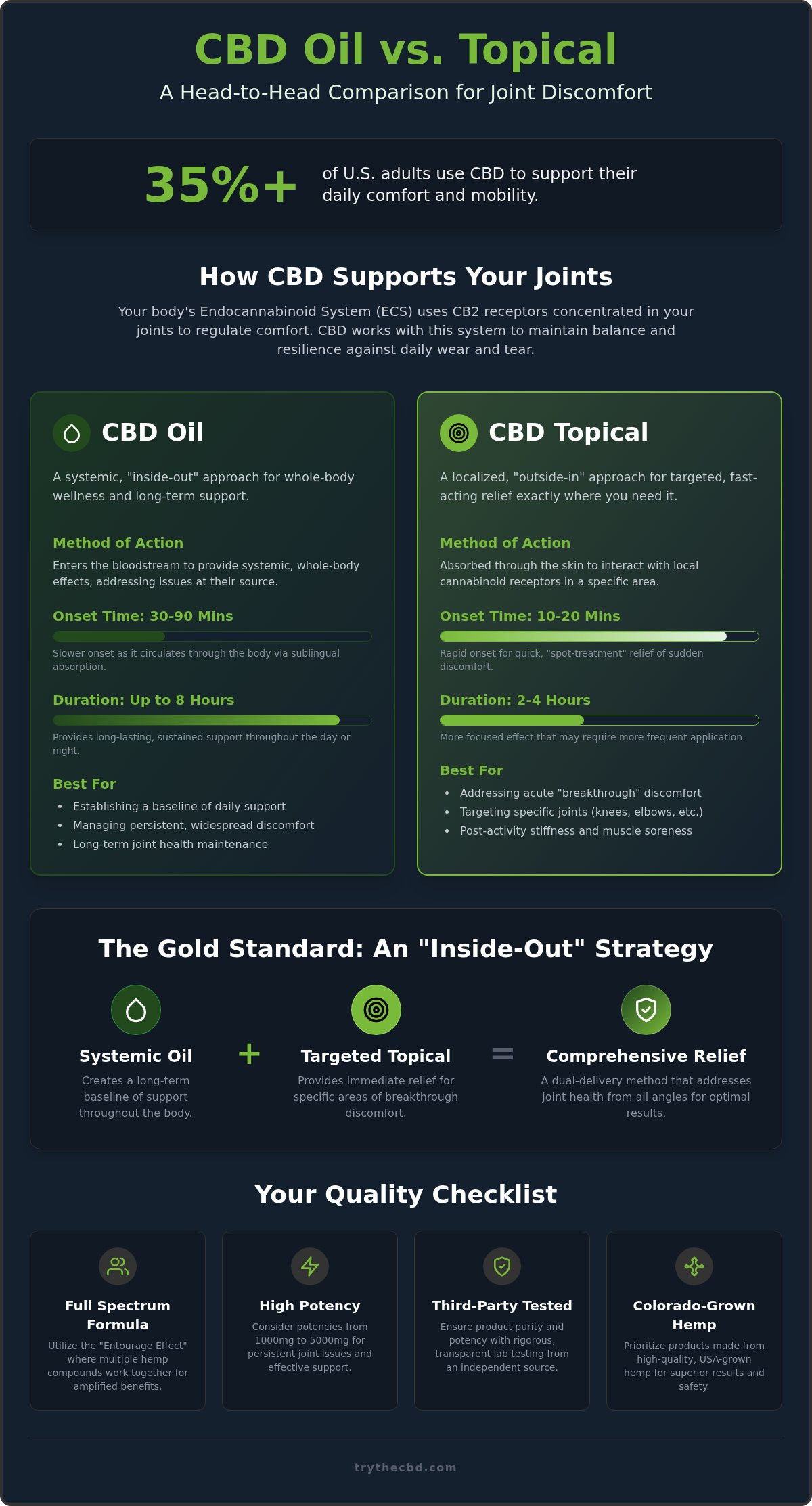
You wake up, reach for the edge of the bed, and feel that familiar, stubborn ache in your knee before your feet even hit the floor. It’s a frustrating way to start the day; as of February 2026, over 35% of U.S. adults have turned to CBD to support their daily comfort. Many are caught in a cycle of confusion while weighing the benefits of cbd oil vs topical for joint discomfort to see which one truly restores mobility. You likely just want a reliable way to move through your morning without that nagging sense of restriction.
We’re here to help you move past the guesswork. In this guide, you’ll discover the scientific and practical differences between systemic CBD oils and localized topicals to determine the most effective strategy for your joint health. We’ll break down how these products interact with your body, the impact of the upcoming November 2026 federal regulations, and why a dual-delivery method is often the gold standard for relief. By the end, you’ll have a clear routine to help reduce stiffness and improve your daily mobility.
Key Takeaways
- Understand how the Endocannabinoid System (ECS) utilizes CB2 receptors concentrated in your joints to regulate comfort and inflammatory responses.
- Compare the onset times and duration of cbd oil vs topical for joint discomfort to determine which delivery method aligns with your daily activity levels.
- Discover the benefits of “spot-treating” localized stiffness with mess-free roll-ons that penetrate skin layers for immediate, targeted relief.
- Learn the “Inside-Out” strategy, which pairs systemic CBD oils for long-term baseline support with topicals for breakthrough discomfort.
- Navigate the 2026 landscape by identifying high-purity, Colorado-grown hemp products that prioritize rigorous third-party testing and transparency.
The Science of Joint Discomfort and the Endocannabinoid System
The Endocannabinoid System, or ECS, serves as your body’s primary regulatory network, working tirelessly to maintain a state of internal balance known as homeostasis. This complex system consists of receptors, enzymes, and endocannabinoids that influence everything from sleep to immune responses. To understand Cannabidiol (CBD), you must first recognize that it doesn’t just mask physical signals; it interacts with this existing biological framework to support wellness from within.
While many people associate cannabinoids with the brain, the ECS is actually distributed throughout the entire body. In the context of your musculoskeletal health, CB2 receptors are specifically concentrated in peripheral tissues and joints. This distribution is why the debate over cbd oil vs topical for joint discomfort is so relevant. CBD oil enters the bloodstream to modulate the inflammatory response systemically, while topicals interact with these localized receptors to provide direct support where you feel it most. Joint discomfort, in the context of the ECS, represents a localized imbalance where the body’s regulatory signals are unable to keep pace with physical stress or environmental triggers.
How CBD Interacts with Joint Receptors
CBD functions as an indirect agonist of cannabinoid receptors. It doesn’t bind to them directly but instead encourages your body to utilize its own natural endocannabinoids more efficiently. This mechanism explains why joint tissue responds differently to cannabinoids than the brain. While the brain is dense with CB1 receptors that affect mood, your joints are rich in CB2 receptors that regulate immune signaling. Maintaining a healthy ECS “tone” through consistent use helps ensure your joints stay resilient against daily wear and tear.
The Role of the Entourage Effect in Joint Care
The Entourage Effect suggests that hemp compounds are more effective when they work together. Utilizing a Full Spectrum product provides a symphony of cannabinoids and terpenes that amplify each other’s benefits. For stubborn joints, Full Spectrum is often considered superior because it provides a wider range of molecules to interact with those peripheral receptors. If you’re curious about the fundamentals of these compounds, you can read our guide on What Does CBD Stand For? to get a deeper look at the basics. Choosing between cbd oil vs topical for joint discomfort often comes down to whether you need this entourage effect to work throughout your entire system or just in one specific area.
CBD Oil for Joint Support: A Systemic Approach to Wellness
CBD oil offers a comprehensive way to manage physical wellness by circulating through your entire bloodstream. Tinctures provide a systemic approach. This means the cannabinoids reach every corner of the body where CB2 receptors are present, from your ankles to your neck. When evaluating cbd oil vs topical for joint discomfort, the primary advantage of oil is its ability to address the root cause of systemic inflammation rather than just masking a single point of pain. It’s a whole-body solution that works from the inside out.
By taking CBD oil daily, you build a consistent “baseline” of support within your Endocannabinoid System. This cumulative effect is crucial for long-term joint health. While oils have a slower onset than some immediate-relief options, their effects are significantly longer-lasting. You can expect a single dose to provide support for up to eight hours. This makes it an ideal choice for managing stiffness that persists throughout the workday or prevents you from getting comfortable at night.
Bioavailability and Onset of CBD Tinctures
The efficiency of a tincture depends largely on your delivery method. Using the sublingual technique, which involves placing the oil under your tongue for 60 to 90 seconds, allows the CBD to enter the bloodstream through the mucous membranes. This method bypasses the first-pass metabolism of the digestive system. Most users report an onset time of 30 to 90 minutes. For a deeper look at the most effective formulas available, explore our guide on the Best CBD Tinctures of 2026.
Selecting the Right Potency for Joint Support
Finding the right concentration is essential for achieving the desired results. Many individuals dealing with persistent joint issues find that higher potencies, ranging from 1000mg to 5000mg, provide the most noticeable relief. Research into CBD for arthritis pain suggests that while everyone’s biology is different, starting with a lower dose and gradually increasing it helps you find your specific therapeutic window. You can browse our full range of CBD Oil and Tinctures to find a strength that aligns with your needs. If you’re ready to start your journey toward better mobility, you can explore our full collection of hemp-derived solutions today to find the perfect fit for your routine.
CBD Topicals: Targeted Relief for Specific Joint Areas
While CBD oil works through the bloodstream to provide comprehensive support, topicals offer a different advantage by delivering cannabinoids directly to the site of discomfort. This localized approach is particularly effective for those who experience stiffness in specific areas like the knees, elbows, or hands. When you apply a high-potency cream or balm, the CBD penetrates the outer layers of the skin to interact with cannabinoid receptors located in the peripheral tissues. Because these products are designed for surface application, the cannabinoids do not enter the bloodstream significantly; this makes them an excellent choice for individuals who prefer to avoid systemic ingestion or are sensitive to oral supplements.
The debate regarding cbd oil vs topical for joint discomfort often centers on how quickly you need relief. Topicals excel at “spot-treating” localized issues, providing a cooling or warming sensation that begins almost immediately upon contact. This makes them a staple for active individuals who need to manage discomfort during or after physical activity without waiting for a tincture to digest. It’s about precision: you aren’t just supporting your body generally, you’re addressing the exact joint that’s slowing you down.
Roll-ons vs. Creams: Which Topical Format is Best?
Choosing the right format depends on your lifestyle and the specific joint you’re targeting. Roll-ons are gaining significant popularity in 2026 for their mess-free application and portability. They’re perfect for throwing in a gym bag or keeping at your desk for quick use on wrists and fingers. If you’re looking for a convenient solution, the CBD Roll-on for Pain offers a precise way to apply hemp extract without getting it on your hands. Creams and lotions are better suited for larger areas like the lower back or shoulders. These often include moisturizing bases that provide added skin hydration, which is a nice secondary benefit for your skin health.
Key Ingredients to Look for in Joint Topicals
The most effective joint topicals rarely rely on CBD alone. Instead, they utilize a synergistic blend of botanical ingredients to enhance the overall experience. Look for formulations that include menthol for an immediate cooling effect, arnica for its traditional use in managing swelling, and camphor to soothe deep tissue. While some brands use CBD isolate, Full Spectrum topicals provide a broader range of hemp compounds that may offer more robust support for stubborn joints. For a deeper dive into what makes a quality formula, check out our CBD Cream Buying Guide to ensure you’re selecting a product that meets rigorous purity standards and contains the right complementary botanicals.

CBD Oil vs. Topical: A Head-to-Head Comparison for Joint Care
Choosing between cbd oil vs topical for joint discomfort often comes down to a choice between the “why” and the “where.” CBD oil addresses the internal regulatory environment by circulating through the bloodstream, while topicals provide a high concentration of cannabinoids exactly where you apply them. The primary difference lies in bioavailability and delivery. When you ingest a tincture sublingually, the CBD reaches systemic circulation to support every joint in your body. In contrast, transdermal application bypasses the bloodstream almost entirely, saturating the local subcutaneous layers to interact with receptors in the immediate area. This makes topicals a precise tool for symptom management, whereas oils are a broader strategy for long-term wellness.
The onset and duration of these methods also vary significantly. You’ll find that topicals often provide a cooling or warming sensation within 15 minutes, though the effect may fade after three to four hours. CBD oils take longer to build up in your system, usually requiring 30 to 90 minutes for onset, but they offer a steady baseline of support that lasts for up to eight hours. If you’re dealing with general morning stiffness that affects your whole body, a systemic approach is typically more effective. For a sudden flare-up in a specific finger or knee, a targeted topical is the faster solution.
The “Winner” Based on Your Lifestyle
- The Office Professional: If you spend long hours at a desk, tinctures are often the best choice. They provide all-day systemic support that helps manage the general discomfort of a sedentary posture without the need for frequent reapplication.
- The Athlete: For those with active training schedules, topicals are the clear winner for post-workout recovery. Applying a roll-on directly to a strained joint provides immediate localized relief that doesn’t interfere with your internal chemistry.
- The Senior: High-potency oils are ideal for managing chronic, baseline joint issues. By maintaining a consistent daily serving, you support the overall health of your Endocannabinoid System.
Safety and Drug Testing Concerns
Safety is a priority for many users, particularly those subject to workplace drug testing. Topicals are widely considered the safest bet in these scenarios because the CBD and trace cannabinoids don’t enter the bloodstream in significant amounts. When using oils, it’s vital to remember the legal 0.3% THC limit for hemp-derived products. While this amount is small, it can accumulate over time with daily use. Always check the Certificate of Analysis (COA) for any product you buy to verify its purity and cannabinoid profile. If you’re ready to find the right balance for your routine, you can browse our full line of Colorado-grown CBD products to see which delivery method fits your needs.
Designing Your CBD Routine: Why a Combined Approach Often Wins
Many people approach the choice of cbd oil vs topical for joint discomfort as a binary decision, but the most effective results in 2026 often come from a combined strategy. We refer to this as the “Inside-Out” approach. By using a tincture or oil, you maintain a systemic baseline of cannabinoids that supports your entire Endocannabinoid System. This creates a foundation of wellness. When a specific joint flares up after a long walk or a session at the gym, a targeted topical provides the immediate, localized support needed to keep you moving. This dual-delivery method ensures that you’re addressing discomfort from every possible angle.
Consistency is the key to success with any hemp-derived routine. We suggest committing to a 30-day trial period to truly gauge how your body responds to these compounds. Use a simple journal or a digital note to track your morning stiffness and daily mobility. This data helps you fine-tune your serving sizes and timing. If you’re looking for a convenient way to start both methods at once, our CBD Bundles provide a curated selection of oils and topicals designed to work in harmony.
A Sample Daily Protocol for Joint Wellness
- Morning: Start your day with a sublingual oil serving. This provides systemic support that lasts through your morning tasks and helps manage general stiffness.
- Mid-day: Keep a roll-on in your bag. Use it to address any specific joint flares that arise during physical activity or long periods of sitting at a desk.
- Evening: Consider a Full Spectrum oil or a gummy. These options support your body’s natural recovery processes and promote the relaxation necessary for a restful night.
How to Identify Quality in a Crowded Market
The high-altitude environment of Colorado offers unique benefits for hemp cultivation, resulting in superior cannabinoid and terpene profiles. This purity is what sets high-quality products apart from the rest. When shopping, always look for a Certificate of Analysis (COA) from a third-party lab to verify the potency and safety of what you’re buying. Be wary of red flags like vague labeling or “hemp seed oil” being marketed as CBD; hemp seed oil is a nutritious culinary product, but it contains no actual cannabinoids. For a complete breakdown of what to look for, read our guide on How to Buy CBD Online to ensure you’re making an informed investment in your wellness.
Take the Next Step Toward Lasting Mobility
Choosing between cbd oil vs topical for joint discomfort doesn’t have to be a trade-off. You now understand that while oils provide a vital systemic baseline, topicals offer the immediate, localized support needed for specific flares. Combining these methods allows you to address stiffness from the inside out, providing a comprehensive approach to joint wellness that adapts to your daily needs. By maintaining this balance, you’re not just reacting to discomfort; you’re proactively supporting your body’s regulatory system.
We invite you to experience the difference that 100% Colorado-grown organic hemp can make in your daily routine. Every one of our products is rigorously third-party lab tested for purity and is trusted by our community, as evidenced by over 5,000 5-star reviews. It’s time to reclaim your comfort and move through your day with ease. Shop Premium CBD for Joint Support today and begin your 30-day journey toward better mobility. You deserve a wellness strategy that is as reliable as it is natural.
Frequently Asked Questions
Is CBD oil or topical better for knee discomfort?
A topical is often better for immediate, localized knee discomfort because it delivers cannabinoids directly to the receptors in that specific joint. CBD oil is a superior choice if you want systemic support for both knees and other areas simultaneously. Many users find that applying a roll-on to the knee while taking a daily tincture provides the most comprehensive relief. This combined approach addresses the issue from both the inside and the outside.
Can I use CBD oil and CBD cream at the same time?
Yes, you can safely use both products together to maximize your results. This “dual-delivery” strategy allows the oil to provide a steady baseline of support throughout your system while the cream targets specific “breakthrough” discomfort in your joints. Using them in tandem is often the most effective way to manage persistent stiffness. It’s a common practice for those seeking improved mobility during daily activities or post-workout recovery sessions.
How long does it take for CBD topicals to start working on joints?
Most users feel the effects of a CBD topical within 15 to 30 minutes of application. The onset time is much faster than oral products because the cannabinoids interact with local receptors in the skin and underlying tissues immediately. Formulations containing menthol or camphor may provide a cooling sensation even sooner. While the initial relief is quick, the effects typically last between three and four hours before you might need another application to maintain comfort.
Will topical CBD show up on a drug test if used for joints?
It’s highly unlikely that a topical CBD product will cause a positive result on a drug test. Most topicals don’t penetrate deep enough to enter the bloodstream in significant amounts. To ensure complete safety, you should always review the third-party lab reports (COAs) for your specific product. These documents verify the THC content is within legal limits. Choosing a THC-free topical further reduces any potential risk for those with strict testing requirements.
How many milligrams of CBD should I use for joint support?
There isn’t a single “correct” amount, but many individuals find success starting with 20 to 50 milligrams of CBD oil daily. When comparing cbd oil vs topical for joint discomfort, remember that oils are measured by the dropper while topicals are applied as needed. We recommend the “start low and go slow” method. Gradually increase your serving size every few days until you find the specific amount that supports your mobility and comfort levels.
Does CBD oil help with morning joint stiffness?
CBD oil is particularly effective for morning stiffness because it works systemically to support your body’s regulatory system overnight. Taking a serving before bed or immediately upon waking helps maintain a consistent level of cannabinoids in your system. This baseline support can make it easier to start your day with improved flexibility. Many people find that a high-potency tincture, such as a 1000mg or 5000mg formula, provides the most noticeable results when they first wake up.
What is the difference between hemp oil and CBD oil for joints?
Hemp oil (or hemp seed oil) is a culinary product made from pressed seeds that contains no cannabinoids. In contrast, CBD oil is extracted from the flowers and leaves of the hemp plant where CBD is concentrated. While hemp seed oil provides healthy fatty acids, it won’t interact with your Endocannabinoid System to support joint health. Always check the label for “cannabidiol” or “hemp extract” to ensure you’re getting a product that contains active CBD.
Are there side effects to using CBD topicals daily?
CBD topicals are generally well-tolerated and rarely cause systemic side effects since they don’t enter the bloodstream. The most common issues are minor skin irritations or allergic reactions to secondary ingredients like fragrances or essential oils. We recommend performing a small patch test on your skin before applying the product to a larger area. Daily use is considered safe for most people. It’s a reliable way to maintain localized comfort without the risks associated with ingestion.
