

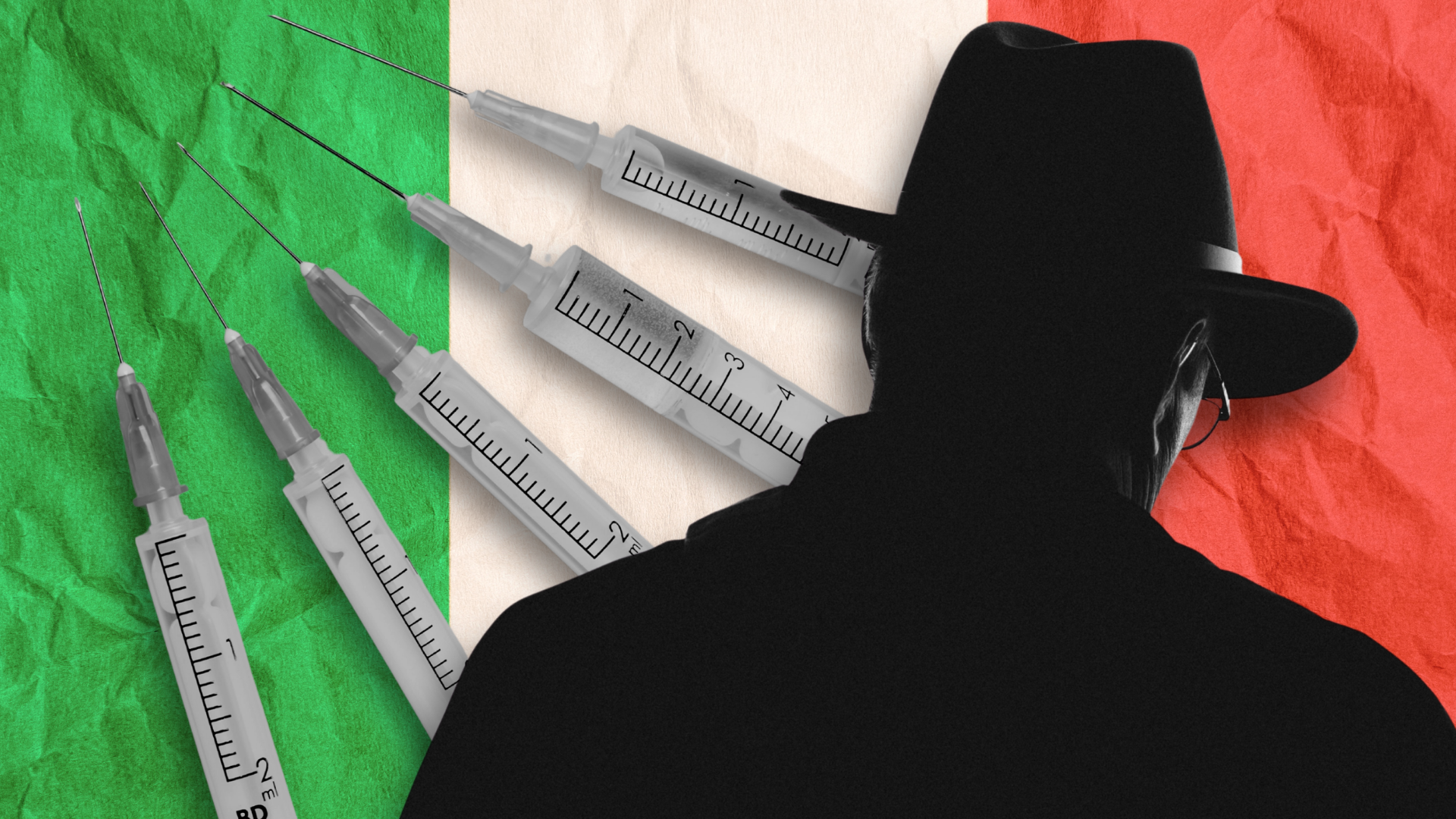
Italy has extensive opioid use, established illicit drug markets and criminal organizations capable of moving substances across continents, yet fentanyl remains remarkably scarce. Theories range from mafia groups protecting established cocaine and heroin markets to simple differences in demand, while a recent hospital theft of 80 vials raises new questions about how long that absence can last.
A recent article in The Economist opens with this reference: in The Godfather, Don Vito Corleone refuses to get into the heroin business. Not because he doubts it could make him money, but because he considers it “a dirty business,” one capable of jeopardizing his political relationships and the empire he has already built.
The outlet draws a comparison between the fiction and a very real-world anomaly. While fentanyl has radically altered the illicit opioid market in North America and remains a concern in Europe, it appears to have a surprisingly limited presence in Italy.
The numbers paint a very different picture from the reality on U.S. streets, for example, where as many as 70,000 deaths caused by the drug were recorded at the height of the crisis. In Italy, one theory offers an explanation that is as uncomfortable as it is difficult to prove: perhaps Italian mafia organizations have something to do with it.
Not because the bosses have discovered moral limits to drug trafficking. History shows exactly the opposite. The hypothesis is much more mundane. Fentanyl may simply be too dangerous for the businesses they already have.
It’s a theory. And for now, it remains just that, but there are enough oddities surrounding the Italian case for investigators, prosecutors and organized crime specialists to have begun asking why one of the most profitable and easiest-to-transport substances on the illicit market barely appears in a country whose criminal groups have been moving drugs internationally for decades.
Fentanyl in Italy: Two Deaths in a Country That Doesn’t Exactly Have Low Drug Consumption
The first hard-to-ignore data point appears in the 2025 Report to Parliament on the Drug Addiction Phenomenon in Italy. Of the 286 fatal acute intoxications examined during 2024, cocaine was involved in 48% and heroin in 24%.
Fentanyl was involved in just two. In one case, it was identified alongside alcohol. In the other, with benzodiazepines and psychotropic drugs.
Of course, this does not mean that Italy is an opioid-free country, nor does it mean that fentanyl does not exist outside the healthcare system. What is strange is precisely that Italy has many of the conditions that, in theory, could facilitate its circulation.
It has opioid users, established illicit drug markets, and criminal organizations with enormous international infrastructure for importing and distributing substances.
The ’Ndrangheta, in particular, has occupied a central position in the international cocaine trade for decades. In July, Vincenzo Molinese, commander of the Raggruppamento Operativo Speciale (ROS) of the Carabinieri, explained to the Parliamentary Anti-Mafia Commission that the agency’s investigations have documented the presence of members of the organization in South America, acting as intermediaries with local producers and trafficking groups. Among other connections, he mentioned established relationships with Colombia’s Clan del Golfo and Brazil’s Primeiro Comando da Capital (PCC).
Moving substances from one continent to another, in other words, is hardly a new logistical problem for these organizations. So, why is fentanyl barely showing up in Italy?
The Theory Making Headlines
On September 24, The Economist published an article titled The Mafia may be keeping fentanyl out of Italy, putting forward the possibility that Italian organized crime is acting, directly or indirectly, as a barrier to the substance’s entry.
The argument is based, among other things, on the minimal levels of fentanyl detected in Italy. Nicola Gratteri, Naples prosecutor and one of Italy’s best-known figures in the fight against the ’Ndrangheta, said police had seized only negligible amounts of fentanyl throughout Italy, suggesting that the substance simply is not moving through the usual trafficking networks in significant volumes, as reported by Wanted in Rome.
The apparent lack of criminal interest is particularly striking because, from a purely logistical perspective, fentanyl would seem to offer several advantages: a small amount can have enormous value and is much easier to transport and conceal than bulky shipments of other substances.
But the business has another side. Fentanyl can also cause fatal intoxications in extremely small doses, triggering a public health crisis and placing any market where it spreads under enormous political and law-enforcement pressure. And that is where a second, more explicit theory comes in.
Roberto Saviano and the Clans’ ‘Veto’
Months before The Economist’s article, Italian writer and journalist Roberto Saviano, known internationally for Gomorrah, had offered his own interpretation.
In a column published by la Repubblica on July 4, Saviano was much more categorical: he argued that Italian clans may be keeping fentanyl from spreading because they want to protect their cocaine and heroin markets.
His argument is purely economic. For Saviano, an epidemic of synthetic opioids would threaten established businesses and, at the same time, force the Italian state to respond to a potential rise in deaths.
In his reading, therefore, there would be no contradiction between trafficking drugs and rejecting fentanyl. It would be precisely a matter of defending the business that already exists.
So far, there is no public evidence of an agreement among Italy’s main criminal organizations (Cosa Nostra, ’Ndrangheta, Camorra and Sacra Corona Unita) to prohibit the substance. There are no known documents or investigations demonstrating a coordinated order to prevent fentanyl from entering the Italian market. The idea of a “mafia veto” attempts to explain an absence. And absences are particularly difficult to prove.
What the Carabinieri Actually Said
On July 7, just days after Saviano’s column, Molinese appeared before the Parliamentary Anti-Mafia Commission to speak about transnational drug trafficking.
When the subject turned to fentanyl, his statement was considerably less conclusive than the “veto” theory. “There are currently no signs on the peninsula of organized crime involvement,” the ROS commander said.
But he immediately added a caveat: this does not necessarily mean such involvement doesn’t exist. Criminal investigations, he noted, only bring certain structures to light when they produce enough evidence to make them public.
He also clarified that Italy is not currently experiencing a phenomenon comparable to North America’s and that the situation must continue to be monitored.
In other words, the official statement offers an interesting data point, but does not confirm any theory. In fact, it can be interpreted in several ways. It could mean that the mafias have decided to stay away from fentanyl. Or it could mean that there is not yet enough demand to justify a significant market. It could also mean that other actors, outside the main mafia organizations, are attempting to distribute it. Or simply that the phenomenon is still too small for investigations to detect it.
And Then 80 Vials Disappeared
There is, however, a recent episode that meant the question was no longer entirely theoretical.
In June, 80 vials of fentanyl disappeared from the pharmacy of Rome’s Ospedale Israelitico.
The report was filed on June 24. According to Italian government sources later cited by ANSA, the amount stolen could have been used to prepare up to 20,000 doses for illicit consumption. The news prompted an emergency meeting at Palazzo Chigi and an investigation by the Rome Prosecutor’s Office into theft and possession with intent to traffic.
The episode drew particular attention from Molinese. During his appearance before the Anti-Mafia Commission, the ROS commander described the theft as a possible sign that someone was trying to obtain a supply of the substance. But he clarified that investigators would have to determine whether the vials were intended for the Italian market, for sale online or even for export.
Weeks later, two hospital security guards came under investigation over the disappearance of the vials. However, authorities were still trying to determine who the fentanyl was intended for and for what purpose.
Thus, the case serves as a warning sign, but not as proof. Nor does it allow us to conclude that there is a conflict between someone attempting to introduce the substance and mafia organizations. It does show that there is interest in obtaining it outside medical channels, and that alone is enough to complicate the picture.
Italy Is Not Sitting on Its Hands Either
Another important piece falls outside any explanation that places responsibility on the mafia: the Italian state has been preparing for the possible spread of fentanyl for some time.
In 2024, the government launched a coordinated prevention plan addressing fentanyl and other synthetic opioids, including health surveillance systems and measures aimed at detecting its emergence early. The strategy was designed precisely on the assumption that the North American crisis could foreshadow future problems for Europe.
The government report presented that year described the possible introduction of new synthetic substances such as fentanyl as a cause for concern and noted that a specific operational plan was already in place.
That is why it would be difficult to attribute the Italian situation to a single cause. The illicit market does not exist independently of demand, health policy, law enforcement, international routes, the price of other substances and the decisions of those who control their distribution.
The Mafia may be one piece of that puzzle. Proving how much that piece matters is another question.
A Business Too Dirty Even for the Mafia?
That brings us back to The Godfather (a little romanticized). Although the idea may be intriguing, Italian mafia organizations do not exactly have a history of rejecting opioids on moral grounds. Cosa Nostra was involved in international heroin trafficking for decades, and the ’Ndrangheta turned drug trafficking into one of the pillars of its global economic expansion.
So, if it is ever confirmed that certain criminal groups decided to keep fentanyl out of their territories, the explanation will probably have much less to do with moral objections and much more to do with a cost-benefit spreadsheet.
That is, essentially, the paradox explored by The Economist and stated even more bluntly by Saviano: a substance can be extremely profitable and, at the same time, prove too destructive for those who already control a multibillion-dollar illicit market.
But there is an enormous gap between an economically plausible theory and a proven agreement among mafia groups.
For now, the data support a considerably more modest and perhaps more interesting conclusion. Italy does, in fact, have opioid users, criminal organizations capable of supplying international markets, and all the logistical conditions necessary for fentanyl trafficking.
Yet the substance is conspicuous by its absence. No one has yet demonstrated why. And after the Rome theft, the question that remains is no longer simply what has kept fentanyl out of Italy until now. It is how long that exception can last.
